
Version 1.3 of the open source collaboration project includes the first major release of AutoBuilder, enables support for EFI in the GRUB installer and improves the terminal UI.
Read more at The H

The Digital Millennium Copyright Act outlaws attempts to “circumvent” digital rights management schemes, but Congress is able to grant exemptions to the rule. Yesterday a bunch of changes were published—making it legal to jailbreak phones, but not tablets. More »

IDC’s third quarter figures are in, complete with a few unexpected shake-ups. The entire cellphone market grew 2.4% over the same time last year, but smartphones shipments drove the majority of that, showing growth of 45.3% and beating the analysts’ expectations. Of the 179.7 million smartphones shipped, Samsung and Apple devices accounted for almost half of them, with the companies retaining their number one and two positions in the market, respectively. IDC notes that iPhone shipments didn’t increase, but this is somewhat expected given the latest iteration was released a short time before the end of the quarter.
Permalink |  IDC | Email this | Comments
A lot has changed in the three years since the last major Windows announcement. Netbooks were on the rise. The iPad wouldn’t be introduced for another six months and Nokia still had the lead for most smartphone sales in the world. Only 172 million smartphones were sold in 2009 vs. an estimated 146 million units in just one quarter of this year. Without wide adoption of tablets or smartphones, Microsoft still dominated the world of personal computing. Linux, while popular in the server room, was virtually non-existent in consumer products, except for its brief rise in netbooks before Microsoft reportedly pressured its OEMs to stop production and shift back to Windows.
That is no longer the case. Google’s Android OS only accounted for a 3.9% share of the smart phone market in 2009 (according to Gartner Group); last year that rose to 64% of the smartphone market. In 2011, smartphones for the first time outsold PCs (including tablets.) With hundreds of millions of those smart phones running Android, the consumer market is fully accustomed to Linux-based software.
And while you won’t catch me making a “this is the year of the Linux desktop” pronouncement today, when comparing 2009 to today, it’s clear even more has changed than the rise of Android on smartphones. In short, Linux is everywhere. Amazon’s Kindle Fire has sold reportedly over 5 million units. Great Android-based tablets like the Nexus 7 or Samsung’s Galaxy Tab have also achieved widespread success. Even more importantly, I can purchase a great Linux desktop on Amazon or in many retailers via a $250 Chromebook. (Well, I could purchase one if they weren’t already sold out.) And unlike the Microsoft pressure applied on netbook manufacturers in 2009, there can be no pressure applied to Google because Google, unlike Acer, Dell, HP or Asus, isn’t reliant on Microsoft in any way to create products. In fact Google is not even a product company; they are a services company.
For many years, I’ve been predicting that hardware will soon be free, subsidized by service providers who use open source software to build low cost devices optimized for their services. Amazon, for instanced, is reported to lose money on every Kindle Fire sold. And at $250 for a decently powered laptop, I can’t imagine there is much profit in the Chromebook either. The profit comes in the services you purchase or experience while using the device. As the senior vice president of Chrome at Google says in the New York Times: “Above all, it brings all of Google services, built straight into the device.”
Microsoft is stuck in the liminal space between the desktop-driven, cost per software license world they dominated and the era we are just now entering: a world driven by open source software and services. They clearly understood that the personal computing industry was shifting toward portability, and with Windows 8 created a hybrid OS for desktops, tablets and phones. Good that they are keeping up with the times, but perhaps bad to apply a jack of all trades approach that may not work so well for their existing bread and butter desktop users. These users want to use Windows 8 with a keyboard and mouse, not a touch screen. As one Gartner analyst said: “I like Windows 8 on a Tablet, but not on a desktop, which is unfortunately where I will use it.”
This is the challenge of a monolithic OS targeting vastly different devices, users and use cases without the flexibility of an open source solution. Google has two Linux-based OSes; one for laptops (Chrome) and one for phones (Android). Why is it a problem for Microsoft and not Google to create products with two different OSes?
Unlike Microsoft, Google leveraged a collective source of R&D that began outside its own walls. Google was able to take the Linux kernel (with R&D valued at about $10b), and many other open source upstream projects such as WebKit, customize them and create both Android and Chrome OS. As of 2010, Microsoft had 89,000 employees to Google’s 24,000. While Microsoft’s overall revenue was much higher, it’s revenue per employee was much lower (0.7m for Microsoft vs $1.2m per employee for Google.) Even with fewer developers and less revenue, Google was able to build two OSes for two rising markets and give it away for free because of open source software.
 The closed model will also create pricing challenges for Microsoft. The Windows products are of course more expensive than their Linux-based counterparts; they have per-device pricing passed on to the manufacturers. Most Windows-based tablets, according to Forbes, are running $500 and $900. Windows-based Ultrabooks run between $800 and $1200. These devices are an order of magnitude higher than any of the Linux-based mainstream machines: Google ChromeBook, Amazon’s KindleFire or Google Nexus 7 Tablet. For $200 or $300 I am more than happy to purchase one of these devices and make use of the services offered by the seller. Why do I need to give my money to subsidize closed software?
As Forbes also says, ultimately the monolithic and consumer-oriented design and pricing differences may open up an opportunity for Linux in the enterprise. The enterprise desktop world is about virtualization, security, standardization, automatic deployments and management, not touch-screen commands. It will be interesting to see if the Linux-based devices that have now attained penetration in the consumer market will soon find their way into the enterprise.
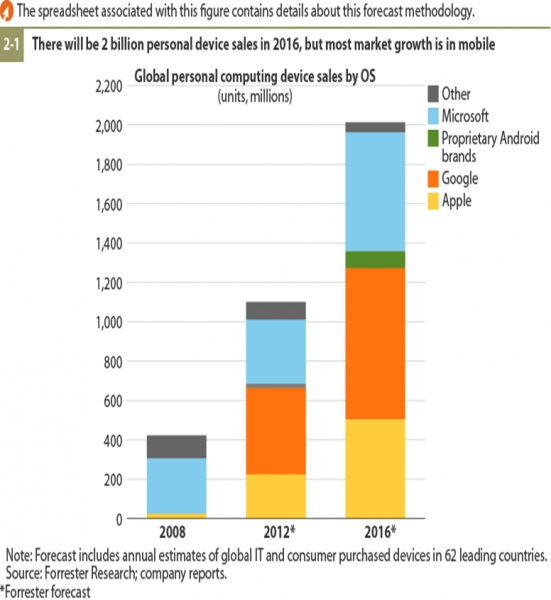
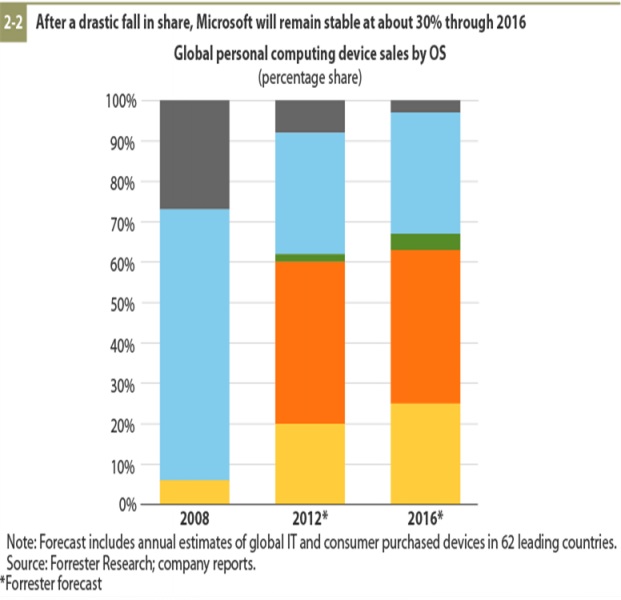 My guess is that Chromebooks and other Linux desktop devices will make slow inroads. Yet Forrester may best show the true nature of Microsoft’s problem. Even if Windows 8 succeeds in protecting the entrenched corporate desktop market, it just may not matter any more. At one time Microsoft dominated the PC market with 95% of sales. But if you take into account the rise of smartphone, tablets and other “personal computing devices,” Microsoft’s share of units has shrunk drastically to about 30% of that market in 2012.
Welcome to the post-desktop era, Microsoft. We think you’ll find it’s quite a different world.