Home Blog Page 2151

Win Your Own LinuxCon Europe VIP Gift


We’re getting ready to head to LinuxCon Europe taking place in Barcelona November 5-7, 2012. Spain is home to many things: masterful architecture, amazing tapas and wine, and beautiful beaches, among many other notable finds around the country.

It is also home to the 2012 UEFA European Football champions. Earlier this summer Spain became the first team to win two consecutive European championships, making the country a figurative capital of some of the worlds best talent in soccer/football.

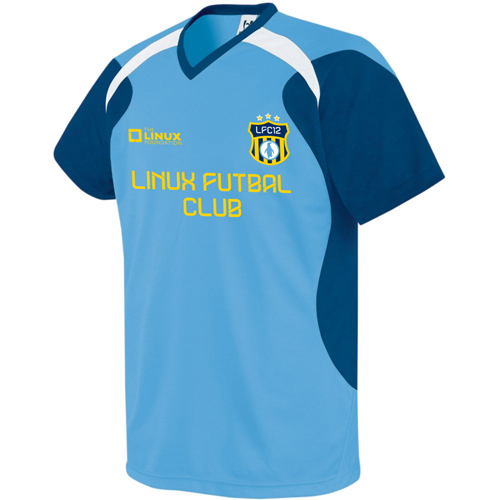
jersey lceuelceCombine the world’s best soccer/football talent with the world’s best developer talent and you get the Linux soccer jersey, this year’s LinuxCon Europe VIP and speaker gift. Are you a part of the Linux Football Club?

If you’re attending but aren’t a speaker or if you’re not attending at all, but want to get your hands on this shirt, tell us. Just share your favorite session from the LinuxCon schedule in the comments section below (you will need to have a Linux.com account or create one. It’s super easy). We’ll conduct a drawing next Tuesday, October 23, alert the winners of two of these soccer jerseys. Your comment might even get your session pick shared with hundreds of thousands of online Linux fans via Twitter, Google+ or Facebook.

If you haven’t registered for LinuxCon yet, you can visit the LinuxCon Europe website now. It includes information about the speakers, schedule and other opportunities such as the many co-located events: the Embedded Linux Conference Europe, KVM Forum, oVirt, EFL Developer Day, Gluster Workshop, Yocto Project Developer Day, OpenSAF European Symposium and the Wireless Mini Summit.

We can’t wait to hear about your favorite sessions and to send two jersey to two different winners!

Android Tablets: Training Wheels for Windows 8 Tablet Makers

The iPad is usually the named competition for the upcoming Windows 8 tablets, but it’s likely Android tablet sales that will be most affected. That’s evident by all the major Android tablet makers preparing Windows tablets for launch.

Wired Op/Ed: When Automakers Become Software Makers

Wired just published an op/ed we wrote about the role Linux and collaborative development are playing in the automotive industry. This role is becoming so important that we recently announced the formation of the Automotive Grade Linux workgroup here at The Linux Foundation. It includes participation by the world’s largest car maker Toyota, as well as HARMAN, Intel, Jaguar Land Rover, Nissan, Samsung, and more.

Here is an excerpt from the article and link to the original post on Wired.com.

I think the fact that Toyota is now going outside its ecosystem by joining with competitors is a significant move toward openness. We know they already collaborate with a complex network of suppliers in one of the most sophisticated just-in-time production systems in the world: the Toyota Production System (which, by the way, inspired lean startups). I’d argue that examples like this show that the automotive industry does know how to standardize and collaborate. The question, of course, is how the automakers will balance their need to collaborate with their desire to provide a branded infotainment experience to consumers.

The telecommunications industry, a traditionally (and many would argue still) closed industry took a similar workgroup approach in the early 2000s, eventually displacing the proprietary systems of old: Linux is now the dominant operating system in the telco market. This industry, much like the automotive industry, requires 99.9999 percent reliability in real-time software. It’s not like you need to be closed to get great performance, no matter what Steve Jobs would say. (And when pondering WWSJD when it comes to being open, please don’t keep saying Apple’s the exception: There’s a lot more open source there than you realize.)

I invite you to read the whole article on Wired.com.

Amazon’s Compute Cloud has a Networking Hiccup

Connectivity problems on Amazon’s EC2 cloud in its main datacentre region have caused problems for some customers.

30 Linux Kernel Developers in 30 Weeks: Chuck Lever

In this week’s30 Linux Kernel Developers in 30 Weeks profile, we talk to Oracle’s Chuck Lever. Chuck works on the Linux NFS and FedFS implementations and got his start while at the University of Michigan. He also has some very specific advice for Linux newbies. Read on for some interesting insights from another member of the largest collaborative development project in the history of computing.

chuck2Name

Chuck Lever

What role do you play in the community and/or what subsystem do you work on?

I work on the Linux NFS and FedFS implementations.

Where do you get your paycheck?

Oracle.

What part of the world do you live in? Why there?

Ann Arbor, Michigan. I came to school here nearly 30 years ago, liked it, and so I stayed. It was close to family. Over the past decade, a cadre of NFS developers has formed here. Working with a global community like Linux means travel, and I’ve certainly learned to appreciate the uniqueness of my home town and of many other cities.

What are your favorite productivity tools for software development? What do you run on your desktop?

This is anathema to some, but I run Mac OS on my desktop and do Linux kernel development in a virtualized environment. Mac OS offers ease-of-use along with a strong set of productivity tools. One productivity tool I use extensively is Evernote.

Virtualization means I can have as many Linux development systems as I need without worrying about power, noise, cooling, and hardware acquisition and recycling.  I prefer command-line tools  and vim, and I like Stacked Git for managing patches.

How did you get involved in Linux kernel development?

Some might remember an embarrassing report during the Internet boom in the late 1990s that claimed Windows/NT was a more scalable internet server platform than Linux. A research program at the University of Michigan was started to help Linux run Internet services better. Back then, this meant just the basics: LDAP, IMAP, and HTTP.  I was tired of being a large-scale system administrator, so I signed on. Eventually the work shifted to focus on NFSv4.

What keeps you interested in it?

I help improve software that people use every day to get their work done. Performance scalability, ease of administration, and reliability of data storage is deeply critical to every computer system in the world.

What’s your advice for developers who want to get involved?

There are many important technical skills: coding fluently, source control tools, reviewing others’ code, tool chain, troubleshooting, testing what you’ve written, and so on. The most important of these, and the most difficult to do well, are code review and thorough testing. Start mastering them early.

A young developer should find a mentor who understands and respects your working style. One of the best things you can learn from a good mentor is how to hear criticism constructively. Another important thing is how to work well with other developers. The breadth of our community is something closed source methodologies can’t touch.

What do you listen to when you code?

Ambient/downtempo, non-vocal classical, and occasionally traditional jazz.  Anything with sung or spoken words becomes distracting fairly quickly.

What mailing list or IRC channel will people find you hanging out at? What conference(s)?

#linux-nfs on oftc.net… LSFMM (Linux Storage, Filesystems, and Memory Management), and on occasion, LPC (Linux Plumber’s Conference). Recently I’ve been attending IETF (Internet Engineering Task Force) meetings.

Cisco Delivers Its Own OpenStack Distribution

Not to be outdone by the many other vendors offering their own OpenStack cloud computing distributions, Cisco has released the Cisco Edition of OpenStack. This contains all the core OpenStack services for the Essex and Folsom releases, along with installation scripts and other open source components to make it easier to install and run in production. It’s also worth noting that Cisco VP and CTO of cloud computing Lew Tucker is also chairman of the OpenStack Foundation. Cisco is likely to throw a lot of support resources at its own distribution, so this is an OpenStack flavor to pay attention to.

The OpenStack open source cloud platform hasn’t been short of powerful companies backing it, and companies ranging from HP to Red Hat have either already delivered their own distributions or soon will. 

Read more at Ostatic

Reiser4 Benchmarked On Linux 3.5

While the Reiser4 file-system has been in development for the better part of the past decade, it still hasn’t been merged into the mainline Linux kernel. Reiser4 is still out-of-tree, doesn’t see much new development activity by its limited developers, and the file-system remains tarnished due to its founder, Hans Reiser, being a convicted murderer. However, Edward Shishkin the former Namesys employee, does continue to drive its development forward. Reiser4 was recently updated to work with the more modern Linux 3.5 kernel.


Read more at Phoronix

Linus Torvalds Isn’t As Anti-Patents As You May Think

In case you missed it, Slashdot recently hosted a question-and-answer online event with none other than Linux Torvalds. Readers were invited to send in questions, and Torvalds addressed a baker’s dozen of them. Among his more interesting and unexpected responses, it seems that he is not so against patents as some people might think.

Earlier this year, Torvalds recieved one of the technology commmunity’s highest honors: He was named a Millenium Technology Prize laureate by the Technology Academy of Finland.  Always popular as an online draw, Slashdot readers asked him about software patents, drawing this response:


Read more at Ostatic

Mandriva Foundation Gets a Name

Following an online vote and approval by the French firm behind Mandriva Linux, a name for the new Mandriva foundation has been announced. However, a name for the distribution itself has yet to be decided.

Read more at The H

EU Inching Towards Microsoft Antitrust Charge, Record Fines Loom

Microsoft is reportedly only days away from receiving a formal antitrust complaint after the software giant left out its required ‘browser choice’ screen to 28 million users. Record fines loom not far away.