 When XBT Holding S.A. decided to simplify how its subsidiaries provided global hosting, network solutions, and web development they turned to the open source cloud infrastructure platform OpenStack. By consolidating the offerings under a single service provider, Servers.com, customers can more easily browse, mix, compare and choose the most suitable services.
“Our companies provide many different services ranging from low latency VPS to powerful enterprise dedicated servers,” said Rajesh Kumar Mishra, Chief Financial Officer of XBT, when Servers.com was announced in March. “However, until now to benefit from these services, a customer would have to contact the particular company, without any knowledge of the other options.”
To create and manage this multi-faceted offering required powerful, capable, reliable software — preferable as a “stack” of components engineered to work together.
OpenStackprovided the flexibility XBT needed to marry all of its services. The Apache-licensed platform is a collection of interrelated projects used to control and manage data center resources like processing, storage, and networking. It can thus be configured in many ways to create private or public clouds, and works with enterprise and open source technologies – making it ideal for heterogeneous infrastructure.
“We wanted an open-source platform, so we could tune services for customer needs, said Nick Dvas, Project Manager for Servers.com. “And we wanted a solution that could scale up for carrier-grade activity, and integrate with other open and proprietary enterprise environments.”
It also needed to be stable and robust. Currently, XBT’s companies have over 1,000 racks of gear in five data centers and are managing more than 16,000 servers. Servers.com customers have their choice of servers, based on Dell hardware, that run from single through quad-CPU, four through 12 cores, and anywhere from 32 to 768 gigabytes (GB) of RAM, and 14 drives. Applications for Servers.com cloud, cloud server, and cloud storage services include e-commerce, gaming, finance, and development.
Servers.com takes advantage of XBT’s existing physical infrastructure, Dvas is quick to point out. “We have state-of-the-art private networking, including 10 GB to every server in our data centers in Dallas and Amsterdam. We can offer private networks between dedicated bare-metal and cloud servers among other options.”

OpenStack for Flexibility, Reliability, Scalability
XBT acquired the Servers.com domain name in December 2013, and active development of Servers.com as a product offering was started in the fall of 2014, Dvas said. In March 2015, XBT announced that Servers.com was “in the final stage of development.”
“OpenStack was mature enough to be used to build clouds — and at that time, OpenStack was the only open platform with sufficiently mature quality,” says Dvas. “We looked at other options, like CloudStack. But we didn’t see any real alternative in the market that met our requirements. OpenStack allows us to build compute and storage platforms that are secure, reliable, and scalable to serve as public and private cloud. We still consider OpenStack the only open platform of sufficient quality.”
OpenStack’s open-source status was very important in XBT’s selection, Dvas notes. No other cloud platform would allow service providers to build public clouds out of the box, he said.
“Closed-source enterprise level cloud platforms like VMware, or Microsoft Hyper-V, are built and designed for private clouds,” Dvas said. “If you’re creating public, service-provider clouds, it is very important to have much more scalability, and the possibility of integration between other services of the same service provider, and the cloud platform. For example, we needed to be able to integrate our bare-metal offerings with our cloud services.”
“We would have considered other options — closed-source — if they met our requirements at the time,” Dvas acknowledges. “But there was no perfect fit in the closed-source world. We had to be able to modify. So we embraced OpenStack.”
XBT is no stranger to open source software, says Dvas. “Our customers have been using, and we have been managing, open source systems, like Linux and BSD. We’ve been actively using OpenStack components like Neutron for networking, and Swift for storage.”
They have also been contributing to OpenStack and have sent employees to the last two OpenStack Summits as technical contributors.
“We recently contributed a significant improvement to a metering agent for the Neutron networking plug-in,” notes Dvas.
Other open source components in use at XBT, says Dvas, “include the Nginx web server behind XBT’s content delivery/distribution network (CDN), helping us serve large amounts — hundreds of gigabits per second — of traffic. We use BackOffice as the management system that provides fulfillment of servers, and on top of the OpenStack cloud. And I’m personally a heavy user of the Vim text editor, I spend about half my day with it open in a terminal window — not for editing code, but as a to-do list manager.”
Lessons Learned, And Other Advice
For customers, “it’s important to know that OpenStack is a mature technology,” says Dvas. “When managed by a proper operational team, and handled with sufficient care by your service provider, OpenStack is secure, and reliable, and allows you the same amount of scalability and features as any other platform.”
For others in the industry, e.g., other cloud builders, “implementing OpenStack requires skilled engineers, and you may need to do a lot of development to adapt OpenStack to your needs,” Dvas cautions. “That’s one reason we offer to the professional services to our largest customers to do the building of private clouds for them, if they need that done, rather than have them do it themselves.”

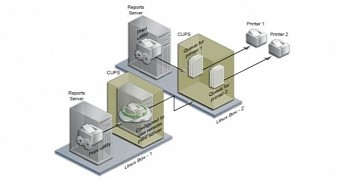 The CUPS (Common UNIX Printing System) open-source and cross-platform printing system for GNU/Linux and Mac OS X operating systems