 This week, we kick off the 8th KVM Forum in Seatttle, Washington. With the exception of 2009, KVM Forum has been held every year since 2007, and it’s about more than just KVM — the open source hypervisor that is most often used together with oVirt or the OpenStack cloud computing platform. The conference covers KVM and QEMU (which provides hardware emulation to virtual machines), but it’s also open to talks about all layers in the open source virtualization stack. In particular, this year’s talks will also cover libvirt (virtual machine lifecycle management and a lot more), oVirt (datacenter virtualization), and OpenStack.
Daily keynote presentations will provide status reports on KVM (presented by Paolo Bonzini, Senior Principal Software Engineer, Red Hat), QEMU (Alexander Graf, Upstream Maintainer, SUSE), and Libvirt (Jiri Denemark, Red Hat).
The conference starts today with a joint hackathon in collaboration with the Xen project; KVM and Xen developers have been collaborating for a long time because Xen also uses QEMU as part of their userspace stack. Some Xen developers are also invited to QEMU Summit, an invitation-only event discussing organizational tasks for the QEMU project. And, after the hackathon and QEMU Summit, Xen and KVM will have a joint evening event as well. KVM Forum’s talk sessions will then start on Wednesday morning, lasting until Friday. The schedule is available online at sched.org.
Whenever possible, similarly-themed talks are placed back-to-back in the afternoon, so that people do not have to switch rooms. For example, there will be sessions about the QEMU “block device” (storage) layer, sessions about the virtio paravirtual devices, sessions about Network Function Virtualization, and so on. A new feature this year is tutorials; we have one a new testing harness (Avocado) with support for virtualization tests and one on the Coccinelle semantic patching tool.
 A tradition that we’ve upheld for a few years is to leave some space in the last day for talks related to the higher levels of the stack (above QEMU). Usually these are called the “management layers”; they store configuration for the virtual machines, start and dispatch commands to the low-level layers, and orchestrate tasks spanning multiple host machines. In contrast, KVM and QEMU are the programs that actually do the work of running a virtual machine, but they are generally stateless and have a very limited view of what happens outside a particular VM. (This is by design: isolated components can also be secured more easily). Around half of the Friday talks will cover libvirt and oVirt.
In addition to the hackathon, face-to-face interaction is stimulated by “birds of a feather” (BoF) sessions and informal hallway gatherings. BoFs start at 5:30pm, after the talks, and usually go on until people leave for dinner. Because we co-locate with other Linux Foundation conferences, the hallway track is a unique occasion to meet people.
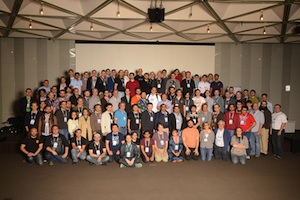
KVM Forum wraps up on Friday, August 21st. Before everyone leaves, we will take a group photo, and a leader from each BoF will summarize the topics that were discussed. Then, it will be time to say goodbye — until KVM Forum 2016!
(Guest blog contributed by Paolo Bonzini.)

 On August 18, Google had the great pleasure of revealing its latest product, OnHub, a router powered by a Linux kernel-based operating system and designed from the ground up to provide home user with a next-generation Wi-Fi network.
 In a morning keynote presentation at
 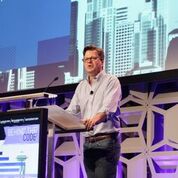 Tuesday morning’s keynote session at
  Next up, Zemlin introduced Bruce Schneier (CTO, Resilient Systems), who presented his talk via Google Hangouts. Schneier began the presentation, called “Attacks, Trends and Responses,” with a discussion about the recent North Korean attack on Sony. He said the attack was surprising in a couple of significant ways. First, it was not an attack on a critical infrastructure but instead on a movie company. Second, the focus of the attack was not data theft but coercion.
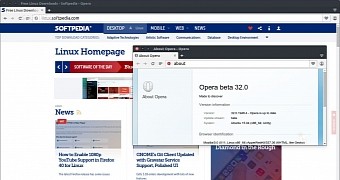 Opera developers have released the next 32 Beta upgrade for the Opera web browser, and it marks the beginning of another development cycle. Now that all the platforms have reached feature parity, we expect to see the new version land on Linux, Windows, and Mac OS X.