

How does OpenStack merge over 900 documentation changes in less than three months? We treat docs like code and continuously publish reviewed content from multiple git repositories.
Read more at OpenSource.com
How does OpenStack merge over 900 documentation changes in less than three months? We treat docs like code and continuously publish reviewed content from multiple git repositories.
Editor’s Note: This article is sponsored by FoxTechnologies, and was written by Linux.com.
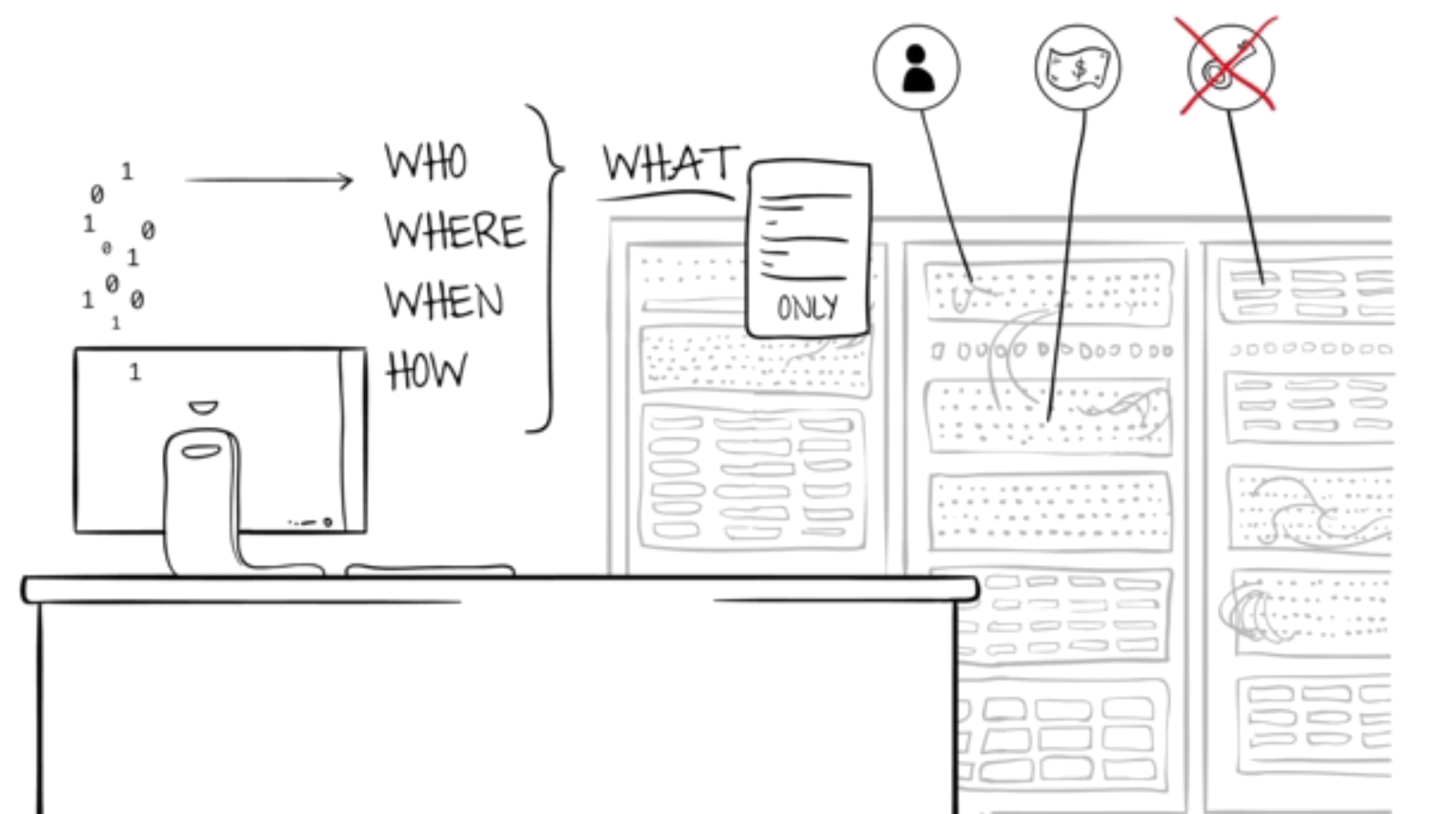
Secure, private, effective use of computers by a company (including hosted, cloud and other services as well as the company’s own systems) relies on managing access privileges.
The problem isn’t unique to computers. Office buildings, hotels, apartments and college dorms, for example, typically have “master keys” (or smart ID badges) that can open many-to-all of the locks in the facility, for security and other staff, while regular staff’s keys or badges only work on specified rooms and entryways.
More on Security from Fox Technologies
In IT, “access privilege” refers to what a given user is allowed to do in the system. A user could be a person, a job category like “admin,” or a process responsible for running a problem, e.g., “www” to run an instance of the Apache web server. In Unix/Linux terminology, “root,” a.k.a. “superuser,” has unlimited, unrestricted privilege. (In Windows-land, this is often referred to as Domain Administrator or Local Administrator, or on individuals’ systems, simply as “Admin.”)
Historically, many companies have simply (but dangerously) allowed any user who needed more privilege — or claimed they did — to run as “root.” Bad idea.
“Many companies think access privilege management within their IT infrastructure — providing, changing and monitoring access privileges — is a solved problem’ for them, it often turns out that it wasn’t,” said Mark Lambiase, CTO of Fox Technologies, which sells BoKS ServerControl software tools for managing and controlling accounts, access and privilege.
Here are Lambiase’s thoughts on how companies can better control access privileges, the barriers they face in doing so, and the danger of leaving it unaddressed.
“Users have (or should have) well-defined and delineated access privileges, based on their job, and most likely also on their department, and current projects,” says Lambiase.
Since users don’t have elevated privilege “out of the box,” it has to be given to them.
Elevating privilege per se within Unix/Linux systems is easy and straightforward, according to Lambiase. “Individuals can be given root privilege — wholesale unlimited power — or, using the sudo command, users (or groups of users) can be given more granular security privileges, e.g. to run specified commands with superuser or other privileges.”
(If you’re a Windows end user, here’s a quick comparison: some programs, when you click to run them, require you to re-click (or reconfigure) to “Run As Administrator.”)
The problem isn’t providing elevated access privilege. The problem, according to Lambiase, is managing it — accurately, efficiently, and cost-effectively, similarly to managing user accounts and software configurations in a cost- and time-effective way.
If access privilege is as important as Lambiase claims, why isn’t it being managed effectively? (Or more effectively?)
According to Lambiase, there are a number of answers, all understandable in context — but none good enough to justify failing to have or move to solutions that meet today’s requirements.
Many companies think that their access privilege management problem is a solved one, because the problem is so old, so it must have been, by now. And they have not checked lately to see whether the problem is solved inside their company, nor how well.
Some companies have started looking into the issue on their own. “Changes in compliance regimes — more requirements, larger fines for failing audits or after security breaches, etc. — led companies to look more closely and deeply at their own systems and practices,” says Lambiase. “Many realized all of a sudden that they have a problem. It’s really a problem that has been there all along, but they’re not always noticing the historical context.”
Some companies understand the problem and have been trying to solve it — but are not happy with the tools or processes that they currently have.
New and increased regulatory and compliance requirements may have outstripped existing in-place solutions, says Lambiase. New (or relatively new) regulations that require organizations to control privileged accounts include Sarbanes-Oxley (SOX), HIPAA, the Federal and North American Energy Regulations Commission (FERC/NERC), and state-level regulations such as the Massachusetts privacy law 201CMR17 and the California Information Practice Act.
Requirements for managing access privilege are “unfunded mandates.” Companies see these as another cost-center item, rather than on the profit-center side, which gives IT less clout in pursuing solutions (getting budget for new software and more staff).
While the Unix/Linux ‘su’ (‘substitute user identity’) and ‘sudo’ (‘substitute user id do’) allow privilege to be changed, the commands are local to a machine or to an OS instance, with specifics defined within a configuration file. Per the next bullet, it doesn’t scale well as the number of OS versions and instances skyrockets.
The number of operating system versions, images and instances, and other “IT things-to-manage” is exploding, thanks to virtual machines, containers, increasingly dense rackmount hardware, cloud-based platforms and services — and the still-growing increase in the total amount of processing and storage power being used by IT. But IT headcount to manage all this isn’t growing to keep pace.
Good solutions aren’t cheap. The tools to manage access privilege effectively are fairly priced, but they aren’t inexpensive.
Managers have no sense of the ROI of good access privilege management. A good tool will allow IT staff to manage privilege, accounts and access more efficiently — increase their “ratios” — and be more responsive to change requests. Lambiase reports anecdotally hearing of companies who had overwhelmed IT staff using home-grown tools migrating to third-party products that, while more expensive in terms of purchase, saved IT time and money.”
The “I trust my employees, make everybody root” approach is simple to do and to manage.
But it’s unsafe.
“Even if you can trust your employees to be honest and to not make mistakes, user credential theft by outsiders have been at the heart of many of the mega-record security breaches during the past several years,” Lambiase cautions. “It’s not about insider mistrust or insider threats. But when admin credentials, or any kind of user credentials, are stolen, the outsider is — becomes — the insider.”
Surely some organizations have gotten their access privileges management right?
According to Lambiase, “About ten percent of the people we talk to have their arms around this issue and think they are doing a good job — and we agree.”
The rest, he — and his company — and presumably other IT consultants and solution vendors in this space — view as an educational challenge.
Fox Technologies, Inc. helps companies protect corporate information assets with network security and access management software as well as striving to simplify compliance and streamline administration with an award-winning access management and privileged account control solution. Our access management software centrally enforces granular access entitlements in real time across diverse server environments. To learn more about Fox Technologies please visit www.foxt.com.
 Corporate and government IT teams have been rushing to prevent the kind of large-scale cyberattack experienced recently by Sony Pictures, Blue Cross, Anthem, Target, Home Depot and the U.S. Department of the Interior, among others. In each of these cases, hackers from locations around the globe were able to gain access to computer networks housing sensitive information, accounts, and personal data, such as the social security and credit card numbers of consumers and employees. The consequences of such security breaches can be devastating.
“Everyone is hoping that they’re not next,” said Bruce Schneier, a security guru and internationally renowned security technologist.
But prevention is only part of the solution, Schneier says. An organization’s response to a breach needs even more attention, he says. “We simply need to get better at incident response. We need to be smarter, faster, and more effective.”
Schneier will give a keynote on “Attacks, Trends, and Responses” at LinuxCon, CloudOpen and ContainerCon North America in Seattle, on Tuesday Aug.18, 2015. Here, he discusses the need for a conceptual shift on security and what organizations can do to better prepare for the – inevitable – cyberattack.
Schneier has authored 12 books as well as hundreds of articles and essays. He writes a popular and respected newsletter “Crypto-Gram” and his blog “Schneier on Security” boasts more than 250,000 readers.
Linux.com: What do you think is the biggest conceptual problem related to security in tech today?
Bruce Schneier: I think we need a major conceptual shift about how an organization relates to data. It used to be something separate, managed by the IT department. That doesn’t work anymore. Data is central to every aspect of an organization, and often an organization’s most important asset. This means that information security is basically corporate security. And while we’ve seen executive positions like CIO and CISO in response to this fact, I don’t think it’s really sunk in enough how much data is part of everything.
One of the things this means is that information security is not technical, although it has a technical component. It is much bigger than that. I am starting to see the conceptual shift in this direction. Conversations about resilience are part of it, because resilience is about a lot more than IT security. Resilience is an emergent property of a way to think about organizations and risk and security.
What would you say are the biggest takeaways of the recent, large-scale attacks (like Sony)?
Schneier: The most important takeaway is that we are all vulnerable to this sort of attack. Whether it’s nation-state hackers (Sony), hactivists (HB Gary Federal, Hacking Team), insiders (NSA, US State Department), or who-knows-who (Saudi Arabia), stealing and publishing an organization’s internal documents can be a devastating attack. We need to think more about this tactic: less how to prevent it — we’re already doing that and it’s not working — and more how to deal with it. Because as more people wake up and realize how devastating an attack it is, the more we’re going to see it.
How is the industry addressing this now?
Schneier: Everyone is hoping that they’re not next.
What is the most important way organizations can improve their security practices?
Schneier: Security is a combination of prevention, detection, and response. Right now, response is the worst of the three and the area where organizations need the most improvement. We simply need to get better at incident response. We need to be smarter, faster, and more effective. We need to integrate IT incident response into corporate crisis management. We need to be able to figure out what’s happening to our organizations and what to do about it. And we need to do it in a way that makes us more resilient as an organization. I know some of this sounds fluffy, but right now it’s the most important thing we need to focus on.
How can we address security issues at a global scale?
Schneier: If I knew that, I would be doing it. International issues are very difficult, and not only in cyberspace. Espionage is global. Cybercrime is global. Legal corporate surveillance is global. This is going to be a major issue in the coming years.
Register now for LinuxCon North America, to be held Aug. 17-19, 2015 at the Sheraton Seattle.
 The Document Foundation has released the third RC (Release Candidate) for the LibreOffice 5.0.0 branch, which is now available for download and testing.
The new LibreOffice 5.0 version is getting all the attention right now, and The Document Foundation has already said that it wants to have an amazing release. From what has been revealed until now, the new LibreOffice 5 will probably be the biggest and most important release, even more consistent that the previous one. In f… (read more)
 Grooveshark is no more, and the service was also removed from Ubuntu Touch, but the developers are working to replace that with something else, and it looks like something is in the works.
You don’t really feel that you miss something until it’s gone, and the same is happening with Grooveshark. That service was implemented in Ubuntu Touch right from the get-go, so when the service was discontinued, Ubuntu developers had to remove it from the phone as well. It might now feel… (read more)
 A new day, a new Solus update. The developers are keeping themselves busy, and they are working to improve the operating system constantly. The latest might not look like a major upgrade, but the devs have managed to refine the boot time considerably.
Just two or three years ago, Linux distributions were comparing boot times. Which distro would boot faster was very important, but that comparison doesn’t exist anymore. The culprit is the SSD drive, for the most part, which r… (read more)