 In May, Google revealed a small-footprint operating system called Brillo, a version of Android for Internet of Things applications that will arrive in a developer preview in the third quarter. It will work with a cross-platform communications framework called Weave that will arrive in Q4.
There have also been some positive developments for Android on the higher end of the embedded market. First, several major Android video conferencing, multimedia conferencing, and interactive education products have been announced in recent weeks. Second, Via Technologies released a study in which 93 percent of respondents said they are either currently using or are considering using Android for an embedded project in the near future.
Android’s expansion into the general embedded market has been evident since at least 2012, when we first reported on the trend, but has progressed slower than some had imagined. Linux, not Android, continues to dominate home automation, even at Google’s own Nest, and while there were more Android compatible community-backed single board computers in our joint Linux.com/LinuxGizmos open SBC survey than in 2014, the Linux-focused boards still ruled in the top 10 picks. Earlier this year, when the Raspberry Pi Foundation finally introduced a board capable of running Android – the Raspberry Pi 2— no Android support was announced, despite an expansion to Ubuntu and Windows 10.
Recent studies have shown varied results for embedded Android. A VDC Research study released earlier this year estimated that aside from mobile consumer devices, Android shipments grew at a CAGR of 149.2 percent over the last three years, culminating in about 15 million units in 2014. However, a 2014 UBM Embedded Market Study (slides 44-45)of embedded developers saw the use of Android rise only one percent from 16 to 17 percent year-over-year, while plans for using Android within the year dropped from 27 to 26 percent.
Both studies suggest that plans for using Android tend to outpace the reality, but that could probably apply to a lot of things. Embedded developers always think they can accomplish — or are told they must — more than is actually possible. One trend both studies agree on: the use of embedded Linux distros aside from Android is rising rapidly in both the real and dream worlds.
The survey results released this week by embedded developer and chip designer Via Technologies show a brighter picture for Android. A total of 20 percent of respondents said they are either using Android in embedded, and 30 percent said they will do so in the next few months. Another 43 percent planned to use Android in the “forseeable future.” That left only 7 percent with no interest in the little green robot.
Granted, the sample size of 250 Via customers is pretty low — by comparison, our open SBC survey had 1,721 respondents — but Via stated that the results reflected the impressions of its own field sales force. The responses came largely from North America and Europe, each with 38 percent.
While Android’s huge app ecosystem is widely hailed as the key benefit for embedded applications, only 12 percent of respondents saw that apps would benefit them. The key motivators to move from Android were touchscreen support (26 percent) and reduced time to market (25 percent). There was no comparison with non-Android versions of Linux, but Linux would presumably come up lower in both categories, as well as in native multimedia support (12 percent). One would imagine that Linux would score about the same or even better than Android in the “customizable” category (14 percent).
When asked which challenges were greatest when working with Android, lack of I/O support led the list at 23 percent, followed by internal expertise, development tools, security, and version maintenance, ranging from 21 to 17 percent each. Interestingly, industrial automation led the list of real and intended projects, at 28 percent, beating out more multimedia-intensive applications like infotainment (20 percent) and digital signage (12 percent). HMI and medical followed at 11 and 9 percent.
Android enters enterprise conferencing
We’re still not seeing a lot of Android industrial equipment, but most such devices are probably custom-built and fly under the radar anyway. Via didn’t analyze why Android is growing so fast in this segment, but one reason may be that the younger workforce is more comfortable with touchscreens than buttons, levers, and gauges. You can do a multimedia touchscreen with Linux or Windows Embedded, of course, but Android was born to the task.
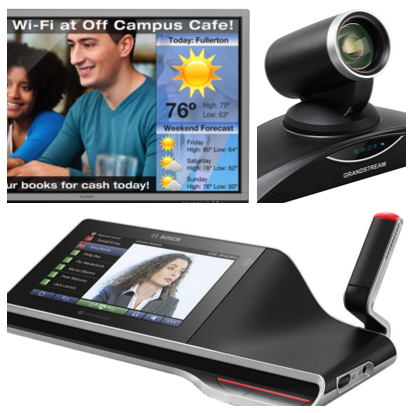
What we are seeing, however, is more high-end signage and multimedia communications equipment running Android. Below are brief summaries of three such products announced in the last two weeks. They’re all focused on the enterprise market, which is still a major unfulfilled goal for Google’s Android team. Given that Android dominates the mobile device market more than ever — this week Windows Phone took another step toward the dustbin of history — and considering that Google has made progress on security, IT leaders may finally be going with the flow.
Grandstream GVC3000— This $3,995, room-size videoconferencing system has a multipoint control unit (MCU) that supports 9-way conferences (4-way at HD), and can mix traditional SIP and Android participants. The Android 4.4.2 system features a 2-megapixel PTZ camera with 12x zoom and a 70° field of view, as well as 23° tilt and 90° pan controls. The system can drive three HD displays simultaneously showing participants and/or multimedia presentations. Other features include a gigabit Ethernet port, WiFi, Bluetooth, and microphones and speakers.
Bosch DCN Multimedia Conferencing System— Bosch’s DCN is designed specifically for council meetings and boardrooms. Each participant gets a DCN console with a 7-inch touchscreen and high-quality Bosch speakers and microphone gear. A currently deactivated 3-megapixel camera may eventually turn it into a videoconferencing system. The devices are connected via dual GbE ports and a Bosch OMNEO networking system that supports daisy chain and PoE-based star configurations simultaneously. The DCN system runs a Wind River version of Android 4.03.
Viewsonic CDE7060T — Viewsonic’s 70-inch, interactive signage computer is primarily aimed at the education market, but can also be used for corporate meetings. The device’s ViewBoard annotation and presentation software lets multiple users write, draw, or annotate with fingers or styluses at the same time. The 70-inch, 1920 x 1080-pixel touchscreen has 6ms response time, as well as 350 cd/m2 brightness, a 16:9 aspect ratio, and a 4000:1 contrast ratio. The $7,299 CDE7060T runs Android 4.2.1 on a dual-core Cortex-A9 SoC.



 Alpine Linux is a security-oriented, lightweight Linux distribution that uses musl libc and Busybox, which make up the terminal. A new version of this distributions is out and ready for download.
 1) Citrix announces it’s ready to release virtual Linux desktops, joins VMware.
  The Document Foundation has released the first RC for the new LibreOffice 4.4.5 branch. It’s a maintenance update for the entire 4.4.x branch and it’s not the last one in the series.