Home Blog Page 1208

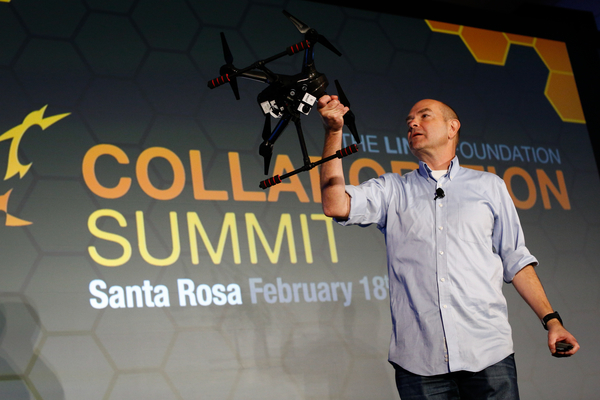
Dronecode: Taking the Internet of Things to the Skies

Chris Anderson

In 2007 former Wired Magazine Editor Chris Anderson built a Lego mindstorms robot with his kids in an effort to get them interested in science. Two years later he founded 3DRobotics, now the largest personal drone company in North America.

The initial toy wasn’t that interesting to his kids who were raised on Hollywood robots, he said in a keynote talk Wednesday at Collaboration Summit in Santa Rosa. So they undertook a more ambitious project to build a Lego autopilot and ended up building the first Lego drone – now in the Lego museum – at a time when drones were largely only built by the aerospace industry for military purposes.

“What we essentially did was weaponize Lego with my children around the dining room table,” Anderson said.

It was through this experience – building something he shouldn’t have been able to build on his own – that Anderson had a realization. The same market forces that enabled Lego mindstorms now represented an opportunity to disrupt an entire industry. While the aerospace industry was busy making military drones, no one was building commercial drones for consumer use, he said. 

“I got chills. And the last time I got chills was the first time I used the Web,” Anderson said. 

But what were the forces enabling a geeky dad to build a drone with off-the-shelf components? The growing smartphone market was making mobile components including MEMS sensors, ARM processors, GPS, camera sensors, wireless modules, and batteries, more accessible and affordable. At the same time, the DIY and maker communities were taking off — sharing ideas and open source hardware designs online. 

In short, “hardware was starting to look like software,” Anderson said.

The combination of open innovation and accessible components created an enormous opportunity and 3D Robotics has blazed the trail to a new commercial drone industry. The startup now has venture capital backing and around 200 employees. 

Drone technology has also reached a maturity level that the embedded Linux, ROS (Robot Operating System) and drone communities are converging, Anderson said. Dronecode, a Linux Foundation Collaborative Project, is designed to bring these various communities together to work on a common open source platform for Unmanned Aerial Vehicle (UAV) technology.

“We’re the Android in our industry,” Anderson said. They’re taking on competitors not with their software or their hardware, but with their openness. 

The Dronecode project includes contributions from companies such as Intel and Qualcomm, which are innovating in ways that 3DRobotics couldn’t on its own, Anderson said. And companies like Google and Amazon are using the platform as the basis for their own drone projects. 

“Drones aren’t just drones anymore,” said Anderson who envisions a cloud of autonomous sensors in the sky, collecting information and effectively digitizing the physical world.  “Drones are sensors in the sky. Drones are big data. Drones are ways to send the Internet into the skies.” 


Linux Kernel Report: More Contributors Than Ever

Working with Jon Corbet and Greg Kroah-Hartman to produce the ‘Who Writes Linux’ report is one of the most important research projects we do, as it surfaces important data and trends that offer some insight into how the Linux kernel development process is going and informs collaborative development practices across the industry. As the world’s largest collaborative development project, Linux can teach us much.

What we’re learning from this year’s data is that there are more developers working on Linux than ever. More than 12,000 individuals have contributed to Linux since 2005 and more than 4,000 contributed in just the last 15 months. Nearly half of these recent developers are first-time contributors, which we think really represents the growing community of people supporting Linux.

We were also really pleased to see that the FOSS Outreach Program for Women (OPW) Linux kernel interns ranked #13 on the top 20 list of contributors/sponsors of development work during this last cycle. We helped fund this work, along with Intel and Codethink, and are encouraged by the results.

It’s also worth noting that more developers than ever are paid for their work; a conservative calculation shows this number at 80 percent. Volunteer developers don’t stay that way for long, as companies continue to aggressively recruit the best Linux talent.

Perhaps all of these factors – more first-time contributors and more paid developers – are contributing to how fast Linux is built. More than 1,300 changes are made per week. That’s nearly eight changes an hour, or two every 15 minutes. In fact, Linux kernel 3.15 was the busiest development cycle in the kernel’s history.

More contributors than ever are contributing to Linux. For more detail behind this data, please make sure to check out this year’s report. 


Linux, JBOD And Video Compatibilities Or Incompatibilities

Below is my current setup and thereafter will be the issues I’ve been experiencing.  

Any help from anyone without the characteristic 2001 follow-up questions before answering will be very much appreciated.  I understand ‘some’ will be required, but I just don’t wish to get into a thousand threads before the first response for resolution is received.  Been there, done that and it’s not necessary with my experiences.  Afterall, even the Einstiens of the world require a little help and collaboration once-in-awhile;  And I’m NOT comparing myself to a genius.  It’s just metaphorically speaking to underscore and make my core concerns more understood is all.

I am new to Linux/Unix/etc, but a veteran Windows user since ’86, so I need some patience given me, but not condecension, because I am new to it.  Understanding, respect and a ‘given’ to me that the most basic and rudimentary of questions will not be necessary.  e.g.  Did I re-boot cold and warm?, Checked the cables?, Updates current?, Un-installed and re-installed?, tried other versions? and on and on they go.  That’s not what I’m looking for.  I am seeking someone; anyone with enough advanced knowledge that may have experienced my issues or experienced similar issues that they feel quite confident they have the resolution or resolutions.  I do not need, nor am I requsting general suggestions.  There’s already enough of that throughout the internet, and although I understand Windows but not Linux, I have enough general computing knowledge within me to quantify my asking for those simple questions and guesses not to be addressed, because I am aware of most basics and have already attempted them; and then some.

OK.  So onto the hardware and firmware / Old system, purchased 2004 with interval upgrades and repairs throughout the years

Dell Dimension 2400 tower with maximum 2GB memory and 250 GB hard drive with a 160GB slave, both internal and connected directly to MOBO and both are IDE drives of course.

BIOS updated to last and latest firmware update.

There is a dedicated graphics board.  BFG NVidia GeForce 8400 GS 512MB DDR2 PCI slot board, of which I believe I’ve seen comments made to the degree that there could be some compatibility issues between it and Linux and the recommendations are to revert back to the MOBO graphics.  NOT doing that.

200 W power supply, test and is good.  Other things like cables and cards tested and found good with the exception of one faulty IDE cable from MOBO to Master and Slave which have since been replaced.

Samsung and Teac DVD drives and one 3½” drive (all still good)  

Intel(R) 537EP V9x DPV PCI Modem

StarTech 2 Port PCI IDE Controller Adapter Card to handle two (02) ribbon cables from one port out

Each ribbon cable is connected to two (02) 160GB IDE hard drives for a total of four hard drives in a JBOD system stacked vertically in a fan cooled rack mounting system.

JBOD powered by external Cooler Master Elite Power suply at 460 W

System is backed up, filtered and powered through an APC Back-Ups Pro 1100

Current OS is Linux Mint 17.1


ISSUES:

Ever since retiring this XP box and relegating it to Linux, I’ve found no distros that want to graphically work nice with it.  All have produced and still produce to this day, severely delayed graphical responses.  Again, I’ve read posts whereby the NVidia card may be at fault because neither NVidia or the Linux communities have address the NVidia graphics issue with Linux.  But I don’t know, so I am asking if anyone has real knowledge of this.

Next is that I had everything working nicely, save for the video delay up until a couple of weeks ago when I had to power the unit down to swap out and replace the APC batteries, when things began acting strange.  I ‘struggled’ to boot the system and even ‘struggled’ to get the system to boot to the Linux ISO disk.  I struggled to get the system to acknowledge the slave drive.  By the word ‘struggle’, I mean that after several boot attempts, changing things slightly around each time, I could get the system to either boot to disks or boot to the ISO CD.  That all finally went away last week whereby I couldn’t get the box to boot, but rather stall half way through the booting process, be it a cold or warm boot or be it booting to the OS disk or IOS install CD.  The culprit ended up apparently being a defective (New) IDE ribbon cable from the MOBO to the Master and Slave internal drives.  Now I can get the system to boot each time.  

The problems now initiate when I attempt to boot with the JBOD hooked up.  I’ve gotten to the point where I can get the system to successfully boot, recognizing the slave and one hard drive at a time in the JBOD, hooking up one hard drive at a time and then re-booting, both, cold and warm.  The problem is that I’ve gotten to the 4th. and last of the JBOD hard drives when the boot process hangs.  Removing the interface card and JBOD connections sometimes will get me back to booting up with one of the four JBOD hard drives and successively adding another between boots, but most times, again, I use the word ‘struggle’, to get there with the majority of times the system hanging up half way during the boot process.  I know it recognizes the disks in the JBOD as I install them becaise I can see them recognized during the post boot-up process, while the activity light for the OS disk whirls away, appearing as though it will be a successful boot, only to stall with a blinking activity light that slows down to virtually nothingingness, at which point I must force shut down the system, remove the interface card, reboot and then to the Linux page in Safety Mode whereby I can choose to repair broken packages and update the GDX or something similar thereof.  Makes no difference whether I run those two choices or continue to the OS defaulting in Safety Mode.  It will boot to the desktop and keep sucessfully rebooting in Regular Mode (i.e.  not Safety Mode after the first boot failure and default to the desktop in Safety Mode), all as long as I only have the Master and Slave internal drives connected.  Again, sometimes I can reconnect the interface card and get between one and three of the four JBOD hard drives to successfully boot, but now can not get all four.

Looking for some help here.  Can also contact me direct at
This e-mail address is being protected from spambots. You need JavaScript enabled to view it
‘;
document.write( ‘‘ );
document.write( addy_text9208 );
document.write( ” );
//–>This e-mail address is being protected from spambots. You need JavaScript enabled to view it
as well.

Making MapR’s Data Centric Platform More Elastic with Mesos and Yarn

MapR has a new release today that provides some perspectives on the influences that are shaping new data centric architectures. In particular it shows the importance of Yarn, Mesos and the continued value that Docker plays as the need increases for developing new patterns that reflect the forces of data gravity and container density.

That’s a lot to process but it can be summed up in Myriad, a new open source project that MapR, eBay and Mesosphere launched last week. Myriad combines the orchestration of Mesos and the resource management of Yarn. It illustrates how data is dominating how apps are developed and giving rise to new thinking about how to make the platforms more elastic so analytics can be more accessible and widely available.


Read more at The New Stack

Crytek to Talk About Linux, Xbox One, and Playstation 4 at GDC 2015

Crytek announced a while ago that it was working on the CryEngine for the Linux platform, but little information has been made available since then. Now, it looks like they are finally ready to share some news about the engine during the upcoming GDC 2015 event.

GDC 2015 is a games convention that focuses more on the technical aspects of things. Games are still promoted and announced, but there is also plenty of information about gaming engines and upcoming hardware projects. As you can imagi… (read more)

Read more at Softpedia News

11 Ways to Get Involved with Humanitarian FOSS

Humanitarian open source software, outreached hand

Humanitarian
FOSS

This article is part of the HFOSS column coordinated by Jen Wike Huger. To share your projects and stories about how free and open source software is making the world a better place, contact us at
This e-mail address is being protected from spambots. You need JavaScript enabled to view it
.

Lending a digital hand for humanitarian projects is just a click away. Whether you have five minutes or a few hours, you can make a difference with a variety of HFOSS projects. The level of skills required vary from web search, verification, mapping, translation, training, and open source software development. Along the journey of changing the world, you can meet like minds and hone your skills. The key is to ask yourself: What do I want to do? How can I get started? How can I find the right project and community?

read more

Read more at OpenSource.com

ASUS’ First Android 5.0 Lollipop Tablet Has Arrived

Android 5.0 Lollipop has been out and about for almost four months now and during this time it has slowly been making its way to phones and tablets. More phones than tablets, to be precise.
But mobile device makers have been slow in picking up the Android 5.0 Lollipop update for their handsets, with some exceptions. Most notably Motorola, LG followed by Samsung and HTC have been known to be concentrating on providing the new build to their flagship devices.

But others like ASUS, Lenovo or Hu… (read more)

Read more at Softpedia News

Collaboration Summit Keynotes Will Stream Live on Wednesday, Feb. 18

Collab-stage-sign

Linux Foundation members, open source developers, open source legal experts, community experts and Collaborative Projects leaders will gather this week in Santa Rosa, Calif., for the invitation-only Collaboration Summit. The Linux Foundation’s live video stream of Collaboration Summit keynotes will be available on Wednesday, Feb. 18, starting at 9:00 a.m. PST. (Login required.)

Watch the Collaboration Summit Live Video Stream.

Here’s the lineup:

9 a.m. 

Linux Foundation Executive Director Jim Zemlin will explain expectations for the Linux platform in 2015.

9:30 a.m.

3D Robotics’ CEO Chris Anderson will cover new Linux Foundation Collaborative Project Dronecode and his thoughts on the future of drone technology and open source software.

10 a.m.

CoreOS CEO Alex Polvi will present on ‘Containers and the Changing Server Landscape’.

11 a.m.

Red Monk Principal Analyst and Co-Founder Stephen O’Grady will discuss the topic, ‘Software at Scale: The Open Source Imperative’.

11:30 a.m.

A panel moderated by OpenDaylight Project Executive Director Neela Jacques, bringing together representatives of OpenStack, OPNFV, and OpenDaylight, including Stefano Maffulli of OpenStack, Chris Price of Ericsson, Phil Robb of The Linux Foundation, and Chris Wright of Red Hat, to discuss how the future of networking and cloud infrastructure is open, and how these projects work together.

1:45 p.m.

Facebook Head of Open Source James Pearce, and Engineering Director Blake Matheny will discuss open source activities at Facebook.

2:15 p.m.

A panel on “Containers, PAAS, and the Future of Application Development,” moderated by Red Monk’s Stephen O’Grady, featuring panelists including Lauren Cooney of Cisco, Craig McLuckie of Google, and James Watters of Pivotal.

3:30 p.m.

LWN.net Editor and Linux Kernel Developer Jon Corbet will review recent events in the kernel development community, discuss the current state of the kernel and the challenges it faces, and look forward to how the kernel may address those challenges.

4:15 p.m.

An Internet of Things Panel, moderated by Linux Foundation Senior Director of IoT Philip DesAutels, and featuring panelists including Glen Allmendinger of Harbor Research and Jan Brockman of Electrolux, will cover the impact of connecting everything on business models, and challenges of building connected products, including Jevons Paradox.


Healthcare IT Market – Global Industry Analysis and Forecast to 2020

Healthcare information technology (IT) is a vast field that involves the use of information technology for designing, creating, developing, using and maintaining information systems in the field of healthcare. Healthcare IT market is growing at a fast rate due to technological advancement in the field and increasing demand for improved healthcare facilities worldwide. Healthcare IT allows exchange of health-related information among organizations electronically. On the basis of applications, healthcare IT market can be segmented into clinical technology, non-clinical technology and payer technology. Various wireless technologies are available in the market such as radio frequency identification (RFID), bluetooth, WLAN, WWAN, WMAN, zigbee technology and others. Use of healthcare IT lowers the cost of treatment and reduces errors associated with healthcare facilities; thus improves the efficiency of the healthcare system.


Buy full report: http://www.persistencemarketresearch.com/market-research/healthcare-it-market.asp


On the basis of delivery mode, web-based technology has the largest market. However, cloud technology is growing at the fastest rate. This is due to various successful technologies being used in cloud technology, such as Saas, Paas, Iaas and others.  North America, followed by Europe, has the largest market for healthcare IT due to rise in incidence of various diseases, increasing adoption of electronic health records and technological advancement in the region. Asia is expected to show high growth rate in healthcare IT market in next few years due to rise in ageing population, increasing patient pool in the region and government initiatives sin the region.


Technological advancement, government initiatives, rise in investments from healthcare IT players, increasing number of patients are some of the key factors driving the growth for global healthcare IT market. In addition, increasing demand for better healthcare facilities and rising need for integrated healthcare systems are expected to drive the market for healthcare IT. However, high maintenance and service expenses, lack of experienced professionals and interoperability issues are some of the major factors restraining the growth for global healthcare IT market.


IT-enabled healthcare solutions for physicians, emerging markets such as China and India and innovation of some new information technology in healthcare are expected to offer good opportunities for growth of global healthcare IT market. In addition, shifting focus towards patient-centric healthcare facilities is anticipated to develop good opportunity for global healthcare IT market. Some of the trends that have been observed in healthcare IT market are increase in the use of mobile devices, rising adoption of electronic health records and wireless and cloud technology in healthcare. Some of the major companies operating in the global healthcare IT market are CERNER CORPORATION, Dell, McKesson Corporation, GE Healthcare, Agfa Gevaert NV, Siemens Healthcare, NextGen Healthcare Information Systems Inc., Epic Systems Corporation, Allscripts and CareFusion Corporation. 


Request full TOC: http://www.persistencemarketresearch.com/toc/3084

Key points covered in the report:
1) Report segments the market on the basis of types, application, products, technology, etc (as applicable)
2) The report covers geographic segmentation
North America
Europe
Asia
RoW
3) The report provides the market size and forecast for the different segments and geographies for the period of 2010 to 2020
4) The report provides company profiles of some of the leading companies operating in the market
5) The report also provides porters five forces analysis of the market.

About Us:
Persistence Market Research (PMR) is a U.S.-based full-service market intelligence firm specializing in syndicated research, custom research, and consulting services. PMR boasts market research expertise across the Healthcare, Chemicals and Materials, Technology and Media, Energy and Mining, Food and Beverages, Semiconductor and Electronics, Consumer Goods, and Shipping and Transportation industries. The company draws from its multi-disciplinary capabilities and high-pedigree team of analysts to share data that precisely corresponds to clients’ business needs.

PMR stands committed to bringing more accuracy and speed to clients’ business decisions. From ready-to-purchase market research reports to customized research solutions, PMR’s engagement models are highly flexible without compromising on its deep-seated research values.

New ARM Platforms Support For The Linux 3.20 Kernel

With the next kernel — regardless of whether it be known as Linux 3.20 or Linux 4.0 — it will contain support for new ARM platforms…

Read more at Phoronix