

Read more at LinuxInsider
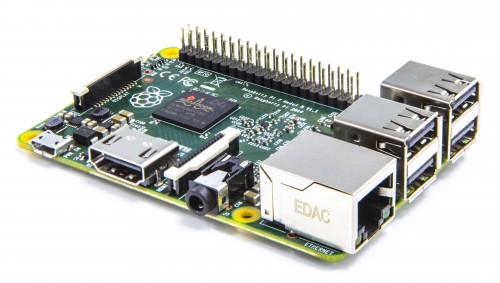 Raspberry Pi enthusiasts started the week with some welcome news: A Raspberry Pi 2 Model B SBC that is claimed to be six times faster than previous versions is available for the same $35 price. The community-backed single board computer swaps out the old ARM11/ARMv6 processor for an ARMv7 system on chip that features four 900MHz Cortex-A7 cores. That, along with a doubling of RAM to 1GB, means that for the first time, the Pi fully supports Ubuntu. In fact, there’s already an optimized build available of Canonical’s new lightweight Snappy variant of Ubuntu.
The faster SoC also means the Pi can join most other hacker SBCs in running Android, right? Well, it should, and no doubt will, but there’s not a single mention of Android in Eben Upton’s RPi 2 announcement. Instead, Upton says the Raspberry Pi Foundation has been “working closely with Microsoft” for six months to bring the newly announced Windows 10 to the Raspberry Pi 2. The Windows 10 build will be free, and supported by the same Windows Developer Program for IoT that announced Windows support for Intel’s open spec Galileo SBC, according to an announcement from Microsoft.
While we ponder this surprising turn of events, along with other mysteries, such as the Seahawks decision to go for a pass play from the one yard line on second down, let us take a closer look at the new RPi 2. The big news is the move from the Broadcom BCM2835 to a new BCM2836 SoC that has changed little aside from the faster processing power. The more powerful processor results in the RPi2 consuming 800mA of power instead of 600mA. It even sports the same VideoCore IV GPU, which was once vilified by open source evangelists, but is now more warmly accepted due to the opening up of the once-opaque codebase.
In addition to doubling the RAM to 1GB, not much has changed here, which is all the better for backward compatibility. The board has the same dimensions and weight, and uses the same 40-pin connector as the first generation Model B+. All the connectors are the same, and in the same positions. Those hoping for gigabit Ethernet, onboard flash, or a SATA connection, however, will likely have to wait until 2016. (For more on the RPi 2, Hackaday has posted a hands-on report.)
The Raspberry Pi 2 will support Raspbian and all the other Linux distributions that run on the RPi 1 Model B+. However, it may be a while before we see Pi-ready distros that are optimized for ARMv7 and Broadcom’s quad-core Cortex-A7 SoC.
According to Upton, “an updated NOOBS or Raspbian image including an ARMv7 kernel and modules” must be downloaded from the RPi website. “At launch, we are using the same ARMv6 Raspbian userland on both Raspberry Pi 1 and 2,” continues Upton. “Over the next few months we will investigate whether we can obtain higher performance from regular ARMv7 Debian, or whether we can selectively replace a small number of libraries to get the best of both worlds.” Upton goes on to write that a Snappy Ubuntu Core for the Raspberry Pi 2 image is available now, and a package for NOOBS will be available in a few weeks.
No doubt, someone’s already hard at work porting Android to the RPi 2. There have been earlier port attempts, but with the limited ARM11 chip and without ARMv7, Android on the Pi has been even less workable than Ubuntu.
It’s telling, however, that the Pi Foundation failed to mention Android. Writing on XDA-Developers, Anthony King writes: “It may be possible that Android will be coming. However don’t count on it. I’ve not been able to find any current Android device that uses this SoC. It may be that we will need sources or blobs from Broadcom, and after last time, I doubt this will happen anytime soon.”
Then again, the Pi Foundation may be downplaying any Android support to please its new partner Microsoft. Since Sataya Nadella took over from Steve Ballmer as CEO, the company has revealed more tolerance of the open source world. Last week, the Wall Street Journal reported that Microsoft has made a minority investment in Cyanogen Inc., creator of the open source CyanogenMod versions of Android.
Partnering with the Pi Foundation should help Microsoft expand its entry into the ARM world while possibly getting some action on the maker front. But what does the Pi Foundation get out of it? After all, even if Microsoft gives Windows 10 away free to Pi users, Windows is still proprietary, and customization is limited. It’s odd that the Pi Foundation would throw in with Microsoft after making a determined effort over the last year to make the Pi a more open source platform.
Yet, we tend to forget that the Pi was founded as an educational platform for teaching computing skills. With Windows, the Pi platform should be able to expand to a larger audience in schools where Windows-compatible software is a requisite. The open source OLPC educational project made a similar bundling partnership with Microsoft, although it did not do much to expand its reach.
Perhaps the Pi Foundation believes it can help steer Microsoft in a more open direction. However, if Windows for the Pi remains proprietary, and if the Microsoft partnership deepens, open source hackers may continue to move to other community-backed SBCs that are just as fast and offer more features.
For now, though, the $35 Raspberry Pi 2 offers one of the best price/performance ratios in the fast-growing field of hacker SBCs. Several million more Pi boards will likely ship before the Pi once again starts showing its age.
 Raspberry Pi was originally meant as a small, credit card-sized PC that students could use at school to learn device programming and engineering.
But it ended up becoming very, very popular almost immediately after its first release, back in December 2011, due to pretty much every news agency emphasizing how it could turn any TV into a smart TV.
The Pi has turned very few TVs into Smart TVs since then, but its popularity is ever on the rise due to how many gadgets and projects it is used in…. (read more)
 All the way back in early 2008, OStatic broke the news about Eucalyptus, an open source infrastructure for cloud computing on clusters that duplicated the functionality of Amazon’s EC2, using the Amazon command-line tools. The project resided at the University of California, Santa Barbara, and was driven and overseen by Rich Wolski, a professer there (shown here)…
OStatic caught up with Rich once more for a few of his thoughts on the cloud scene and what emerging projects he finds interesting. Here are his thoughts.
The Current Scene
Was Wolski surprised by the rapid rise of commercial open cloud efforts? “I can’t say that I’m surprised at what we’ve seen with open source cloud adoption,” he said. “It really seemed like the next step, and solved so many problems.”
 Cars have been getting increasingly intelligent, and now they are even gaining the ability to drive on their own. That means faster processors, more efficient overall hardware and, of course, better storage.
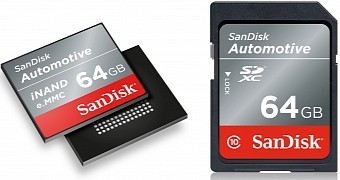
SanDisk has just revealed some NAND Flash-based products that will meet the last of those needs.
One of them is an SDXC memory card with a capacity of 64 GB. It can work in temperatures of -40 to 80 degrees Celsius and can hold up to two boot/user partitions.
The other one is an iNAND e… (read more)