Home Blog Page 1245

How to Modify the Motorola Moto E for Anti-Surveillance

What if you could have a phone that wasn’t a walking room bug? What if it was a useful, cheap and easy wifi hotspot but with an actual user interface? Wouldn’t it be nice if it had good battery life?

The Motorola Moto E (model: XT1021 and related devices) is an affordable modern Android cellphone. It may be purchased in cash at your local MediaMarkt for around 100 Euros. It is easy to modify for your everyday surveillance detection, counter-surveillance and anti-surveillance needs. This phone is popular as it is compatible with SnoopSnitch. Nearly full information about the chips used on the phone are available. A high resolution tear-down image of the mainboard is floating around as well.

Read more at Tor Project. 

Google Isn’t Fixing Some Old Android Bugs

Google appears to no longer be fixing security flaws in the oldest versions of its smartphone Internet browser.

The previously undisclosed move could leave some users with older phones exposed to snooping by hackers and spies, security researchers said.

Read more at the Wall Street Journal.

How the Rise of Open Source Could Improve Software Security

One of Jim Zemlin’s top priorities for 2015 is security. As executive director of the Linux Foundation, his purview extends beyond Linux to Cloud Foundry, Open Daylight, Tizen, Xen, and many more — including the Core Infrastructure Initiative that was formed in response to the hellacious HeartBleed vulnerability in OpenSSL discovered last year. The hourlong conversation I had with Zemlin last week began and ended with discussing that initiative.

We all know the Heartbleed saga: The flaw stood unaddressed for two years until Neel Mehta of Google Security found it in March. A patch was made available almost immediately. But tracking down and patching all those OpenSSL instances took months, and over time evidence surfaced of breaches related to the flaw, including one at Community Health Services that reportedly affected 4.5 million people.

Read more at InfoWorld.

Drones, IoT, Containers and Cloud: CollabSummit 2015


collab kernel panelOur schedule for The Linux Foundation Collaboration Summit is out and I’m proud of the speakers and projects we have assembled. I use CollabSummit and its unique structure as a litmus test for The Linux Foundation’s progress. When we started CollabSummit in 2007, we gathered about 200 people at the GooglePlex and brought Linux kernel developers, ecosystem executives, open source legal experts and more together for the first time. Convincing the world that open source was safe was a dominant theme on the agenda, as was better collaboration between business and the open source developers shaping Linux.

Eight years later we still have a large focus on Linux: From Jon Corbet’s Linux Weather Forecast to tracks on Linux tracing and file systems to the toolchains used to create and administer Linux, we are bringing the leaders from the Linux ecosystem and community together to solve problems and learn. Our members use this event to meet directly with the technical, legal and business leaders from the world of Linux.  But elsewhere in the agenda we also see how the process of Linux — the very DNA of distributed development that Linux helped pioneer — is transforming so many industries, technologies and companies.

The Internet of Things has arguably the greatest potential to change our lives. The dominant IoT platforms are open, hosted at The Linux Foundation and will be discussed at CollabSummit at length.

Containers built on Linux are changing how applications are built and maintained and, in the process, are altering the server landscape. Alex Polvi from CoreOs will present a keynote on this topic and we will have a keynote panel featuring many of the brightest minds and companies discussing this transformation.

Facebook will take us through how they use the power of open source in every aspect of their business. They wouldn’t exist without Linux and open source (or certainly not in this form) and have committed to using open source ideals to gain competitive advantage.

Networking is what makes all of this go. The future of networking and the cloud are open: be it OpenStack,OpenDaylight or OpenPlatform for NFV. But how do they work together? Where is the overlap? How can we optimize efficiency? Not only do we have a keynote on this topic, but we also are gathering the brightest minds from these projects together to enable a deeper level of collaboration.

We are mid-stream in the revolution from proprietary to open source as the dominant form of software development. Stephen O’Grady from Red Monk will take us through this transformation and explain the paradoxical position of the software industry we are now living in. Software is “eating the world” yet open source is eating software. Who will survive?

And kicking off the conference is a look at the technology that has the potential to transform industries: drones. Chris Anderson, former editor of Wired and author of The Long Tail, will take us through how he is using open source to change the face of autonomous vehicles and building the de facto platform in the Dronecode Project. If you haven’t seen Chris speak, you are in for a treat.

When we started CollabSummit, none of these projects existed. Look at us now. Please request an invite if you are a leader in the technology field. No longer is open source relegated to one operating system; it truly is eating the world and The Linux Foundation Collaboration Summit has been a venue shaping that revolution over the last eight years.

Docker Security Gets Thumbs-up Despite Containers’ Rapid Rise

Although Docker container technology has rocketed in popularity, new research from Gartner suggests its rapid rise hasn’t necessarily outstripped its security features.

Read more at ZDNet News

Intel Releases New Version Of XenGT Graphics Passthrough

The latest quarterly update to XenGT for Intel Graphics Virtualization Technology is now available that allows providing a complete vGPU solution with mediated GPU pass-through…

Read more at Phoronix

Manjaro Linux: A Few of My Favorite Things

After just a few days of using Manjaro Linux, here is a list of my favorite features so far.

Read more at ZDNet News

German City of Munich To Help Shape Future of LibreOffice

libreoffice tileThe City of Munich has joined The Document Foundation Advisory Board, a role that will see it help shape the future direction of LibreOffice.

The post German City of Munich To Help Shape Future of LibreOffice first appeared on OMG! Ubuntu!.

 
Read more at OMG! Ubuntu!

The 4 Best New Linux Distributions to Watch in 2015

There was a time when new Linux distributions popped up on what seemed like a daily basis. They came and went so fast, you might have completely missed their short lives. That’s not so much the case these days. Linux distributions arrive a bit less frequently and, when they do finally arrive, tend to have a bit more staying power.

Why is that? My guess would be that the stable of standard distributions has become so strong, it’s hard for competition to stand up to the likes of Ubuntu, Arch, Mint, Fedora, SUSE, and Debian. That doesn’t mean, however, that new distributions don’t try to take down the mighty standard bearers. In fact, there are a few distributions that could give those kings and queens of Linux a run for their money this year. Which ones, you ask? Let’s take a look at what I believe will be the distributions to watch in 2015.

1. Evolve OS

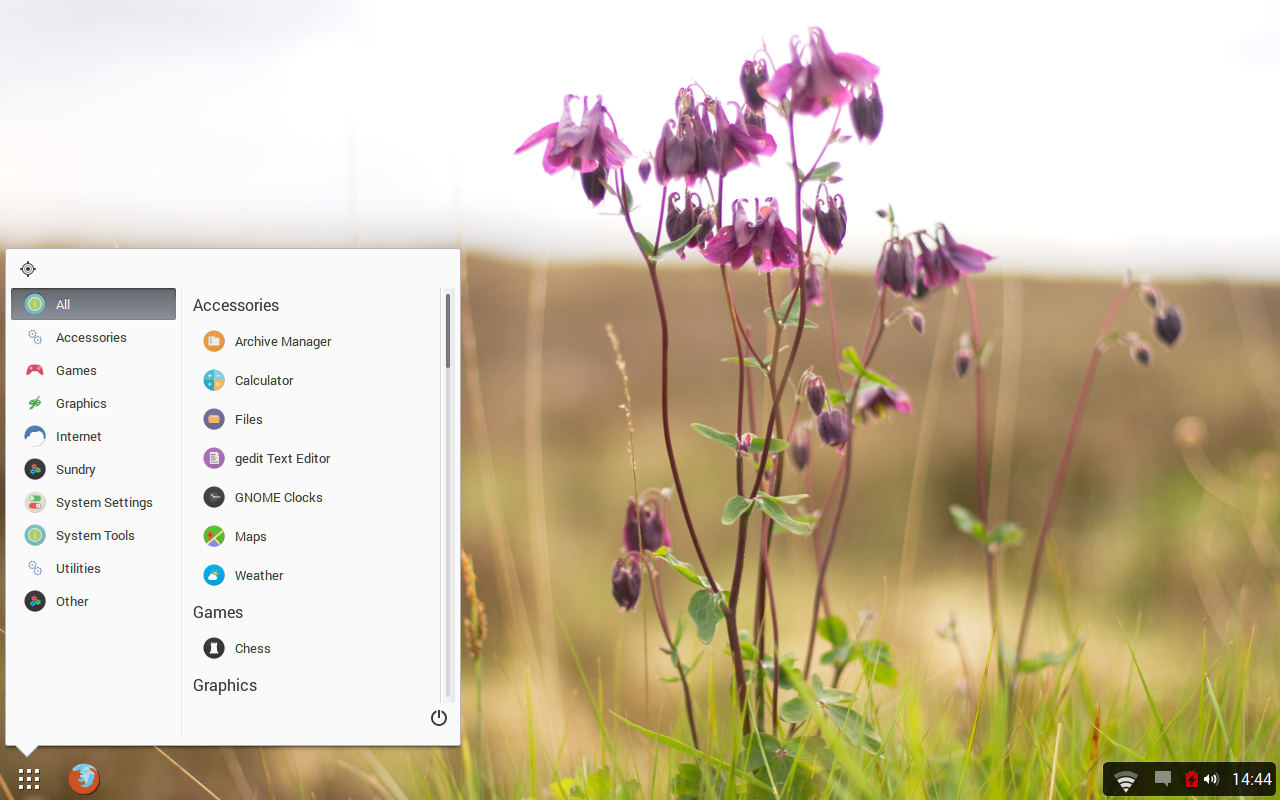
There is a reason Chrome OS and Chromebooks are so popular (other than their cost) ─ they are incredibly simple to use. Why? The Chrome OS desktop is an elegant, user-friendly interface that anyone can sit down with and immediately use. The developers of Evolve OS have taken a page from the Chrome OS design book and created the Budgie desktop. Budgie is not a fork of another desktop ─ it is built from the ground up. Both Evolve OS and Budgie are in alpha, so it’s not the most stable platform out there, but even running Evolve OS from a live ISO, you can see where the project is going and how incredibly simple it will be to use.

When you are exposed to this distribution, your first thought might be that Evolve OS is about the desktop ─ and a reaction to the current crop of desktops for the Linux platform. You are experiencing a shift from what some might consider desktops with “too many bells and whistles” or “too profound a shift in design.” Evolve OS makes the Linux desktop as simple and graceful as possible, without turning the desktop metaphor completely on its head.
evolve os

2. SparkyLinux GameOver Edition

Are you ready to play a game?

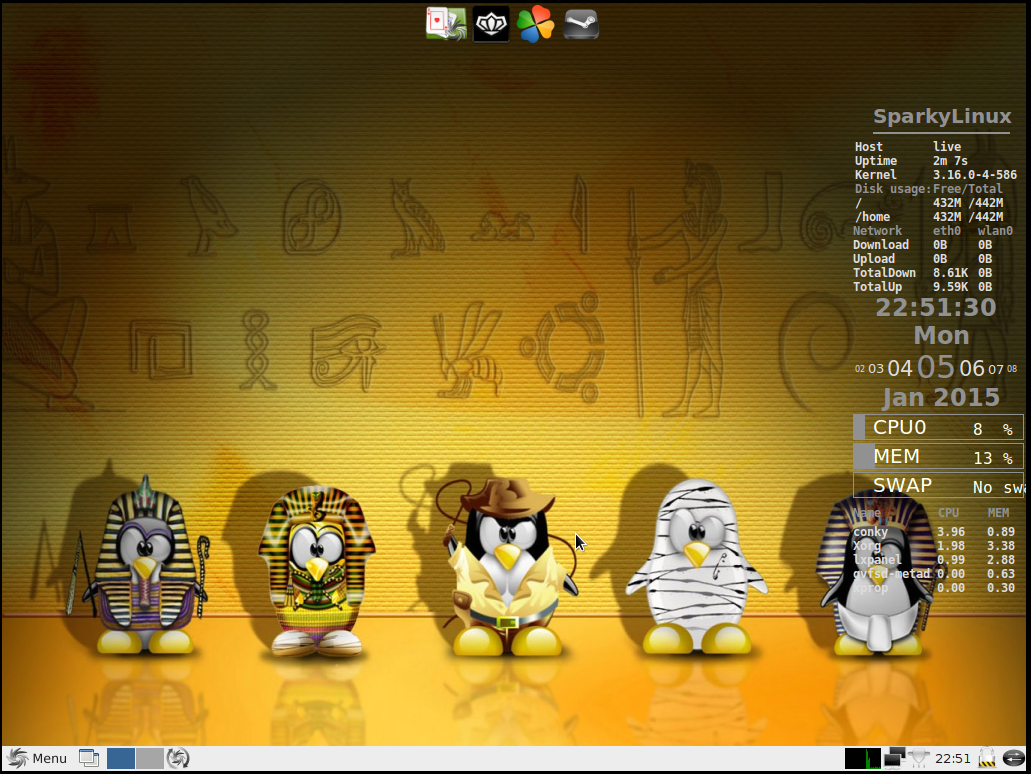
SparkyLinux is yet another addition to the “lightweight” category of Linux distributions. It’s based on Debian testing, is a rolling release distribution, offers a number of different desktops to choose from (from LXDE, Enlightenment, Openbox, JWM, and Mate desktops), and offers support for most wireless network cards.

But SparkyLinux offers another flavor that will appeal to a large cross section of Linux users ─ something that few other distributions are taking advantage of. SparkyLinux has an edition focused specifically on gamers ─ SparkyLinux GameOver Edition. With this edition, SparkyLinux adds: Steam, Steam Launcher, WINE, Playonlinux, and Desura. Along with the standard gaming tools/services, the GameOver edition includes Sparky APTus Gamer ─ a small tool that allows you to easily install all the available system’s and machine’s game emulators (such as EPSXE ─ PSX emulator, Kega Fusion ─ Sega Mega Drive/Genesis emulator, and PPSSPP ─ PSP emulator).
sparkylinux

3. Korora

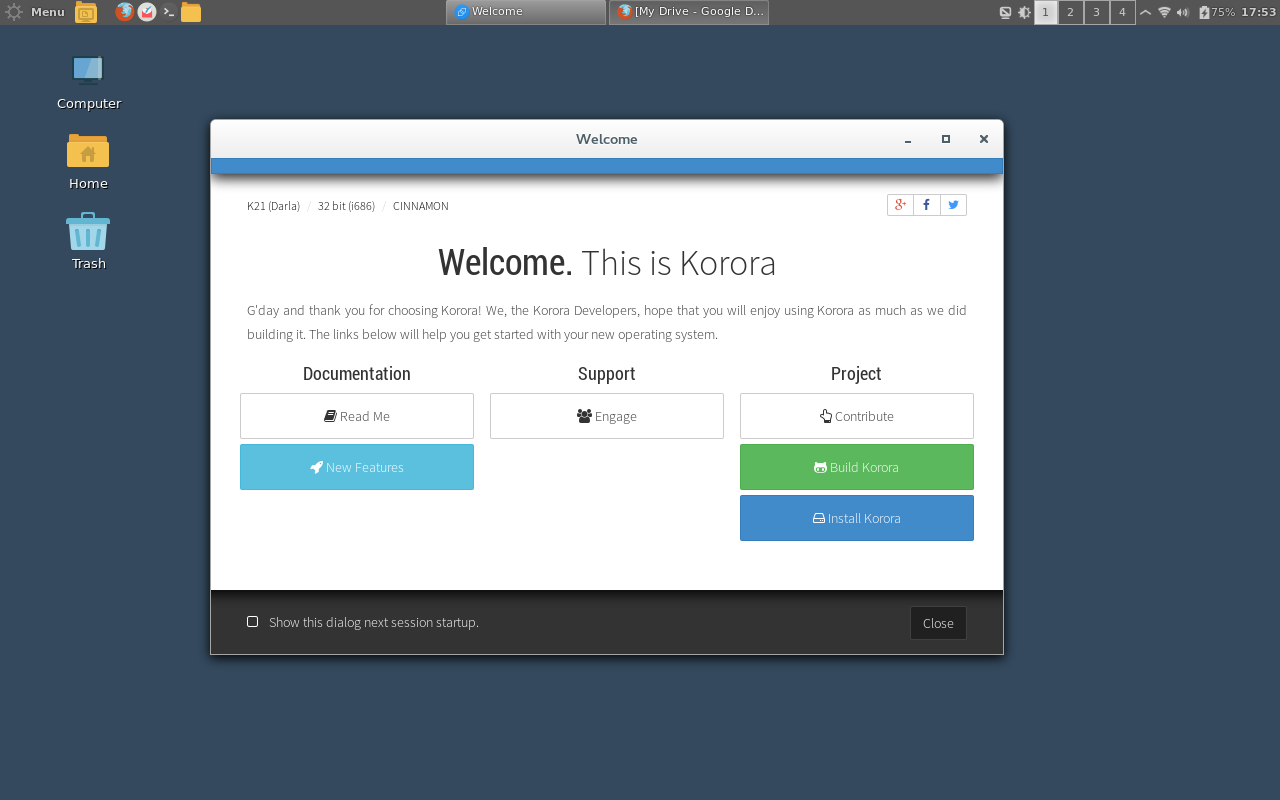
Korora was born out of the desire to make Linux easier for new users, while not sacrificing features and power for the experienced. Korora is a Fedora remix that allows you to choose between the KDE, Mate, Cinnamon, GNOME, and XFCE desktops and includes a number of packages that Fedora cannot ship (due to licensing issues). Thanks to those extra packages, Korora just works out of the box ─ no need to add repositories for the likes of music or video playback. You will also find pre-configured repositories for the likes of:

  • Adobe Flash

  • DropBox

  • Google Chrome, Google Earth and Google Talk plugin

  • RPMFusion

  • VirtualBox.

In addition to all of this, Korora includes a package called Pharlap, which makes the installation of third-party drivers (such as for NVIDIA graphics) as simple as installing an app.

The Korora beta release (Korora 21 ─ Darla) also includes a new tool, called Lens. Funny thing about Lens is that Korora is keeping hush hush about what this tool actually is. If I had to take a guess on what Lens is, I would say it is a search feature in line with Ubuntu Unity Scopes.
korora

4. Ozon OS

If you’ve used Linux long enough, you’ve heard of the Numix Project. Numix has been, for some time now, behind some the best looking themes for both GNOME and Ubuntu. So it makes perfect sense that the designers and developers of the Numix Project would move on to develop their own flavor of Linux. That is what Ozon OS will be.

There’s very little to see at the moment, but Ozon OS will be based on Fedora and will have a Numix-flavored spin on the GNOME desktop. What’s even more interesting about this project is that it is partnered with Nutrix, which sells specialty Numix themes as well as desktop PCs. Could this be the beginning of one of the first-ever Linux distro developer/resellers? If the Numix team can pull off a stunning distribution and blend it seamlessly with fantastic hardware, this could very well be the start of something quite special. Nitrix already sells inexpensive, tiny form factor PCs (check out the $230.00 NXQ). If Ozon OS and Nitrix play their cards right, they could easily become one of the main darlings of the Linux community in 2015.

Every year new Linux distributions pop up and promise something new and game changing. I believe this time around, the claims certainly have a chance of changing the way Linux is seen by a number of user groups. Whether you’re an average user, a gamer, a power user, or some hybrid user in need of a desktop to perfectly suit your needs, I believe 2015 will bring to light some projects that will be right up your alley.


AWS Debuts Haswell-Powered C4 Instances for Heavy Duty Computing

New instances launched across seven regions deliver the highest level of processor performance on EC2, aimed at high-performance computing applications.

Read more at ZDNet News