
Home Blog Page 1257

Live DVD for Advanced Gtk+ Sequencer

Initiating minos-one

Ever wanted to try out Advanced Gtk+ Sequencer and Swami? Then you need minos-one download available at sourceforge.net:

minos-lxdm.iso

This live DVD is shipped with most popular GNU software including:

  • Advanced Gtk+ Sequencer
  • Swami
  • Mplayer
  • ffmpeg

It is a x86_64 build with realtime kernel linux-3.14.25-rt22. System requirements are probably lots of RAM. Me could borrow you with some anoying details but rather deciding to give you a brief howto extend minos-one Live DVD ….

Objectives

GNU/Linux is providing /dev/shm it is a tmpfs its advantages are all files are provided within RAM. Here comes the magic part. You builded a initrd kernel this initrd fs is provided in RAM as well and remounting root / is done anyway.

To get a full setup with source I would recommend you linuxfromscratch.org where you do /usr/share/mkinitramfs/init.in this is the file launched just before /sbin/init.

Note if you wish to start kernel command line:

linux vmlinuz initrd initrd.img init=/bin/bash

There’s a not documented /sbin/init paramater –init which does all magic ie. start init and invoke /etc/init.d

Setup directory structure and base files

First we create some directories to mount our ISO files:

$ cd /mnt
$ mkdir {image,rootfs,rootfs,usrfs,build,cdrom}

Create build.iso file which is large enough to contain and build linux kernel, here we create a 100G file for your builds so make sure to have enough disk space.

$ dd if=/dev/zero of=build.iso bs=512K count=200000
$ vfsnode=`losetup -f`
$ losetup -P $vfsnode build.iso
$ mkfs.ext4 $vfsnode

The created iso is now mounted using loopback device. To know what loopback device just enter:

$ echo $vfsnode

You can either do your own linux from scratch or do:

$ wget -c http://sourceforge.net/projects/ags/files/minos-lxdm.iso/download
$ mount -o loop minos-lxdm.iso /mnt/cdrom

For know we mount the rootfs and usr directory of our live DVD by issueing:

$ cp -rv cdrom/* image
$ mount -o loop image/casper/rootfs.iso rootfs
$ mount -o loop image/casper/usr.iso rootfs/usr
$ mount $vfsnode rootfs/sources

Chroot to the ISO environment

Chroot provides you a nested root environment further we bind devfs to the chroot environment.

$ mount -v --bind /dev rootfs/dev
$ mount -vt devpts devpts rootfs/dev/pts -o gid=5,mode=620
$ mount -vt proc proc rootfs/proc
$ mount -vt sysfs sysfs rootfs/sys
$ mount -vt tmpfs tmpfs rootfs/run
$ chroot /mnt/rootfs /usr/bin/env -i             
     HOME=/root TERM="$TERM" PS1='u:w$ '
     PATH=/bin:/usr/bin:/sbin:/usr/sbin    
     /bin/bash --login

For now your able to build your applications for the iso within chroot environment it is
to use /sources for your build since it’s really large and will not be included in the iso.

ISOLINUX

Download syslinux either with your favourite repository or from syslinux.org and unmount your ISOs when not needed anymore. So you have to logout the chroot environment:

$ exit
$ cd /mnt
$ umount rootfs/{dev/pts,sys,proc,run,dev}
$ umount rootfs/{sources,usr,}

The build your ISO and burn it using cdrecord or wodim:

$ cd image
$ mkisofs -o ../minos-lxdm-new.iso
   -b isolinux/isolinux.bin -c isolinux/boot.cat
   -no-emul-boot -boot-load-size 4 -boot-info-table
   .
$ cd .. && cdrecord -v minos-lxdm-new.iso

 

5 Key Enterprise Computing Trends in 2014

cloud foundry logoIt’s often striking at the end of any given year to reflect upon how much things changed over the preceding 12 months, and 2014 is no exception. After all, open source software reached a “tipping point” this year, as Linux Foundation Executive Director Jim Zemlin recently noted, achieving new prominence in software development and driving what Zemlin calls an “innovation renaissance.”
Within the business world, it would be difficult to find an area that saw more rapid evolution in 2014 than enterprise computing. “The past year has seen some major events in enterprise computing, and Linux and open source have played major roles in many if not most of them,” Charles King, principal analyst with Pund-IT, told Linux.com.

A few key shifts stand out as particularly notable in enterprise computing’s evolution over the past year. Here are five examples.

1. Docker and Containerization

On any list of significant changes in enterprise computing in this past year, “Linux containers and Docker would have to be the No. 1 item,” Al Gillen, IDC‘s program vice president for servers and system software, told Linux.com.

Indeed, “Docker and containerization were among the most disruptive enterprise IT trends of 2014,” agreed Jay Lyman, a senior analyst for enterprise software with 451 Research. There were implications for adjacent trends as well, including cloud computing and DevOps, he noted.

“As evidenced by participation and investment from a variety of vendors including new startups and established megavendors, Docker and containers are something developers and lines of business want to use and something central IT departments must contemplate,” Lyman explained. “Docker also has implications for a variety of infrastructures, including PaaS, IaaS, cloud-enabling and automation software and traditional virtual machines and environments.”

2. Bigger and Bigger Data

Got data? Enterprises certainly do, and as volumes expanded rapidly this year, so too did expectations for the market. IDC, in fact, expectsthe Big Data technology and services market to grow at a compound annual growth rate of 26.24 percent over the next few years to reach $41.52 billion by 2018. No wonder Hadoop is expected to become a “cornerstone” for enterprises over the coming year. “Hadoop is the rising star of the business technology agenda for a simple reason — it disrupts the economics of data, analytics, and someday soon, all enterprise applications,” Forrester analyst Mike Gualtieri recently wrote.

3. Scale-Out Computing

Start talking about Big Data and it’s only natural to think next about capacity. But whereas increasing enterprise computing capabilities used to mean making huge investments in large, inflexible units of computing power, the trend toward scale-out computing — where companies use relatively low-power commodity hardware for the flexibility to add and remove distributed capacity as needed — has wrought nothing short of a transformation in enterprise IT. This year, that shift became more apparent than ever, and associated trends like software-defined storage, for example, drew increasing attention.

4. Openness Everywhere

At the risk of echoing Zemlin’s observations about open source’s ascendance in software development this year, it would be remiss not to point out the corresponding rise in enterprise computing.

Open source gained considerable enterprise ground this year, often with the involvement of big-name players. “Of the major vendors involved in open source, IBM has been particularly active in 2014,” King noted. The company open-sourced its POWER chip architecture via the OpenPOWER Foundation, for instance, and the group has attracted more than 70 member companies, including Google and Nvidia.

As for Linux, “deployments are up 14 percent over the last three years, while Windows is down 9 percent,” King noted, referring to a recent Linux Foundation report. “As a group, Linux solutions have grown 23 percent since 2013. The takeaway is that Linux isn’t simply profiting from shifts in behavior related to cloud and other enterprise computing technologies, it’s helping to drive them.”

5. PaaS Standardization

Last but not least, the establishment earlier this month of the Cloud Foundry Foundation as a Linux Foundation Collaborative Project is not just “another feather in the hat of open source,” but also bodes well for Cloud Foundry’s growing traction as a framework for Platform-as-a-Service cloud, King suggested. “It doesn’t mean that proprietary platforms like those used by Salesforce, Amazon, Microsoft, etc., will go away,” he said. “But with a growing number of influential vendors backing Cloud Foundry — including EMC, HP, IBM, Intel, Pivotal, SAP and VMware at the Platinum level — the chances are that it will emerge as a leading platform for PaaS development, to the betterment of enterprise and other businesses.”

The formalization of Cloud Foundry as an industry standard, in turn, will create a strong ecosystem capable of supporting the 27 percent estimated annual growth rate expected for PaaS over the next few years, and will also help advance the state-of-the-art for open cloud. The result, according to Current Analysis senior analyst Charlotte Dunlap, will be a much-needed “OpenStack equivalent for the unique characteristics of PaaS.”

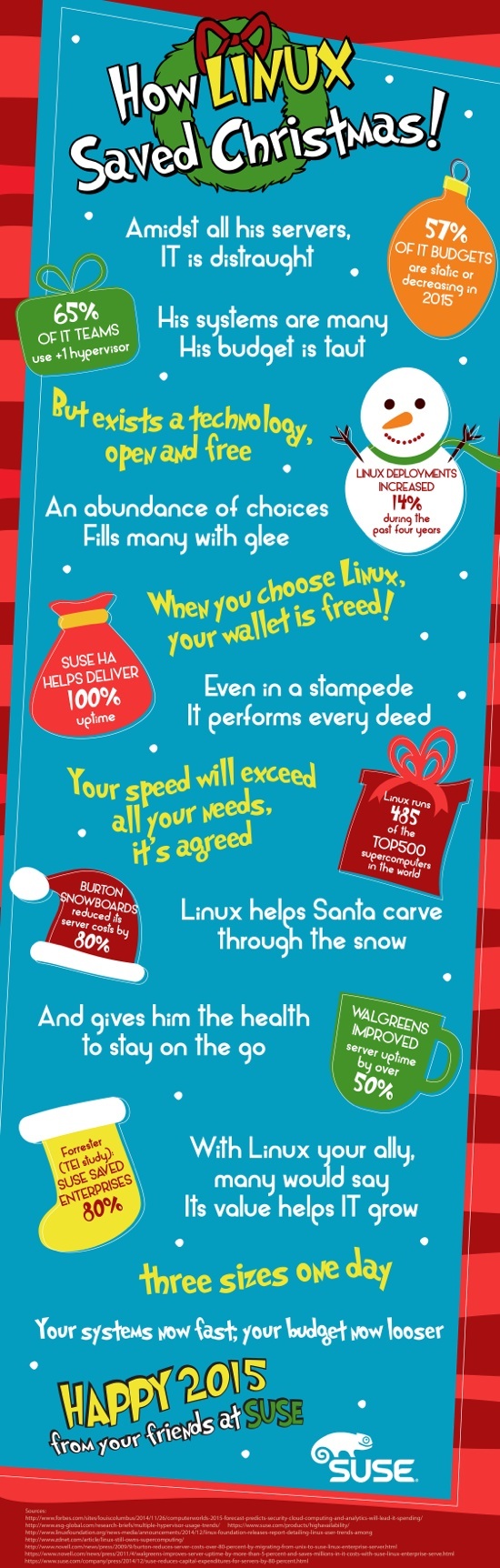
SUSE: How Linux Saved Christmas

 SUSE How Linux Saved Christmas

Using Your Open Source Work to Get a Job

So you’ve worked on an open-source project, and you want to place that experience on your resume in order to move your career forward. Fantastic! In theory, there’s no reason an employer should shun your experience, just because you did the project from home on your own time. But how can you actually leverage that project work to obtain a full-time job?

The Entire Project Is a Reflection on You

First, make sure that any project you present on your resume is a good one. Even if you did an awesome job on your parts of it, a bad project could lead a potential employer to attribute the less-than-stellar elements to you, even if you weren’t responsible.

Read more at Dice News.

10 Ways Data Center Industry Will Change in 2015

As we approach the end of 2014, those in IT who like to ponder industry trends send us their predictions for next year. Here are some of the more interesting predictions we have received from folks so far. Stay tuned for more 2015 predictions on Data Center Knowledge in the coming weeks.

Here it is, our list of data center industry trends that will dominate the conversation in 2015:

1. The Big Guys Build Their Own Networks

Operators of massive data centers, the hyperscale cloud and Internet content providers, also known as web-scale operators, are increasingly buying their own switching gear and dark fiber to expand their networks instead of relying on commercial carriers, according to Cyan Networks, a U.S. networking technology vendor.

Read more at Datacenter Knowledge.

Tor Project Leaders Warn of Possibly Imminent Network Attack

In the world of online anonymity, the Tor network is a silent king. Millions of users depend on Tor to keep their tracks untraceable online, and not just individual users. Banks and other institutions leverage the Tor network as a security layer. In the U.S. last year, when NSA snooping was in the news, usage of the Tor network doubled within a matter of days.

Now, though, leaders of the Tor project said the network may have to contend with attempts to incapacitate it over the next few days through the seizure of specialized servers. And, befitting an online anonymity network, Tor project leaders are not naming who the culprit is.


Read more at Ostatic

HP Details the Promise of the Cloud and NFV

VIDEO: Saar Gillai, SVP and general manager of NFV at HP, discusses the opportunities and the challenges of cloud deployment.

Read more at eWeek

UEFI Secure Boot Tools Updated For v2.4

James Bottomley has updated the open-source UEFI Secure Boot Tools for Linux distributions to build against the UEFI 2.4 specification…

Read more at Phoronix

Help Port Tizen onto the Intel Edison Development Board

  Recently we have seen some great progress being made on getting Tizen running on different development boards lately, which includes the Odroid U3, MinnowBoard MAX, Renesas R-Car, Radxa Rock, A10S-OLinuXino-MICRO and A20S-OLinuXino-MICRO. Last week we started a Intel Galileo Gen 2 board giveaway, in an effort to get Tizen ported over to this potential Internet of Things (IoT) board.

This week we have another amazing giveaway, but this time it’s the Intel Edison board that devs can get their hands on, assuming they have relevant knowledge or experience to help port Tizen onto this board.

Read more at Tizen Experts

GPU-Based Acceleration For PostgreSQL

A developer has modified the PostgreSQL database software so that it can exploit GPGPU computing for faster performance…

Read more at Phoronix