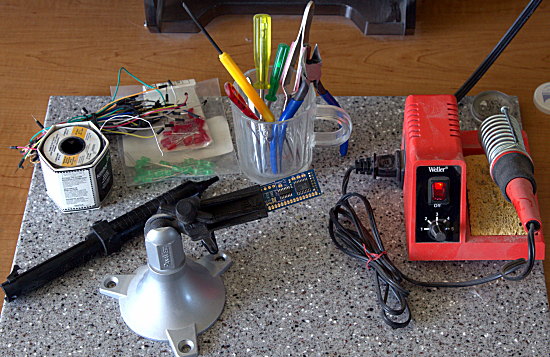
 Linux and FOSS have already changed the world, and we’re just at the beginning. This is a great time to learn to be a maker, in contrast to being a mere consumer. Clicking buttons on a smartphone is not being tech-savvy; hacking and building the phone is.
Some people give Make Magazine the credit for launching the Maker Movement. Whether they launched it or just gave it a name, it is a real phenomenon, a natural evolution of do-it-yourselfers, inventors, and hackers in every generation. Remember Popular Mechanics, Popular Science, Hands-On (for Shopsmith projects), photography magazines, woodworking magazines, electronics…remember Heathkit? Remember when Radio Shack was still an electronics store? How about Edmund Scientific? That is still a wonderful playground of anatomical models, microscopes, telescopes, dinosaurs, prisms, lenses, chemistry sets, lasers, geology stuff, and tons more. All of these still exist, and have moved online like everything else. It’s a feast of riches, plus we have all the cool new stuff that Make Magazine covers. This is absolutely the best time to be a curious tech adventurer.
My family did not own a television until I was a teenager, and that was a good thing, because we had to be creative in our amusements. My parents and grandparents valued developing skills such as creative writing, playing musical instruments, carpentry, cooking, and whatever came to hand. We went camping in tents, rather than monstrous houses on wheels that are more luxurious than most stationary houses, and actually spent time outside. In the weather. With bugs and stuff. Our imaginations were not stunted by television, and nobody ever wailed “Oh but I can’t possibly learn to do that.”
Allow me to rant a wee bit. “I can’t possibly learn to do that.” There are few phrases I detest as much as that one. Of course you can. Anyone can learn to do anything.
What is the Point
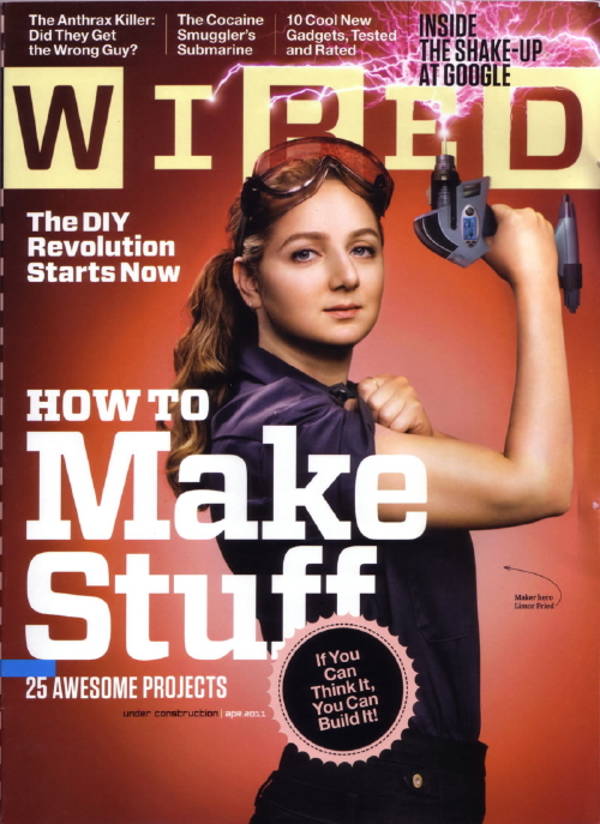 So, you may be wondering, what does this have to do with Linux, Free software, and open source software? It has everything to do with these. High tech is about crafting solutions to real-world problems. If you’re not connected to the real world then you’re not going to have any fuel for your imagination, or any kind of useful purpose. Albert Einstein said “Imagination is more important than knowledge. For knowledge is limited to all we now know and understand, while imagination embraces the entire world, and all there ever will be to know and understand.”
Tech needs to solve real problems, and not just feed on itself. If I never hear the words “innovation” and “disruptive” I will be happy, because every week my inbox receives fresh influxes of recycled “innovation” and “disruptive” announcements of recycled product ideas. Because of this I rather enjoyed Silicon Valley Has Officially Run Out of Ideas:
“Over the years, the competition has proven to be something less than a fountainhead of world-changing ideas. Past champions include a conference-calling app, a car-sharing service that is not Uber or Lyft, and a half-hearted “Second Life” ripoff that hasn’t been heard from since 2012.”
Now I don’t know if Silicon Valley has really run out of ideas. I do know that chasing wealth, and wanting to build something useful are two different goals that don’t often intersect. Linux and FOSS freely give us tools for literally changing the world.
Noble Purpose
Doubtless this brands me as some kind of moldy old hippie, but I believe that life is about more than chasing wealth. Money is just a tool, and making it the end rather than the means to an end is inevitably corrupting. We have a limited number of days on the planet, and every morning when we wake up we have the same choice as all our days before: Do I live purposefully today, and try to make my little bit of the world a little better? Or do I fritter it away?
Linux and FOSS have already proven that they are genuinely innovative and transformational. The only limitation on the reach and influence of Linux and FOSS is our imaginations. Which brings us to the most essential element in fueling imagination: Diversity.
Diversity is Everything
A lack of diversity leads to a failure of imagination. This is illustrated with brilliant sarcasm in Silicon Valley Has Officially Run Out of Ideas: “…a highly diverse panel of six other fabulously wealthy tech luminaries.”

Inspiration comes from real life, from everyday activities, from having relationships with diverse people and from observation. You don’t have to personally experience everything to understand the difficulties that other people face. Just pay attention. “Scratching your own itch” doesn’t need to be a selfish act that benefits no one else, though it is often interpreted that way. Rather, it means finding fulfillment and satisfaction in building something useful. Here are a few examples:
- Open Prosthetics Founder: Challenges Ahead for Open Source Medical Devices. The medical industry has had decades to make prosthetics customizable and affordable, and hasn’t even tried. Open Prosthetics is changing lives.
- Farmbot has the potential to revolutionize small-scale, customized, diverse and healthy farming.
- Sourcefabric is a sophisticated digital newsroom for online and print publication, and radio and Internet broadcasting.
- Open Source Beehives collects data on the decline of honeybee populations with sensor-enhanced beehives which are available to anyone who wants to participate.
- GCompris educational software for kids of all ages. Where are the next generations of tech nerds going to come from? Not from clicking iPhone buttons.
- Open Source Hardware teaches electronics skills such as soldering and building printed circuit boards, embedded programming, robotics, sensors, and lots more.
- Reglue does the best and hardest kind of Linux advocacy: face-to-face, hands-on, getting Linux computers into the hands of kids who can’t afford them.
These are just a very few examples of the thousands of genuinely useful and innovative FOSS projects all over the world.
Steve Jobs famously recruited John Scully away from Pepsi to head up Apple by asking “Do you want to sell sugared water for the rest of your life? Or do you want to come with me and change the world?” We can ask ourselves the same question. Do we want to be mundane, or do we want to use the amazing and freely-available tools that Linux and FOSS give us to change the world?


 As we’ve reported