
The Samsung Gear VR virtual reality device works in conjunction with a Samsung Galaxy Note 4 smartphone and will retail for $199 by itself or for $249 with a Bluetooth gamepad.
Read more at eWeek
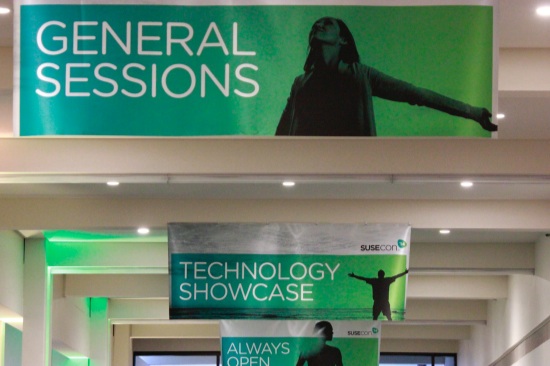
Here at SUSECon 2014, I’ve settled in with wide-open eyes to cover a convention that has, somehow, been off my radar. But it’s on now. It is very on. And after my initial chats with the likes of Nils Brauckmann (President & General Manager), Edwin L. Bowman III (VP North American Sales), Michael Miller (Vice President Global Alliances and Marketing), and Ralf Flaxa (Vice President SUSE Engineering), there’s one very clear image coalescing ─ the whole of SUSE needs to learn the fine art of bragging.
Why? They’ve earned it. Plain. And. Simple.
I went into SUSECon intentionally in the dark with what they are bringing to the table. I wanted to be blown away. I wanted someone in the world of Linux to remind me exactly what it was (back in the late 90s) that opened my eyes to the open source ecosystem in the first place. The more I spoke with the leaders of SUSE, the wider my eyes became. By the time I completed the first round of interviews, all bets were off. SUSE had won me over just like Caldera Open Linux 1.0 had so many years ago.
Along with their current, world-wide Enterprise-level offerings, SUSE is about to unleash some serious, game-changing technology onto the world. This is the stuff most other companies can only dream of delivering. In fact, SUSE is about to unveil one of the single most important technological breakthroughs to come about in recent years. That technology is live kernel patching. SUSE Enterprise Live Patching is based on the kGraft project (created in the SUSE Labs) and will effectively allow you to patch a live kernel … without interruption. What does this mean? Simple, it means, say, a security patch could come through and be rolled into your production machine without a second of downtime for that server. No services are disrupted, no immediate reboot is required. That server can keep on serving until you decide when a reboot can occur (if it is even necessary). For businesses demanding 24/7 uptime, SUSE Enterprise Live Patching will come as close to delivering that guarantee as anything ever has.
Of course, SUSE is much more than just a promise of 24/7/365 uptime (though that, in and of itself is about as impressive as you can get). SUSE, as a company, is truly passionate and dedicated to the “open” in open source. This passion does not just apply to their code, patches, and other software developments ─ but in their processes, their very business. SUSE is one of those companies that greets their partners and prospects with open arms and a level of transparency most others in the enterprise sector cannot touch. Their theme is “always open”. This applies to businesses, developers, customers, press … anyone and everyone. SUSE is proud to deliver:
True open source
No closed stacks
Freedom of choice, even within the open source world
Open collaboration ─ work with many tech partners
Enhanced performance
Optimized interoperable solutions for enterprise customers.
But with all of this massively impressive work going on, what strikes me the most is how gracefully and humbly SUSE approaches what they do ─ almost as if they were bereft of ego all together. In a world where business is brutally competitive and every company must hold their advantage close to the vest, SUSE takes the opposite approach. Not only do they function in a nearly 100 percent open capacity, they do so without a hint of braggadocio.
To that end, SUSE needs to learn how to brag. They’ve earned it. What they are about to drop into the lap of the enterprise world is game changing. But you wouldn’t know it by chatting with them. To the executives and developers at SUSE, they are just doing what they do.
More coverage of SUSECon 2014 to come.
Editor’s Note: Thanks to SUSE for sponsoring travel expenses to cover this conference.
 In recent months, without a lot of fanfare, major technology firms have been open sourcing extremely sophisticated security tools. A number of these are flying under the radar, but they are worth knowing about. Here are some of most useful tools to be open sourced recently by Google, Facebook and Netflix.
Nogotofail. Last week, as covered here, Google has announced an open source tool for testing network traffic security called Nogotofail. The project is now available on GitHub, and Google is inviting the community to work with it and help improve the security of the Internet. The tool provides an easy way to confirm that the devices or applications you are using are safe against known TLS/SSL vulnerabilities and misconfigurations. Nogotofail works for Android, iOS, Linux, Windows, Chrome OS, OSX, or any device you use to connect to the Internet. The Android security team has already been using this tool for quite some time.