Few would dispute the notion that open source projects live and die by their communities. Show me a successful project, as the saying goes, and I’ll show you one with an engaged and passionate community. Show me one that’s struggling, on the other hand, and there’s a good chance community members don’t have their hearts in it.
It would be difficult to find a better example of the former scenario than the OpenDaylight project. With a focus on software-defined networking and network functions virtualization, OpenDaylight launched in April 2013 as a collaborative open source project hosted by The Linux Foundation. Since then, it’s taken off like a rocket. Today, OpenDaylight is classified as a “Very High Activity” project on Open Hub, which notes that it has 12,312 commits made by 280  contributors, representing almost 1.9 million lines of code.
So what induces passionate and energetic developers and sysadmins to get involved in an enterprise open source project? Linux.com asked a few OpenDaylight participants for some insight.
‘More Than Corporate Loyalty and a Paycheck’
“I think there’s a misconception that the people who show up to work on OpenDaylight are basically doing it because the company is paying them to,” says Colin Dixon, a principal engineer at Brocade who serves as a “commiter-at-large” on OpenDaylight’s technical steering committee. “In reality, for many of us, it’s the other way around. That’s not to say that we don’t like the companies we work for, but there’s something else driving people that deeply engage in the community than corporate loyalty and a paycheck.”
Specifically, “I think the thing that makes the community work is a combination of individuals truly believing in the project and having mutual respect, friendship and working relationships,” Dixon told Linux.com. “I know that I’m here because I 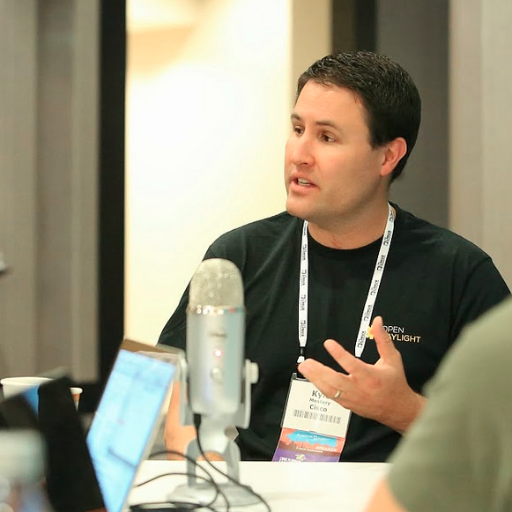 think we have an opportunity to change the way networking is done, and those don’t come along all that often.”
‘A Living, Breathing Thing’
Kyle Mestery, an open source cloud computing architect at Hewlett-Packard who participates in both OpenDaylight and OpenStack, had a similar tale to tell. (Born in 2010, OpenStack boasts 129,579 commits made by 2,556 contributors, according to Open Hub, representing more than 2 million lines of code.)
“Over the past 1.5 years or so, OpenDaylight has attracted some incredible developers and users,” Mestery began. “All of these people meet virtually daily on mailing lists, IRC and Google Hangouts. The social aspects of a project like ODL are what make it a living, breathing thing.”
Particularly memorable for Mestery was a period roughly a year ago, when he was a part of the team working on the ODL OVSDB (Open vSwitch Database plugin) code integrating ODL with OpenStack.
“We had weekly Google Hangouts where it became clear there was a core group of us who had become close friends,” he explains. “And ultimately, this is why the social fabric of ODL matters so much: When you’re spending most of your day, evenings and weekends working closely with a group of folks who have the same goals as you, you’re bound to bond with them outside of the constraints of the project you’re on.
 “The friendships I’ve built in ODL will last me well beyond the ODL project,” Mestery adds. “And that is what makes Open Source special.”
‘It Started With Academic Curiosity’
Srini Seetharaman, a contributor to SDN Hub who until recently worked at Deutsche Telekom, has felt an ever-changing motivation for working with the OpenDaylight project over the past year and a half or so
“It started out with an academic curiosity because I believed in the core
SDN technology underlying this software,” he told Linux.com. “Once I understood the platform and saw its potential, my interest shifted to educating and building the community. Simultaneously, I started building simple prototypes that I could use to evangelize the technology within Deutsche Telekom.
“My interest now has evolved further to combine both app/product development on the platform and community development to build viable products that end users could potentially use,” he said. “I commit code to OVSDB because I think it has the most potential for being deployed at a user environment.”
‘I Get So Much Energy from the People’
Last but not least, data center engineer Matt Oswalt got started in IT primarily in software development, but over the past  three years or so he’s focused almost exclusively on network operations and services.
“As a result of this, I’ve had a chance to see things from both sides of the fence, at a time where the face of networking is changing dramatically,” he explained. “The OpenDaylight community has given me a place to grow both of these skill sets together, mentored by some of the brightest and most passionate individuals I’ve ever met.”
Oswalt’s motivation for being involved? “Not only to stay plugged in and keep tabs on where software-defined networking is going in the next few years, but also because I get so much energy from the people,” he says. “I consider myself privileged to be able to learn from them, and contribute back what I can.”
‘The Most Valuable Thing’
Involvement with open source software projects tends to improve developers’ and sysadmins’ own ability to technically support themselves and the software they are writing or deploying, Jay Lyman, a senior analyst for enterprise software with 451 Research, told Linux.com. “There is often a curiosity, learning process and improvement that takes place when developing, contributing to, using and supporting open source software,” Lyman said.
For example, open source software is “not a necessity to more modern, agile IT and DevOps methodology and processes, but it certainly helps to be familiar with open source tenets such as customization, collaboration, communication and transparency to more rapidly and effectively adopt a DevOps approach,” Lyman said. “We’ve also seen enterprise organizations seek out use of open source for cost or flexibility reasons, then find other advantages that center on performance, innovation or competitiveness — and I suspect the same holds true for individuals.”
In short, “one may start working with open source software because of availability, access to code or requirements, but then find the project and their own work in general improves because of that involvement,” he concluded.
Indeed, “the community is the most valuable thing in OpenDaylight,” Brocade’s Colin Dixon concluded. “Literally, you could take away all of the code, and if we still had the community it would still be fine. The community is where nearly all the value comes from: The community is who answers questions about the code for experts and newbies alike; the community is who fixes bugs as they come in; the community is what makes OpenDaylight antifragile.”


 Mirantis