Home Blog Page 1325

Why To Use Cloud Hosting Technology?

Cloud hosting? It’s a buzz-phrase, it’s popular and appears to work – but is that enough justification for you really to utilize it? Cloud hosting has its pros and cons, just as the traditional IT solutions it replaces. Read the list below to see if oahu is the right solution for you.


Actually, What Is Cloud Hosting?


First of all, let’s make sure most of us have exactly the same perception of ‘cloud hosting ‘. The concepts of cloud hosting and computing aren’t new. You can consider ‘cloud’ as a kind of shorthand to explain a network of computing resources(typically servers). A user connecting to the ‘cloud’ via a terminal, a PC or a mobile device like a smartphone can utilize the resources in the cloud to store data and run software applications on the servers in the cloud. To mix metaphors a little, the cloud is just a black box: as long as do you know what you place in and that which you escape, you do not have to be concerned about the way the cloud works inside. Physically however, the computer files and commands you send to the cloud all go to one or more real servers somewhere and connected to the network (very often the Internet) that you too are accessing. The recent development in cloud hosting that folks speak about today has come about as more and more service providers have made online computing resources available as services to consumers and enterprises.


What are the Fortes of Cloud Hosting?


Cloud hosting services that are available over Internet frequently have the next advantages:


Financial Flexibility. You rent a site from somebody else rather than investing in your server. Which means you pay lower monthly charges (some cloud hosting is even free), rather than committing a more substantial quantity of capital. In many cases, cloud hosting can be more cost-effective. However, you must always compare the sum total startup and ongoing costs of all of the solutions you’re considering (cloud or other) to see what’s best for you.


Universal Access. You can connect to the cloud hosting service anywhere you can connect to the web. With broadband, 3G and Wi-Fi access points, meaning pretty much everywhere.


Reliability and Resilience. Service providers have extensive server networks and can host multiple copies of your data in different locations. If you have a problem with a server in one single place, your data can be recovered from another server elsewhere on the network.


Scaling of Resources. For a person person or company, there’s typically no limit to the total amount of storage space or power for applications that may be made available. Cloud hosting providers operate huge, networked data centers giving ample room for growth for only the largest customers.


Up to Date Backup and Encryption Software. Cloud hosting services run current versions of software and a number of them also provide ‘strong encryption ‘, which makes it practically impossible for someone minus the encryption key to hack your data. However, see below for more information.


Service Choice and Flexibility. Because you rent a site rather than invest in your server, you can even move your data from one cloud hosting provider to some other if you obtain another hosting deal you prefer.


Eco-friendly. Cloud resources are also shared between customers (with appropriate security), making total power consumption per customer less than if each customer had to utilize its own individual private server.


Please check at http://www.thesagenext.com if you are looking for cloud hosting.



Dronecode Likely to Include Larger Role for Linux in UAVs

Parrot rolling spider

The Linux Foundation’s announcement last week of a new Dronecode Collaborative Project for open source Unmanned Aerial Vehicles (UAVs) was notable for its lack of any mention of Linux. That doesn’t mean, however, that Linux is out of the aerial picture.

Dronecode is formalizing the de facto standard that dominates the hobbyist, academic, and increasingly, commercial UAV world: 3D Robotics’ Arduino-focused, open source APM (ArduPilotMega) platform for drone autopilots. The project also encompasses the related PX4 project based at the Technical University of Zurich. The PX4 autopilot can run APM software as well as its similar PX4 Flight Stack, but instead of using Arduino, it taps the Cortex-M4-based Pixhawk hardware foundation. In either case, the OS involved is not Linux, but the open source Nuttx real-time OS.

Linux will soon play a role in Dronecode, however. As we noted in our drone report last May, 3D Robotics is in the process of porting APM to Linux. The effort is associated with Erle Robot’s work on a BeaglePilot autopilot, which combines APM with Linux using a BeagleBone Black platform.

The Linux port was not sufficiently complete to merit mention in the Dronecode announcement, but it will no doubt be supported by the project. The Dronecode project is comprised of 3D Robotics, as well as Intel, Qualcomm, Baidu, Box, and seven APM-oriented drone vendors: DroneDeploy, jDrones, Laser Navigation (owner of VirtualRobotix), SkyWard, Squadrone System, Walkera, and Yuneec. Some 1,200 developers are already working on Dronecode with more than 150 code commits a day on some projects, according to the Linux Foundation.

Over the next year, we’re likely to see new autopilots and drones based on the Linux APM port. We’ll also see Linux playing an auxiliary role in hybrid designs, just as Linux is often found nestled side by side with the open source Robot Operating System (ROS) on land-based robots. (FYI: some drones do use ROS, and APM is also available in a terrestrial robot version, but generally the two are separate.)

Intel’s participation in Dronecode stems in part from a partnership with 3D Robotics announced last month to use the Intel Atom-based Edison module as a companion computer for image processing. Judging from the headline in the 3D Robotics-backed DIY Drones community site — “3DR announces partnership with Intel on Edison for Linux-based companion for Pixhawk” — it would appear the Arduino-compatible Edison will run its usual Yocto-based Linux stack.

In September, 3D Robotics demonstrated its new IRIS+ UAV design with an Edison-based optical version of its 3PV Follow Me technology. 3PV is part of the recent trend of attaching GoPros or similar cameras to drones to trail you and record video. On the IRIS+, the Edison acts as a companion computer to the Pixhawk autopilot, letting the 3PV system track the subject using vision technology instead of relying on a GPS signal.

Other Linux Drones

Several Linux-based UAVs are available that are unrelated to APM. These include fixed-wing military aircraft and micro-helicopters, but most are multi-rotor copters, such as quadcopters. The latter group includes the biggest Linux success story in drones so far: Parrot’s hobbyist-focused AR.Drone 2.

Parrot’s next-generation BeBop quadcopter will ship by year’s end. The smartphone-controlled device runs Linux on a dual-core processor, and offers a 14-megapixel fisheye camera, a 3-axis sensor suite, and a WiFi-extending remote with Oculus Rift support.

Parrot also recently launched a $99 Rolling Spider quadcopter that is controlled via Bluetooth instead of WiFi. The Linux-based toy can flip in multiple directions, and when fitted with its removable pair of wheels, it can even climb walls.

Hitting the same $99 price is the MeCam drone from Always Innovating. This tiny, voice-controlled “follow me” UAV runs Linux on a Cortex-A9 processor, and provides a 1080p video camera and 14 sensors.

Pleiades’ Kickstarter-launched Spiri quadcopter, which ships in December for $865, offers a far more advanced design. The Spiri runs Ubuntu with ROS on a Freescale i.MX6, and integrates multiple sensors and three cameras. These include a 3D Time of Flight range-finding camera, to help it navigate autonomously.

Shields and capes are available that integrate autopilots with Linux-based hacker SBCs. There are also DIY drone projects based on SBCs such as the BeagleBone-based BeagleDrone, the Raspberry Pi-based Owenquad, and the Odroid-U3-based Quad-Rotor.

Commercial Linux drones

Commercial use of drones is still illegal in the U.S., with a number of exceptions. The FAA (Federal Aviation Administration) has been dragging its feet on deciding how to regulate UAVs, and the regulations may not arrive until 2016. Meanwhile, drones are being put to work under the radar, primarily in test deployments, exploiting the FAA’s PrecisionHawk lancasterperhaps intentionally lax enforcement of the existing laws. As they wait for FAA approval in the States, UAV vendors can survive by serving the growing international market.
As detailed in an interesting, non-technical overview of drones earlier this month in New York Magazine, the commercial drone market is heating up fast, with widespread testing of UAVs in agricultural and environmental monitoring applications. The film industry is experimenting with the technology, and hobbyist drones are increasingly visible above parks and parking lots.

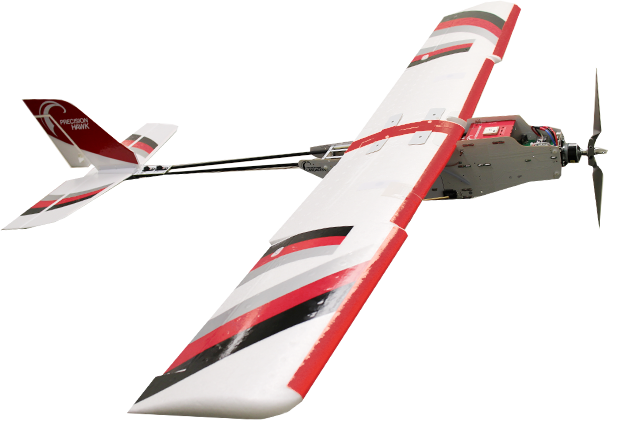
Commercial Linux-based designs include PrecisionHawk’s Lancaster fixed-wing UAV, which is designed for crop, forestry, mining, and emergency response monitoring. The semi-autonomous Lancaster runs Linux on a 600MHz processor, and also integrates Dronecode APM code. The Lancaster provides LiDAR and other advanced sensors, and can create its own optimal flight path depending on the latest weather conditions.

At least one UAV — the agriculture oriented Draganflyer X8 — uses Linux in the ground-station control device, but not the autopilot. Meanwhile, U.S. military drones are turning to Linux for their next-generation support drones, although not apparently yet on the weaponized models.

https://www.youtube.com/watch?v=_5n7iG_XK-Q?list=UUfX55Sx5hEFjoC3cNs6mCUQ” frameborder=”0

Will Android and Chrome Marry?

Perhaps, the better question is: “When will they set the date?” Sooner or later, Google’s operating systems will come together.

Video: Linux Kernel Developers Respond to Concerns About Community Culture

kernel panel 2014

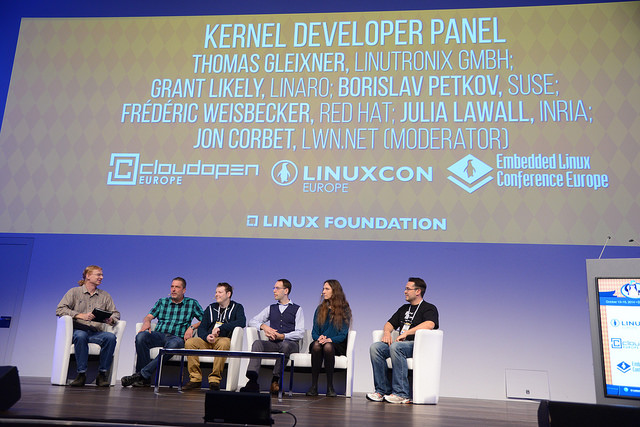
Shortly after a live Q&A with Linux creator Linus Torvalds at LinuxCon and CloudOpen Europe on Wednesday, the kernel developer panel took the stage for a roundtable discussion. LWN Editor and panel moderator Jon Corbet didn’t beat around the bush; he asked the panelists to first respond to systemd developer Lennart Poettering’s controversial post in which he called the open source community “a sick place.”The developers’ responses were varied, but Linaro developer Grant Likely’s thoughts perhaps drew the most audience applause.

“Ninety-nine percent of the time all of the conversations have been respectful and productive. The problem is when things do bubble to the surface, they end up setting the tone for the entire community, and I am concerned about this, it keeps some people out of the community that would otherwise be involved,” Likely said. 

“I don’t want to work in a community that will tear down other people or anger bubbles to the surface too quickly, or it devolves into attacks on a person,” he said. “If that happens in my communities, I’ll call you on it, and I hope that if I start to get emotional, you’ll do the same for me.”

For the full discussion, which largely addressed technical issues, see the video below.

https://www.youtube.com/watch?v=XFog3086NQo?list=UUfX55Sx5hEFjoC3cNs6mCUQ” frameborder=”0

Linux is on the Right Side of History, Says Open Source Figurehead

Jim Zemlin is excited. We’ve caught up with him backstage at LinuxCon in Dusseldorf where, as executive director of The Linux Foundation, he has just given a keynote. But it’s not that which is exciting him right now. It’s the fact that he’s in the home of Kraftwerk.

“The other people with me in the room hadn’t heard of this band, but did you know that Kraftwerk are from Dusseldorf? One of the original German electronica bands! I told you guys!” he beams.

Read more at The Inquirer. 

Vitesse: Using LLVM To Speed Up Databases

A new start-up is attempting to speed up PostgreSQL database performance by leveraging the LLVM compiler infrastructure…

Read more at Phoronix

Qt 5.4 Now In Beta With Web, Bluetooth LE, Graphics Improvements

Digia — well, what’s being spun off into The Qt Company — published the official beta for the upcoming Qt 5.4 tool-kit release…

Read more at Phoronix

AMD’s Radeon R9 285 On Linux Offers Good OpenCL Performance

In complementing this week’s Linux review of the AMD Radeon R9 285 and follow-up articles with some extra GPU scaling tests and Catalyst AI Linux benchmarks, here’s some more OpenCL R9 285 “Tonga” performance numbers under Ubuntu compared to what was shared in the original Linux review…

Read more at Phoronix

IBM, SAP Cloud Deal a Major Step for Enterprise Cloud Adoption

IBM’s new cloud deal with SAP will not only connect IBM’s fast-growing cloud with SAP’s HANA in-memory computing capabilities, but also will tap IBM’s large consulting arm to benefit customers of both companies.

Read more at eWeek

GNOME Developer Comes Up With New Animated Image Format

Jasper St. Pierre who we’re usually talking about on Phoronix due to his GNOME contributions related to Wayland support, shared today he’s come up with a new animated image format to compete with GIF…

Read more at Phoronix