

Home Blog Page 1340

Slide Show: 11 Smart Eyewear Devices Running Android or Linux

Linux and Android glassesGoogle Glass wasn’t the first eyewear computer, but it achieved several technological breakthroughs, especially in its sleek, lightweight construction. The much maligned device has spawned a growing industry of head-mounted smart eyegear. Our slide show of 11 Android and Linux eyewear devices includes simple Bluetooth accessories for notifications, full-fledged industrial headgear, sports gear for bikers and skiiers, and even a motorcycle helmet (click Gallery link below).

Like Glass, eight of the 10 other devices listed in our slide show are based on Android, while two — Laforge’s ICIS and Tobii Glasses 2 — use embedded Linux. Almost all the devices are open for pre-orders at the very least, and most are shipping, although sometimes only in beta form. Several are OEM-focused devices. Glass only recently became publicly available for $1,500, and sales are still controlled by Google, with restrictions in terms of age (18+) and a requirement that you live in the US or UK.

Only a few of these devices, such as the ICIS and GlassUp, appear to be competing directly with Google Glass as a general purpose smartphone accessory or replacement. Yet Glass is also being promoted for some of the industrial and field-service applications where most of these devices are targeted.

As with smartwatches, smart eyewear can be generally split into two groups: those, which like Google Glass, are primarily Bluetooth accessories, and those that are more fully autonomous.

Most of the devices in this slide show fall into the latter category, in large part because many of these are enterprise focused devices where fashion – and therefore size — is less of a concern. All the devices in the slide show offer Bluetooth, and most, like Glass, provide WiFi. A number of them also incorporate GPS, as well as sensors, which can be used for positioning, or in the case of the sportier devices, health and performance feedback.

Several of the bulkier, more autonomous, enterprise-focused devices replace the Google Glass like monocular displays positioned on the side of the field of view (FOV) with 3D stereoscopic displays that use transparent overlays for augmented reality applications. Two products — Epson’s Moverio BT-200 and the R-7 Glasses from Osterhout Design Group (ODG) — use Qualcomm’s Vuforia SDK for Digital Eyewear (VOD) technology for accurately mapping augmented displays to the visual field. These devices use multiple depth sensing cameras for accurately matching overlays to objects.

Gallery


View Gallery
(11)

Android and Linux lead the way again

As with most cutting-edge gadgets these days, there’s not much going on in the smart eyewear market that doesn’t involve Android or Linux. There are, however, a few low-end smart eyeglasses that don’t appear to run a formal OS such as the WeON Glasses, which do little more than flash a colored light when your phone gets a text.

Apple has built eyewear prototypes, but nothing seems to be eminent. Instead, the company is focusing on its Apple Watch

If smartwatches do take off, it could slow down the consumer smart eyewear market. Public backlash to Google Glass over privacy issues, and the resulting bans on “glassholes” by many communities, bars, restaurants, and public institutions, pose another obstacle. Removing the camera or microphone doesn’t necessarily solve the problem, as it may be difficult to detect what’s going on in your particular device.

Then there’s the fashion issue. Even the relatively svelte Google Glass is seen by many as embarrassingly geeky. Yet the latest lightweight devices, such as the ICIS, look almost like regular glasses. With increasing miniaturization — and the hiring of fashion designers — future devices should appear much less obtrusive.

For the near future, privacy and fashion concerns are likely to keep the eyewear revolution a mostly enterprise-focused affair. Yet, smart eyewear should find a willing audience among those who need to keep their hands free for sports, or for industrial, field service, or even some retail applications.

The idea of smart eyewear has a certain inevitability to it. Isn’t this how we always imagined we’d look in the future, except with white track suits and flying cars?

Daqri Smart Helmet — Daqri
GlassUp — GlassUp
Google Glass — Google
ICIS — Laforge Optical
Moverio BT-200 — Epson
R-7 Glasses — Osterhout Design Group (ODG)
Recon Snow 2 — Recon Instruments
Recon Jet — Recon Instruments
Skully AR1 — Skully
Tobii Glasses 2 — Tobii
Vuzix M100 Smart Glasses — Vuzix
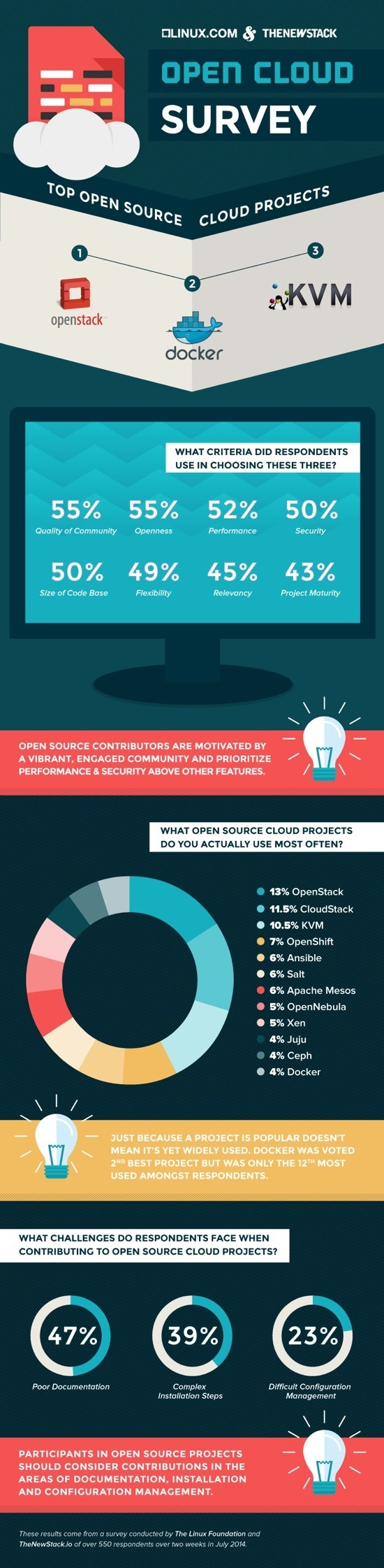
Infographic: Three Facts About the Open Source Cloud

With CloudOpen Europe now less than two weeks away, we took another look at the data from the recent open cloud survey, conducted by Linux.com and The New Stack. Three surprising conclusions emerged that aren’t necessarily obvious on a quick read through the survey results.

1. Open source contributors are motivated by a vibrant, engaged community and prioritize performance and security over other features.

2. Just because a project is popular doesn’t mean it’s yet widely used.

3. Participants in open source projects should consider contributions in the areas of documentation, installation and configuration management.

The following infographic explains these findings nicely.

OpenCloud Infographic

ARM Launches IoT Platform Revolving Around mbed OS

The move, which goes along with last week’s launch of the Cortex M7 processor, is designed to create core standard functions and then let developers add value on top of the hardware.

Linux-Based Kano Ships Its First 18,000 Learn-To-Code Computer Kits

Kano Computing, a startup that plays in the learn to code space by adding a step-by-step hand-holding layer atop the Raspberry Pi single-board microcomputer to make hacking around with code and learning about computational thinking child’s play, has shipped all the hardware kits in its first batch of crowdfunded orders and pre-orders…

“Kano OS, our software stack, is really the jewel in the crown of Kano,†said Alex. “I’m really, really proud of what our team has been able to do. I would describe it as perhaps the most simple and intuitive Linux based operating system ever designed. And the fact that it’s been designed for a new and challenging platform like the Raspberry Pi I hope will get people excited. I hope people will try it out because it’s free and open source. Even if they don’t buy a Kano they can just use it on any Raspberry Pi.â€

Read more at TechCrunch.

Secure Your Linux Desktop and SSH Login Using Two Factor Google Authenticator

The algorithm used for the one time password in the Google Authenticator app is known as the Time-based One-Time Password (TOTP) algorithm. The TOTP algorithm is a standard algorithm approved by the IETF in (RFC 6238) totp-rfc.

It is a little known fact that you can use the TOTP algorithm to secure your user accounts in Linux systems. This article will walk you through the steps necessary. While the exact commands will be for Fedora 20, the TOTP algorithm can be deployed to any Linux distro with a little modification.

Read more at nixCraft.

New Linux Foundation Certification Review Guide Available for Free

Last month we announced the Linux Foundation Certified Engineer and Sys Admin exams that you can take anytime, anywhere through your computer. We created this program because we know Linux talent exists everywhere and we want everyone to be able to showcase that talent through a performance-based, challenging exam that focuses on what you do everyday as a Sys Admin.certifiably awesome

The response has been fantastic with thousands of people signing up to take the exam from all corners of the globe. We have also engaged with large companies who are buying certifications in mass as a requirement for their teams. It’s been very satisfying to see so many of you engaging with the program.

I have a few pieces of critical information I wanted to share:

  1. We now have a free exam prep guide that covers some very basic information on what is covered in the test, such as a list of the domains and competencies and the system requirements for the itself. It doesn’t list a lot of detail (we are working on more information on that) but at least it’s a start. Download it now. 

  2. When you sign up for the exam you can set the date to take it well in the future or choose your date when you’re ready. It’s not an instant process since a proctor has to be scheduled and so on. We encourage you to sign up for the exam and get your testing date scheduled so you can get your preparation underway. You have 12 months from the time you sign up to take the exam, so you can give yourself as much time as needed to prepare and you’ll be in the system for updates or changes.

  3. If you’re interested I suggest yosign up for our certification newsletter here. It will alert you when we have limited time discounts, give you prep materials and keep you up to date.

  4. For professionals who want an inside track on how to prep, we’ll be hosting a Twitter Chat on Thursday, October 9 at 9 a.m. PT/noon ET. Just follow @linuxfoundation and the #LFCertChat hashtag. We’ll be answering your questions live for an hour.

I hope you find these resources helpful and good luck with your professional development. It’s a great time to be a Linux pro and we can’t wait to see many of you certified.

Linux Calendar App California 0.2 Released

Following on from last month’s update to Geary and Shotwell the non-profit software outfit Yorba is back, this time with a new release of their California calendaring application.

A capable desktop calendar is a must-have for the well-organised (and wannabe well-organised!). The release of the hugely popular Sunrise app to the Chrome Web Store means choices aren’t as scant as they once were. California bolsters this.

Read more at OMG!Ubuntu!

Adobe Pulls Linux PDF Reader Downloads From Website

Things are about to get tricky for anyone needing to use Adobe’s own PDF reader application on Linux, as the company has pulled the software from download.

As flagged by a Reddit user who visited the Adobe site to grab the app, Linux builds are no longer listed alongside other â€˜supported’ operating systems.

Read more at OMGUbuntu.

The Path to Full-Time Open Source

Two years ago today I released Sidekiq Pro, my commercial extension to Sidekiq, as an experiment to see if I could make OSS development financially viable for individual developers. I had no idea if anyone would trust me and buy it. Can you think of anyone else selling a Rubygem?

Sidekiq Pro sales for the last three months of 2012 were $7500. In 2013 they totalled $85,000. This year sales should top $175,000.Open Source development is now my full-time job, with no need for a corporate patron!

Read more at Mike Perham’s blog.

Rackspace Joined Amazon in Patching, Rebooting Cloud Servers

About a quarter of Rackspace’s 200,000-plus customers were impacted when the cloud provider had to patch a flaw in the Xen hypervisor.

Read more at eWeek