Samsung Electronics showed off the very first Tizen-OS based smart TVs at Samsung Open Source Conference held at the Grand Inter-continental Hotel in Samsung-dong, Seoul. The reveal was shown as part of the ‘Overview on Tizen TV Architecture’ session.
Tizen TV was presented running on a 65-inch Smart TV Model UN65H8000AF had already been released earlier this year, but here it was running Tizen version 2.2.1, but it is thought that the commercial product will ship with Tizen 2.3. This is the first time that Samsung have showed off Tizen running on a commercially available device, opposed to the prototype that was showcased at the Tizen Developer Conference.
Klaus Knopper has released KNOPPIX 7.4.1, a bug-fix release of the project’s Debian-based live CD/DVD that provides the LXDE (default), GNOME 3.12 and KDE 4.13.3 desktops, as well as a separate “ADRIANE” edition designed for visually impaired users: “Version 7.4.1 of KNOPPIX is based on the usual picks…
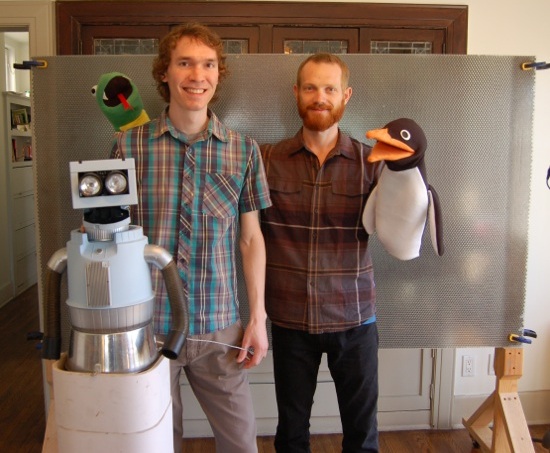
Growing up in rural Utah, brothers Jared and JR Neilsen spent their free time recording videos that starred a cast of homemade puppets. As adults they’ve reconvened to create their own web series,Hello World, which aims to teach kids about computer science.
The latest segment in the series, “Superusers: The Legendary GNU/Linux Show,” is focused on teaching Linux fundamentals. Puppets Adelie the penguin and Aramis the gnu lead kids on operating system adventures to teach topics such as how to use commands, write basic shell scripts, and find a file or directory.
“We wanted to do something creative and fun, merging the adventures of our youth with our current interests in computer science,” Jared Neilsen said, via email. “It’s a pastiche of things we love: puppets, surreal British comedy, philosophy, music, superhero cartoons, and Linux, of course.”
Neilsen made his way to Linux designing and hacking interactive museum exhibits at the Natural History Museum of Los Angeles where he worked as a technician. He was tasked with upgrading the aging exhibits from PIC chips to Arduinos, and later to Raspberry Pis. He also worked on light and sound installations using Pure Data to control DMX dimmer packs and multiple audio channels, he said.
“I found Linux ideally suited for this type of development because it’s so lean, light and customizable,” he said.
His brother JR, a web developer, started using Linux a few years ago and never looked back.
Together they produce the Hello World program entirely on Linux (Mint 17 Cinnamon) and open source software. Or, when needed, they develop a workaround. For example, they create stop-motion animations on Linux using Entangle and avconv.
“One of our goals is to prove that anyone, anywhere, with an Internet connection and access to a computer and camera can produce professional media with no budget,” Neilsen said.
Their open source toolbox includes:
– Lightworks for video editing
– Blender for animation and compositing
– Inkscape, GIMP and ImageMagick for graphics and photos
– A combination of LMMS, BitWig, Audacity and Ardour for sound processing and music composition
– Entangle for stopmotion
– avconv to compile all of their moving-image assets.
The Neilsens are now seeking Indiegogo funding to start a new series of 10 videos and an e-book that will teach kids the basics of programming.
A “Com 1″ Indiegogo project is the first Android Wear smartwatch to use a Ingenics MIPS SoC. The watch offers IP67 waterproofing, WiFi, and a $125 price. The Com 1, which comes from an unnamed Brooklyn-based startup, aims to reach $75,000 in Indiegogo funding by Oct. 6. Considering that major vendors have jumped on the […]
While the Linux 3.17 kernel isn’t being released for a few weeks, we already have a good idea for the DRM graphics driver improvements coming for the Linux 3.18 cycle…
systemd not only brings improvements for administrators and users, it also brings a (small) number of new APIs with it. In this blog story (which might become the first of a series) I hope to shed some light on one of the most important new APIs in systemd:
Socket Activation
In the original blog story about systemd I tried to explain why socket activation is a wonderful technology to spawn services. Let’s reiterate the background here a bit.
Samsung Electronics are looking at releasing Tizen TV as well as other other home appliances that will use the Tizen Operating System early next year, in fact we should see them at CES 2015. According to an executive that is in charge of the Smart Home range of products, Tizen will be found in increasingly more appliances. This is also what Samsung Co-CEO J.K. Shin mentioned in an Interview in August 2013 with CNET, that Tizen was destined to be the OS of Cross-convergence between many different type of gadgets and Industries.
Canonical just keeps deepening its commitment to the OpenStack cloud computing platform, to the point where a lot of people who are loyal to the company for its Linux roots may not recognize its business model in a few years. Canonical is now partnering with AMD to upgrade the OpenStack cloud in the box concept that was originally the Ubuntu Orange Box to an OpenStack cloud housed on a rack.
The Orange Box, of course, capitalized on the fact that many people are deploying OpenStack on top of Ubuntu, and the new OpenStack on a rack concept serves up Ubuntu LTS 14.04 and OpenStack in one bundled offering.
The fact is you can already access ownCloud on your Chromebook via the web interface, but it’s not very useful because you can’t really take full advantage of Chrome app to work on your files. You have to manually download each file, work on it using the Chrome apps and then upload then back to your ownCloud server.
If there is ownCloud integration within the File Manager of Chrome OS, then it will be much easier to work on files stored on your ownCloud. You will also be able to save files to your ownCloud, instead of Google Drive, easily.

 Canonical just keeps