We recently celebrated the 23rd birthday of Linux – with the original announcement of our beloved kernel having appeared, as if by magic, on August 25th, 1991.
[Incredibly important side note: Later that same day, Cheers would win its fourth Emmy award for Outstanding Comedy Series. This is important for two reasons. The first being that I just remembered how much I loved that show…. I should watch it again. The second reason is that I spent two minutes of my life looking up and verifying this information. Now you are spending two minutes of your life reading about it. That’s the circle of life, boys and girls.]
 Twenty-three years old. That got me thinking, “That means Linux will be 25 years old in just two years. A quarter of a century. What will happen to Linux between now and then? I should write down my predictions in an article and send it over to those swell chaps at Linux.com.”
Then I realized that, if I did that, two years from now people would look up my predictions and mock their astounding inaccuracy. Because of the fact that I am a complete and total coward, I thought better of this course of action. Instead, opting to write a far safer article. An article that jives with my natural predisposition towards the aforementioned cowardice.
I’m going to look back at other people’s old Linux predictions… and I’m going to make fun of them.
[20/20 hindsight. Monday Morning Quarterback. Call it what you will, but this sounds a whole heck of a lot easier than coming up with original predictions.]
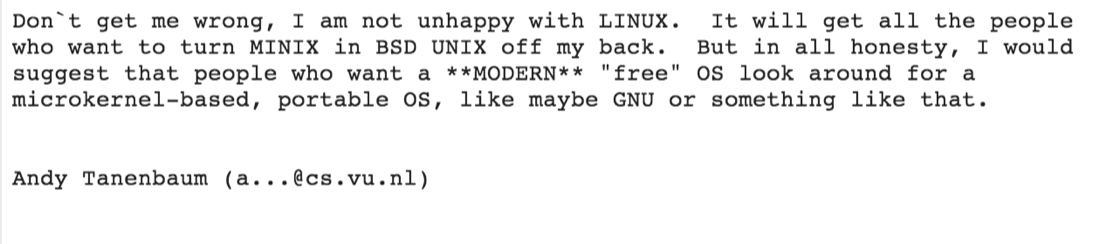
For the first prediction, I have decided to kick things off with a doozy. What, for obvious reasons, is a clear candidate for “Most Astoundingly Wrong Linux Prediction Of All Time”. Back on the 29th day of January, in the year Nineteen Hundred and Ninety-Two, on that beacon of knowledge known as Usenet… a post was made with the following title:
“Linux is obsolete”
[Ok. Technically the title was “LINUX is obsolete”. But having “Linux” in all caps feels wrong. So I fixed it. I fixed history. You’re welcome.]
That post was made by none other than Andrew Tanenbaum, the creator of MINIX and one half of the most entertaining software architecture flame war of all time.
His declaration of obsolescence was at least 22 years off (and counting). But, hey. It was Usenet in the 90’s. Everyone had at least 17 different crazy posts there that they would live to regret having ever typed out – and that was even before the Eternal September. So we’ll let this one slide, Andrew.
Flash forward seven years to the autumn of 1999. The person that originally ran Linux.com at the time, Trae McCombs, graced the pages of Maximum Linux magazine with the following words:
“In five years we’re going to sit around and laugh that we even had operating system wars; there’s just going to be Linux. We’re going to take over.”
The best, most straight forward, way I can think of to describe this is “undeniably bonkers levels of didn’t happen.” But, now in Trae’s defense on this one, I think I’ve made similar predictions nearly every year, myself. And, really, Linux isn’t doing too gosh darned shabby. Complete domination of the super-computer world. And servers. And set top boxes. And I hear it’s also doing pretty swell on those new-fangled cellular gizmos the kids keep raving about.
But, alas. As much as I would have loved for the optimistic words of Trae McCombs to have proven accurately prophetic… for 2006 to have actually been a year where the majority of every-day computing devices, in the hands of average people, were powered by Linux. Oh what a glorious year that would have been.
Oh well. He was only off by a few years.
You know what? Enough with going through one prediction at a time. One forward looking statement, proven to be factually incorrect, after another. It’s enough to drive even the strongest of men to the brink of insanity. [What dullard wrote this article anyway?]
Let’s cut to the chase and jump to the most prophetic of all Linux prophesies ever to be prophesied.
“XXXX will be the Year of the Linux Desktop.”
We’ve all heard it. We’ve all said it. And, if we’re going on market-share numbers (and I think we all know we should be), we’ve all been wrong about it.
And it’s all Dirk Hohndel’s fault.
Dirk claims to be the first person to prophesy that an upcoming year would be “The Year of the Linux Desktop”. A refrain that gave lazy technology journalists, from here to Timbuktu, at least one really easy article to write each and every year.
[Sorry for giving away one of our trade secrets guys. I promise to keep the whole “we don’t actually report the tech news, we manipulate the tech world like evil puppet masters” thing quiet. Mums the word.]
Last year, Dirk revised his original prediction with the following:
“If I changed it from the year of Linux desktop and changed it to a decade and a half from now client computing will be mostly Linux, which has happened.”
Two critical things strike me about that.
First… he’s right. That happened. Roughly a decade and a half on from 1999 and we have reached a point where client computing devices (mobile gadgets, set top boxes, TV’s, embedded systems, PC’s, etc.) truly are mostly Linux-based. That, right there, is terribly cool.
Second… he just… wait… did he say something akin to, “You know that prediction I made that didn’t happen? If I had made a completely different prediction that actually was accurate… then it would would have been accurate.”… ?
Yes. Yes, he did. This guy’s got moxie. I think he’s my new hero.
Oh, and 2015 will be the Year of the Linux Desktop.
Bryan Lunduke is Social Media Marketing Manager at SUSE.

 First off, why is this idea even considered to be of importance? That answer is simple. Mobile devices have overtaken the desktop in both usage and sales. For example, in 2013 desktop sales totalled (in the thousands of units) 315,229, whereas smartphone sales totalled 1,875,774. That is a sizable difference. Clearly, people (especially younger generations) depend upon their smartphones more than their desktops. Because of that, the transition between mobile device to desktop will eventually need to become seamless. The desktop and the mobile experience will have to become one — otherwise, the desktop will continue to stagnate and users will, more often than not, defer to the platform they know best — the smartphone. To that end, convergence has to be a crucial factor for desktop OS designers/developers.