

In the first of this series on Docker security, I wrote “containers do not contain.” In this second article, I’ll cover why and what we’re doing about it.
Read more at OpenSource.com
In the first of this series on Docker security, I wrote “containers do not contain.” In this second article, I’ll cover why and what we’re doing about it.
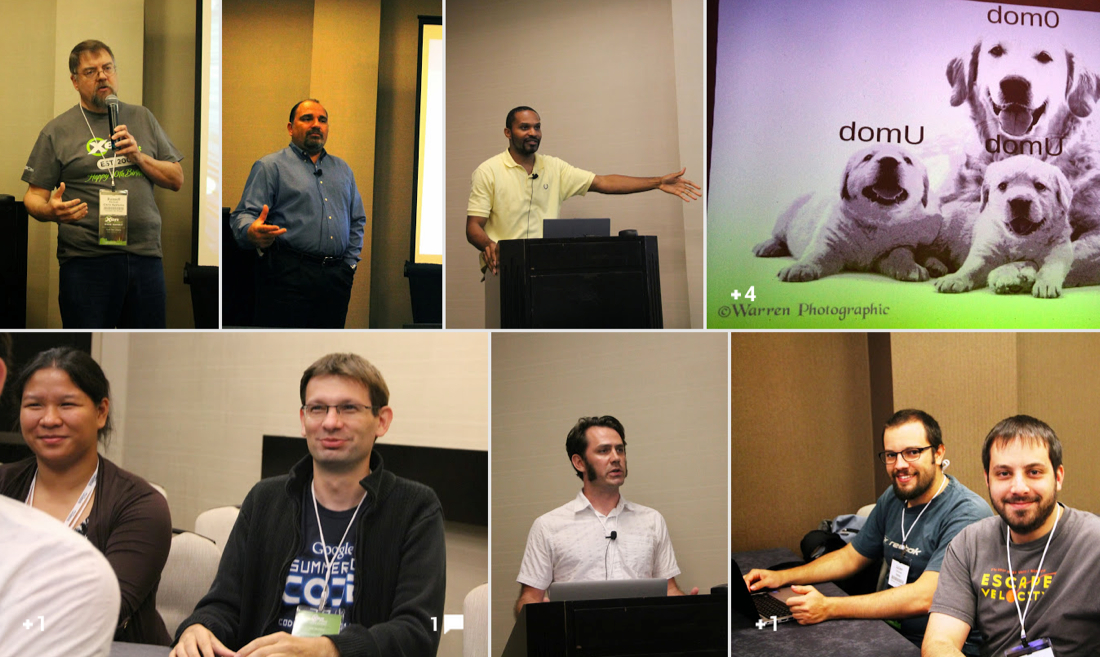
Some claim that the age of virtualization is now past. However, nothing could be farther from the truth. And this year’s Xen Project User Summit will highlight many of the newest advances in virtualization. If you use the Xen Project Hypervisor — or if you are simply evaluating your virtualization alternatives — join us in New York on September 15!
This year’s event focuses on a number timely topics, including:
Some of the hottest technologies in the world of virtualization are the unikernels. Small, lightweight, and secure, unikernels will power a new type of cloud. Allowing for hundreds, or even thousands, of VMs per host, unikernels will allow us to develop exciting new visions of the cloud. Hear from the creators of such notable entries like OSv and HaLVM.
Many organizations are making plans for clouds based on OpenStack. Now is an excellent time to see how SUSE Cloud can leverage Xen Project software to make those plans become a reality.
Some mature projects slow down development as they age. But not Xen Project! Our upcoming release has the longest list of new features we’ve seen in years! Get the lowdown on what changes are coming, so you can start making plans. Plus, we’ll hear about the latest news from the Board of Advisors.
You can’t get serious about the cloud without addressing security. Learn about the Advanced Security features of Xen Project as well as the Zazen security architecture. And hear about the case study describing the deployment of Xen Project-powered security devices.
Last summer marked the birth of the Open Source XenServer project. For years, XenServer has been a very popular commercial product which leverages Xen Project software. Now learn what’s planned in the next iteration of XenServer.
There are a number of other software projects in the Xen Project ecosystem. One of the most exciting is Xen Orchestra, a web-based GUI for XAPI and XenServer.
Last year, Xen Project was re-integrated into CentOS 6 via the Xen4CentOS effort. Learn how to use Xen4CentOS and hear what’s coming in the new CentOS Virtualization SIG.
There’s plenty more in development at Xen Project. Still under development is COLO, an effort to bring high availability to VMs using lock-step failover. Hear about the status of this project while it is still cooking.
Many of our presenters are from industry leaders like Oracle, Intel, Citrix, Red Hat, and SUSE. But we also have people from up-and-coming organizations like Cloudius Systems, Galois, Vates, Zentific, and Sound Linux Training.
For the schedule and registration information, please visit the Linux Foundation Events website. And we hope to see you in New York!
 Before Elizabeth Joseph began her career as a system administrator, she was a hobbyist who attended a lot of Linux Users Group meetings in her hometown near Philadelphia. Now she’s an automation and tools engineer at HP, working on the OpenStack infrastructure team and recently co-authored the latest revision of The Official Ubuntu Book.
“I really love it,” said Joseph, one of two winners in the Linux Foundation SysAdmin Day contest, announced in August.
When Joseph started using Linux in 2001 she was working as an accountant who played around with computers in her free time – building websites, setting up Apache servers and email, and writing Linux tutorials. Then in 2006 a tech services provider from her Linux Users Group asked her to take a contracting role as a junior admin. For a while she held down two jobs: accountant by day, admin by night.
“At the time I wasn’t sure if I wanted to be a developer or sysadmin, but it really grabbed my interest,” she said. “I like the engineering – building infrastructure to solve a problem. It’s exciting when you build the system and it works.”
She decided to make the career change and became a full time admin at LinuxForce where her boss allowed her to continue her open source contributions to Debian and Ubuntu. But after six years she felt like she was outgrowing that job and started looking for a position that would combine her two passions: open source software and system administration. She reached out to her contacts in the open source community and heard about an opportunity at HP.
“I didn’t know a lot about OpenStack but I’ve learned a lot in the year and a half I’ve been here now,” Joseph said.
Though there are similarities to her former job, maintaining OpenStack infrastructure is very different. One big change, she says, is that her clients aren’t your average consumer, but developers working on OpenStack.
“Developers tend to be slightly more forgiving when things go down because they understand portions of the  infrastructure and they understand what’s going wrong,” she said.
And when something does go wrong the OpenStack team has admins around the world who can respond; no more middle of the night pager calls.
But perhaps the most significant difference between her old job and the new one at HP is that, just like the OpenStack code itself, the project’s infrastructure is completely open. Anybody can make changes to it by submitting a patch, which then goes through OpenStack’s peer review process using the Gerrit code review tool.
“At my old job, in the morning we’d do basic triage, and have meetings to talk things through, and we’d go off and fix things. We didn’t have a configuration management system; we trusted each other to do things well,” she said. On the OpenStack infrastructure team, “we’re all doing code reviews for each other’s changes and chat about them on IRC; that’s how we communicate everything. We’re all supporting each other’s projects.”
The admins work collaboratively, oftentimes with the project’s developers, to build and maintain new systems. OpenStack’s infrastructure is, she says, “collaborative by default.”
“Since we work with developers, giving them the ability to write patches on our infrastructure has been really powerful – even though they’re not sysadmins they can help us,” she said. “Rather than say “We don’t have time to fix that,” we say “Why don’t you write something and we’ll review it?”
There are a few things they can’t do through code review, such as big upgrades, she said. But even then the team is working together through the upgrade, troubleshooting and suggesting commands over IRC.
This open, collaborative approach to IT is becoming more common among open source projects and can be a good way for junior system administrators to gain experience, Joseph said. She recommends becoming a volunteer admin on a project with open infrastructure to help improve your skills and job prospects.
“A lot of people have trouble getting that first experience with actual, real world infrastructure,” she said. “A lot of people who volunteer on these projects end up getting hired.”
Some projects that she recommends for those looking to get involved include:
Debian:https://dsa.debian.org/
Fedora:https://fedoraproject.org/wiki/Infrastructure
Mozilla: https://wiki.mozilla.org/ReleaseEngineering/PuppetAgain
Jenkins: http://jenkins-ci.org/content/come-join-infra-team
And OpenStack http://ci.openstack.org/
For more information on how a system administration career progresses, see the Linux Foundation’s Evolution of a SysAdmin chart.
 A growing dependency on digital data has spurred new interest in flash storage technologies along with cloud-based services and storage. With the broadest portfolio of flash-memory based solutions in the industry, SanDisk is on the leading edge of this transformation, with Linux and open source at the heart of its innovation. By working with hundreds of open source projects in compute, storage, and networking, SanDisk can help enable software stacks to take advantage of flash’s behavior and performance, says Nithya Ruff, director of the SanDisk Open Source Strategy Office.
SanDisk recently joined the Linux Foundation as a corporate member along with Adapteva, GitHub, Seagate, and Western Digital. Here, Ruff explains why SanDisk uses Linux and open source software, why the company joined the Linux Foundation, which trends in the storage industry are affecting them, and how they are participating in the storage industry transformation.
Linux.com: What does SanDisk do?
Nithya Ruff: SanDisk Corporation is a Fortune 500 and S&P 500 company and a global leader in flash storage solutions for more than 25 years. SanDisk has expanded the possibilities of storage, providing trusted and innovative products that have transformed the electronics industry. Our quality, state-of-the-art solutions are at the heart of many of the world’s largest data centers, and embedded in advanced smart phones, tablets and PCs. You can also find our consumer products at hundreds of thousands of retail stores worldwide.
How and why do you use Linux?
Open Source is used in tools and as a core for some of our embedded devices such as the SanDisk Connect™ Wireless Media Drive. We also work with open source ecosystems, like Android and OpenStack, where we enable users to truly take advantage of the full benefits of flash from performance to energy efficiency to small footprint. These ecosystems start on a Linux base and encompass hundreds of compute, storage and networking projects which form the basis of mobile devices and datacenters.
Why did you join the Linux Foundation?
The Linux Foundation has become the central place for all things Linux and open source. It brings together education, sponsorship for emerging projects, events for commercial and community collaboration and a place to showcase our support for Linux and open source. As leaders in flash storage, SanDisk can bring its knowledge of flash enabled storage to the table and to engage with the community to drive new ways to incorporate open source to flash-enabled storage devices. We are excited to be part of the Linux Foundation.
What interesting or innovative trends in the storage market are you witnessing and what role does Linux play in them?
Storage is undergoing a dramatic transformation from the creation of more data at the edge to the transportation and eventual storage and use of the data. As a company that plays in all of the points of storage, we see a number of trends.
Proliferation of edge devices – mobile, wearable, Internet of Things – all capable of data generation and some storage.
Massive generation of data of all kinds that needs to be stored and ready for on-demand access.
Cloud is becoming a dominant media for the storage of data with object storage as a dominant means of storage.
Use of more open source and open standards based software in all aspects of the datacenter.
Need for faster and high-performance access from multiple devices and applications and hence more flash-transformed datacenters.
Need for more efficient storage of the data in datacenters – smaller footprint, less energy usage, less cooling etc.
How is your company participating in that innovation?
Because SanDisk plays in all aspects of the data journey – from the generation of content at the edge in smart phones or devices to that data’s transportation to the cloud or an enterprise datacenter – we are in the middle of all this change. We are driving the transformation by enabling high performance, small footprint, highly efficient storage needed in the next generation of datacenters. Being a vertically integrated company from fabs to applications, we can truly drive what is needed in storage to handle the new cloud and service oriented datacenter. Being an expert in flash, we can enable software stacks to take advantage of flash’s behavior and performance through flash optimization with software. We can also bring the right footprint and quality to the edge devices and enable never before seen innovation.
What other future technologies or industries do you think Linux and open source will increasingly become important in and why?
Open source is transforming everything, especially how we work together across companies and communities to innovate and create. It provides a model of collaborative creation that can be used to create anything including art, music, better education, better hardware and better cities. It will be the use of the model that will transform industries and the way we live more than any one specific technology.
Are you hiring?
We are always looking for good talent. You can find more specifics at http://www.sandisk.com/about-sandisk/careers/