System Activity Report, also known as sar, is one of the most important utility for Linux system administrators when it comes to performance monitoring of a Linux system. sar provides an overview of the Linux system with various crucial metrics which include Processor, Memory, I/O Devices and Network related information. With sar, one can gather and store the information whenever there is an issue with the Linux server, and then use this data in order to deal with similar issue in future by comparing these system statistics with the ones at that point of time. In brief, historical analysis can be made a lot easier, when sar is used.
With sar, one can get information regarding following metrics:
Overall CPU Utilization
Individual CPU Utilization
Memory Utilization
Swap Utilization
Block Device Statistics
I/O Related Details
System Buffer and Context Switch Related Information
While open source practices have come to dominate the software industry, they’re still fairly new to hardware. Many open source hardware projects are now seeing some early success but there are still many challenges ahead, as the keynote speakers at LinuxCon and CloudOpen on Friday demonstrated.
MakerBot VP Anthony Moschella, Open Prosthetics Project Founder and Iraq war veteran Jonathan Kuniholm, and IBM Power Systems General Manager Doug Balog each had a unique take on open source hardware. But all agreed that open source principles will speed technological innovation whether it’s in 3D printing, prosthetics, or servers. Here are some of the successes and challenges they highlighted and the opportunities they presented for the open source community to get involved and make a difference.
1. MakerBot
The promise: An open source approach to 3D printing will allow makers and manufacturers to someday iterate on and create physical objects for their own purposes the way developers modify open source software today.
“This is the real innovation of 3D printing: the idea that objects themselves are not final,” said Moschella in his keynote.
Success: While MakerBot’s newest model, the Replicator 2 is no longer open source, MakerBot’s Thingiverse boasts a community of about 13,000 makers, designers and engineers who download and share open source designs for printed objects. The Robohand, for example, is a 3D-printable prosthetic hand for children who are continuously outgrowing their prosthetics and can’t afford to replace them. The open source design allowed for rapid iteration and improvements that made it easier to assemble and share.
Challenge: Consumer-focused 3D printing machines are largely limited to printing plastic toys and other small objects. Making useful, everyday objects is still uncommon, but it won’t always be. As a wider variety of objects can be printed, Moschella says that copyright will become a real issue.
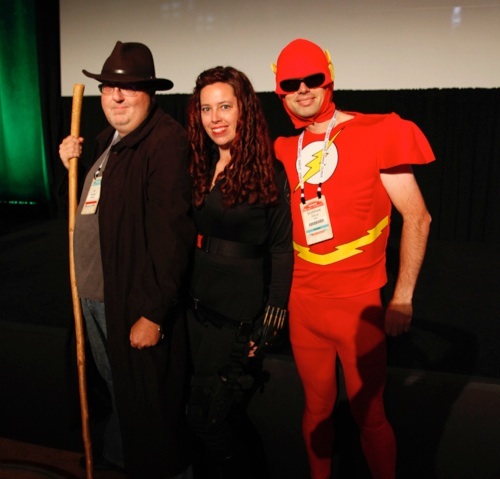
A Reddit thread posted earlier this week posed the question, “What if Linux distros were super heroes?” Would Ubuntu be Superman? We’ll leave it to the Redditors to debate that one. But we can weigh in on the question “Which super hero would Linux community be?”
The developers, system administrators, architects, business managers, and community leaders who attended LinuxCon and CloudOpen North America this week are all Linux super heroes. But this year some attendees also decided to dress the part – mingling in the hallway track and attending sessions as their favorite hero as part of the event’s first ever Comic Book Hero Day and costume contest.
Attendees were invited to bring their costume from home or rent one from the store available onsite and wear them throughout the day on Thursday. At the end of the day, a panel of three judges chose the “most original,” “most humorous” and “best costume.” Each winner received a one-day pass to Chicago Comic Con, taking place August 21-24 at the Donald E. Stephens Convention Center. The following winners were announced at the Booth Crawl Thursday evening: Brian Proffitt, Red Hat, as Harry Dresden; Ruth Suehle, Red Hat as the Black Widow; and Matthew Wilcox, Intel as the Flash.
Watch the video, below, to catch a glimpse of these and other Linux heroes in action.
Patty Hatter. CIO of McAfee, explains the need to evolve and shift relationship with other parts of the company. She offers practical and important advice for anyone working in IT.
Leaders from open source companies around the globe are getting involved in the ALS ice bucket challenge. The campaign has gone viral and has raised over $31.5 million dollars. My research led me to BlackDuck Software CEO and CFO who challenged their company to take get involved. They willingly did, then, BlackDuck nominated Acquia, Red Hat, and the Linux Foundation to step up to the plate.
In today’s Linux news Jack Wallen review Elementary OS and says it’s not just the poor man’s Apple. Jack Germain reviewed SparkyLinux GameOver yesterday and said it’s a win-win. Linux Tycoon Bryan Lunduke testdrives Ubuntu’s Unity today in the latest entry in his desktop-a-week series. And finally tonight, just what the heck is this Docker thing everybody keeps talking about?
Jack Wallen today reviewed the latest beta of upcoming Elementary Freya. He sounded quite impressed. He said it was “something new and fresh” and “not only easy on the eye, but easy to use.” And it’s fast, “very fast.” The praise continues and Wallen concludes, “I believe [Elementary OS] has the potential to overtake all other Linux distributions as the leader in user-friendliness.” See the full review at TechRepublic.com.

 A Reddit thread posted earlier this week posed the question, “
 In today’s Linux news Jack Wallen review Elementary OS and says it’s not just the poor man’s Apple. Jack Germain reviewed SparkyLinux GameOver yesterday and said it’s a win-win. Linux Tycoon Bryan Lunduke testdrives Ubuntu’s Unity today in the latest entry in his desktop-a-week series. And finally tonight, just what the heck is this Docker thing everybody keeps talking about?