Home Blog Page 1385

VMware’s Cloud Hybrid Now Works with Ubuntu Images, OpenStack

For many IT administrators, the worlds of virtualization and cloud computing have converged. Lots of them want to take advantage ofcloud platforms like OpenStack. However, they  don’t want to completely do away with infrastructure like VMware they’ve already invested in.

Now, Canonical and VMware have sought to address this issue with OpenStack-ready Ubuntu images available on VMware’s enterprise-grade vCloud Hybrid Service. VMware has also rebranded its vCloud Hybrid Service to VMware vCloud Air.


Read more at Ostatic

LinuxCon: What’s Going On With Fedora.Next

For those curious about what’s going on with “Fedora.Next” in revolutionizing the Fedora Linux distribution, Matthew Miller — Fedora’s new Project Leader — is presenting at LinuxCon Chicago today covering the ongoing working for the Red Hat sponsored distribution…

Read more at Phoronix

Local Motors: Cars Should be Open Source Hardware

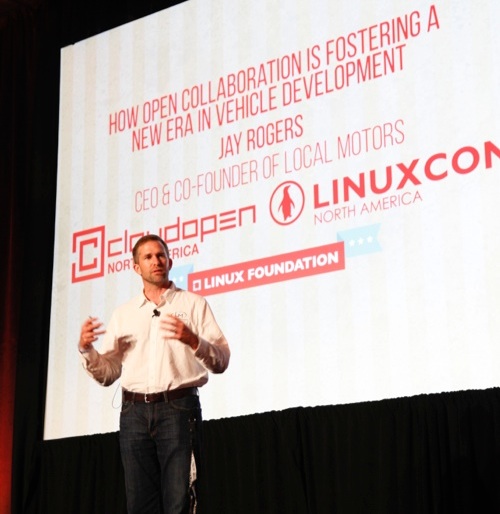
Jay Rogers Local MotorsThough Local Motors was the first car company to produce an open source vehicle, Founder Jay Rogers says it is not an open source car company. It’s a hardware company.

Traditional car companies have long product cycles, intricate assembly processes, and high production and distribution costs. Local Motors’ approach is instead akin to a software or microelectronics company that’s iterative, fast and lower cost.

“We can develop a hardware system that’s commonly known as a vehicle five times faster and with 100 times less capital put into it,” Rogers said in his keynote Wednesday afternoon at LinuxCon and CloudOpen in Chicago.

To accomplish this, the company is re-imagining every aspect of a car’s design and construction, using Internet-age practices familiar now to the software industry but that are entirely new to the car industry, including crowdsourcing, collaboration, and open source design.

Their cars are designed by individuals – designers, engineers and enthusiasts, and fabricators – who collaborate and iterate on their open source schematics online and in their garages. The cars are then made locally in their “microfactories” in direct response to demand from commercially accessible, hand-welded or 3D-printed parts. And they’re sold online and through a new chain of Local Motors retail stores.

“Our microfactories can’t take on Deerborn or Toyota City in making things but what they do is much more important,” Rogers said. Instead of focusing on large volume production, Local Motors can meet immediate consumer demand, “by bringing down the minimum efficient scale of what can make profit on a build floor,” he said.

Open source design is key to their design-build process, he said, because it allows for transparency into what works and what doesn’t work, which in turn speeds production.

“I’m going to call out Tesla on this, as much as I love them, they didn’t open source the car company. There’s no way that you get inside the Model S,” Rogers said. “And therefore there’s no way for you to learn how to make a car better. That’s what’s important in creation of a vehicle.”

There are several open source initiatives already underway to enable open source software in cars, including the Linux Foundation’s Automotive Grade Linux group. But so far those projects have been mostly focused on the in-vehicle infotainment centers, which provide the user interface for the car and its entertainment system but not to the car’s internal systems. That’s not enough to fully transform the industry, Rogers said.

“You need to know how to hack the hardware in the car, because that’s what defines how you can drive it and how you can run it.”

Beyond the monumental task of attempting to disrupt the automotive industry, Local Motors also faces many of the more mundane challenges familiar in the open source software world. Patent law inhibits sharing, he said. Figuring out how to better enable the community to collaborate on hardware is also a challenge, as is the culture of Silicon Valley which “doesn’t understand hardware,” he said. Despite these obstacles, Local Motors is aiming high.

“We’re going to change the vehicle industry,” he said, “and for the better.”

https://www.youtube.com/watch?v=GjuIM8xzYL4?list=UUfX55Sx5hEFjoC3cNs6mCUQ” frameborder=”0

Canonical Joined The Khronos Group To Help Mir/Wayland Drivers

Canonical, the company behind Ubuntu Linux, has joined the Khronos Group to help push open, cross-platform, industry-standard APIs…

Read more at Phoronix

15 Practical Examples of ‘echo’ Command in Linux

echo is one of the most commonly and widely used built-in command for Linux bash and C shells, that typically used in scripting language and batch files to display a line of text/string on standard output or a file. The syntax for echo is: echo [option(s)] [string(s)] 1. Input a line of text and…

[[ This is a content summary only. Visit my website for full links, other content, and more! [[

 
Read more at TecMint

Linux emergency booting mode and init=/bin/sh

  • Acceder a grub, desplazarse a la línea del kernel que se quiere arrancar. Pulsar “a” (append). Añadir “init=/bin/sh”
  • Cambiar ro por rw, para evitar tener que remontar después /

kernel […] rw root=/dev/mapper/VolGroup-lv_root […] rd_LVM_LV=VolGroup/lv_root rd_NO_DM rhgb quiet init=/bin/sh

  • Pulsar INTRO para que arranque el sistema con el kernel que hemos modificado las opciones.
  • Una vez accedemos al sistema (y tenemos / en modo rw), arrancar el demonio udev:

sh-4.1# /sbin/udevd -d

  • Activar los LV’s del VG que queremos:

sh-4.1# lvchange -ay system_vg

  • Para reiniciar la máquina, ejecutar:

echo b > /proc/sysrq-trigger

Video: Everybody Do the Zombie Shuffle and More Linux Trivia

What is a zombie shuffling desk? What does the d in systemd stand for? Test your knowledge of these Linux trivia questions and watch your fellow Linux community members, including kernel developer and Linux Foundation Fellow Greg Kroah-Hartman, attempt to answer in our annual LinuxCon and CloudOpen Live Linux Trivia video. This year the video opened the conference, playing to the live audience before the morning keynote sessions.  (See more morning keynote coverage in our Top 10 quotes from the Linux kernel developer panel.)

https://www.youtube.com/watch?v=-tpVKK-mpmg” frameborder=”0

 Want more trivia? Check out our Linux trivia video from LinuxCon and CloudOpen New Orleans, 2013. https://www.youtube.com/watch?v=eHfymaDHryw

Thanks For Making Games Faster: Top 10 Quotes from the Linux Kernel Developer Panel

kernel-panel

Linux gamers owe a debt of gratitude to kernel developer Andy Lutomirski for his recent work getting 32-bit programs to run faster on a 64-bit kernel, said Greg Kroah-Hartman during the Linux kernel panel today at LinuxCon and CloudOpen North America.

“A lot of people thought, who cares? It turned out Valve cares,” Kroah-Hartman, a Linux kernel developer and Linux Foundation Fellow, said. All of their games are still 32-bit applications but Valve wanted them to run on the 64-bit architecture, he said.

“You just sped up all the gamers,” Kroah-Hartman said on stage to enthusiastic applause. “You made their machines run faster without realizing it. Thank you.”

“You’re welcome,” said Lutomirski, a relative newcomer to kernel development.

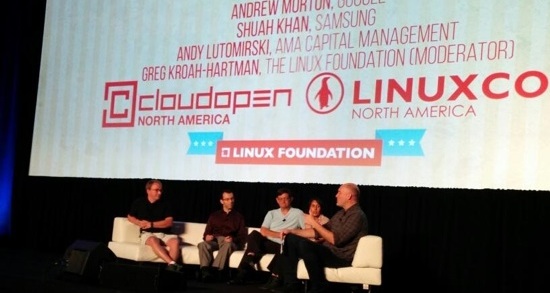
Kroah-Hartman, who moderated the panel discussion, was joined on stage by Linux Creator Linus Torvalds as well as kernel developers Andrew Morton from Google, Shuah Khan from Samsung, and Lutomirski, a co-founder of AMA Capital Management. Their discussion covered a range of topics from the top challenges facing the kernel community, to the toughest bugs they’ve fixed and everything in between. Here are some of the highlights of the discussion, below. The full session is available below and on the Linux Foundation YouTube channel.

10 Quotes from the Linux Kernel Developer Panel

1. “I downloaded the 2.2 kernel only to discover that Alan Cox had marked my network driver obsolete. So I decided to make it unobsolete which involved about a 2,000-line patch and 5,000-line changelog.” – Andrew Morton on his first patch.

2. “We had the Kernel Summit over the past few days and it seemed pretty boring. We weren’t arguing anymore… (Disagreement from the panelists.) Wait, we were?” – Greg KH.

3. Greg KH : “Containers are not secure natively, you have to use namespaces, yet we keep finding bugs in (namespaces). Are they ready to use?” 

Lutomirski: “It’s a tradeoff. If they’re off you have a security problem. If they’re on you may also have a security problem. At least the rate of severe bugs seems to be decreasing over time so that’s reassuring.”

4. “We’re trying to extend our interfaces to the point that you can safely run code that you traditionally absolutely could not as root.” – Linus Torvalds, on namespaces and container security.

5. “I’m too old to fix bugs nowadays. My first response is, who can I manipulate into fixing this?” – Andrew Morton.

6. “I’d love for Linux to shrink again… We’ve clearly been bloating up the kernel a lot over the past 20 years…. It’s a problem if we want to push the envelope into embedded devices, in particular.” – Linus Torvalds.

7. “Lots of ARM stuff is coming in, so for the next few years that will be a challenge. A lot of people will want to leverage drivers built on ACPI and use them in the ARM space.” -Shuah Khan.

8. “Projects like Raspberry Pi were actually great at seeding random people with hardware… and very few of those will necessarily decide to do kernel development, but if you seed the world a small percentage is still a lot of people.” – Linus Torvalds.

9. “I’ve had a patch rejected because it’s overly complicated… the x86 maintainers have been amazing about this… It makes the development take a little bit longer in the short term… but it’s much more effective as a long term strategy.” – Andy Lutomirski.

10. GregKH: “We’re running really well. We’re running everywhere. Where are we going next? We’ve conquered pretty much every major industry.”

Linus Torvalds: “I still want that desktop.”

https://www.youtube.com/watch?v=8myENKt8bD0″ frameborder=”0

LinuxCon NA 2014 Kicks Off in Chicago, New Linux Certification Program Announced

“The demand for Linux skill has been far outpaced by the demand of Linux. 90% managers says its hard to find qualified Linux pro’s and the Linux Foundation has multiple efforts to help increase the supply of Linux talent,” said Jim Zemlin, executive director at The Linux Foundation, during the keynote at LinuxCon North America 2014.

To address this problem The Linux Foundation has announced a new certification program at LinuxCon NA 2014. The program is for both early-career and engineer-level systems administrators.

The foundation is giving away way nearly 1,000 free exams today to attendees at LinuxCon and CloudOpen and is offering exams to the next 500 people for a special introductory price of $50.

Read more at Muktware

The Top Open Source Cloud Projects of 2014

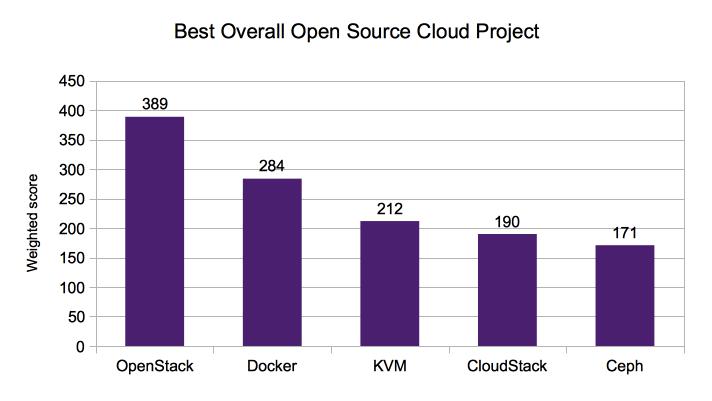
Best overall open source cloud project chartOpenStack is the most popular open source cloud project, followed by Docker and KVM, according to a survey of more than 550 respondents conducted by Linux.com and The New Stack and announced today at CloudOpen in Chicago.

The results reflect the rising popularity of a new generation of open source projects that for the most part are less than five years old and aimed at meeting the growing enterprise demand for cloud computing infrastructure. In turn, these young projects are showing favor but the strength of the more solid technologies have a certain degree of longevity that is also reflected in the results.

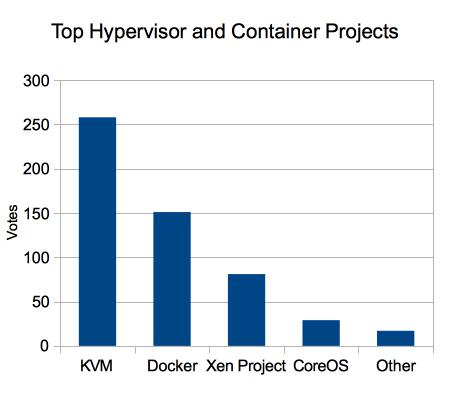
The survey, conducted on SurveyMonkey over a two-week period in July, asked respondents to choose the best top hypervisor or container project chartopen source cloud project in five different categories, which included the following:
  • Hypervisor/Container
  • Infrastructre as a Service
  • Platform as a Service
  • Configuration and Management Tools
  • Storage.

Respondents were also asked to provide what they viewed as the first, second and third best open source projects overall. A weighted score was reached by the following formula to determine the top projects:

Number of first choice votes x3

+ Number of second choice votes x2
Best open source PaaS chart+ Number of third choice votes

= Total score.

OpenStack was the most popular choice with 389 points (72 first, 68 second, and 37 third choice votes). Docker received 284 total weighted points, making it second best overall. KVM  had 212 points, making it the third most popular open source project. (See the chart, above, for the top 5.)

OpenStack had the most contributors weighing in on the survey and has been growing quickly. Fewer respondents said they contribute to Docker but it’s the project everyone said they want to contribute to more. They’re hot. The totals show the strength of such newer projects. OpenStack is the open source cloud software project started four years ago. Docker is less than two years old but has already established itself as one of the fastest growing open source projects of all time.

Top Projects by Category

In the hypervisor category, KVM received 48 percent of the vote, followed by Docker with 28 percent. It is interesting to note that Docker was chosen by more respondents than Xen, which received 15 percent of the vote.  Xen is an established hypervisor used in some of the world’s largest and most sophisticated cloud services. Docker, in contrast, is less than two years old but has seemed to carry enough influence to make it one of the most important open source projects of the past 20 years.
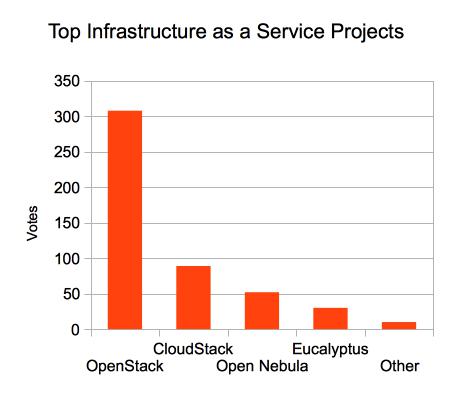
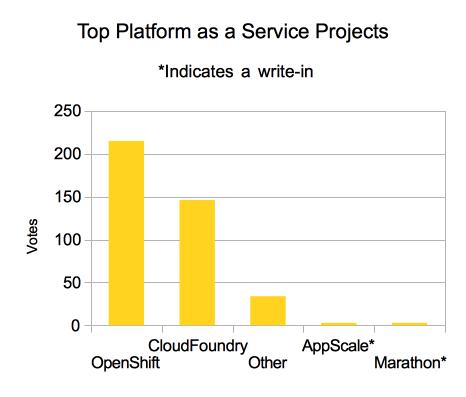
IaaS chartOpenStack was the clear favorite among IaaS platforms with 63 percent of the vote, followed by Apache CloudStack with 18 percent. Among PaaS platforms, OpenShift was the clear winner with about 54 percent of respondents choosing it over CloudFoundry which had about 36 percent of the vote.

Respondents were also given an option to list their platform of choice not listed under ‘other’ category. Among IaaS platforms, there were a handful of platforms different from the four choices provided (OpenStack, CloudStack, OpenNebula & Eucalyptus), making up about 2 percent among total responses.  Among PaaS platforms, write-in alternatives to OpenShift and Cloud Foundry made up to 10 percent of responses, though not all were open source projects. For example, Marathon and AppScale were two write-ins listed multiple times. Heroku was also commonly mentioned but it’s not open source.

Both OpenShift and Cloud Foundry reflect the market’s immaturity. Developers are starting to use PaaS these two offerings are dominated by large enterprise companies.  The real change may come with a new breed of PaaS providers that are using Docker, namely, they’re open source and designed to let users run their own PaaS.

This indicates a still-early stage of PaaS platforms, with clear indication towards the dominant two platforms.  

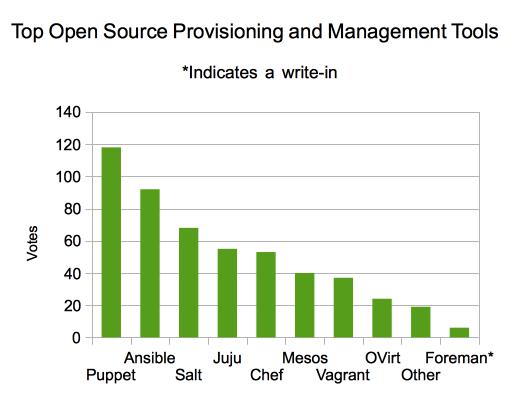
Puppet had 23 percent of the vote and was rated the most popular provisioning/ management tool, followed by Ansible with 18 percent. Salt Stack received 13.3 percent of the votes cast and JuJu squeaked past Chef with 10.7 percent compared to Chef with 10.4 percent. Ansible and Salt Stack’s strong showing illustrate the demand for a higher level of automation in cloud scale environments, compared to the more traditional configuration management provisioning and management chartsystems.
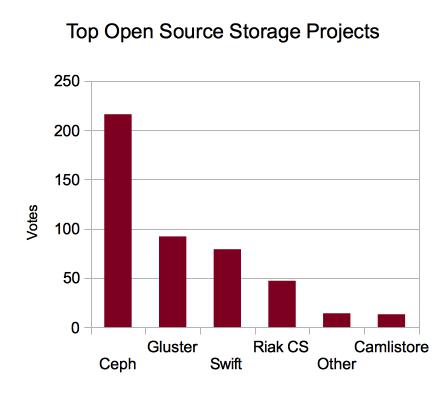
Ceph lead the storage category with 49.6 percent of the vote. Gluster came in second with 20 percent and Swift had 17 percent of the vote cast. Riak CS from Basho had 10.2 percent of the vote

Deciding Factors, Challenges

Unsurprisingly, the quality of the community and openness were rated the most important deciding factors in choosing the open source projects for each category. Each of these factors received 55.3 percent of the vote. Performance with 51.6 percent and security with 50 percent were rated as the next most important factors. Flexibility had 49 percent, relevancy, 45 percent and maturity of a project played a factor in 43 percent of the vote, while size of the code base received 36 percent, reflecting the desire not just for trust but for richness of the project, too.

Interestingly, 27 percent of the respondents said they do not contribute to open cloud projects, which may reflect the fact that most participants in these projects represent their companies as a voting block. They represent a powerful part of the open source community but are smaller overall in terms of the total number of participants.

Among the respondents, OpenStack had the most contributors, with 17.2 percent of respondents saying they contribute, followed by CloudStack with 12 percent of respondents contributing. OpenStack also saw the most use, with 13 percent of respondents choosing it as the project they work with the most, followed by CloudStack (11.5 percent), KVM (10.5 storage project chart percent) and OpenShift (7.3 percent).
Approximately 47 percent of the voters cited poor documentation as the biggest challenge contributors face while deploying the projects they use the most. In second, 38.8 percent of the voters said complex installation steps posed the biggest challenge, followed by difficult configuration management with 22.7 percent of the vote.

Github is the most popular development platform, with about 67 percent  of respondents using it. Text editors are still a rage, with 60 percent of respondents making use of them, while only about 32 percent using full-fledged development platforms. A sad 3 percent of respondents don’t use any source control mechanism at all!

Docker is the open source project that most respondents said they would like to contribute to, with 21 percent responding so indicating the popularity of the Docker open source project. Among the contributors, about 42.5 percent were independent contributors.

Survey results illustrate that OpenStack and Docker are clear winners of mindshare among open source cloud projects. They also emphasize the need for correct and valid documentation, along with easier deployment options. Finally, they also show a non-trivial percentage of independent contributors making an impact.  

OpenStack and Docker will continue to dominate the open source cloud discussion. But Docker may prove to gain the most as it is also breeding a diverse ecosystem of open source projects. OpenStack is primarily contained (no pun intended) to the development of its own cloud operating system. It does integrate with OpenShift, for example, but for the most part the different groups within OpenStack do the lion’s share of development. Docker’s influence is such that it is affecting the overall open source community. The projects that are closely tied to Docker, such as Ansible, will continue to grow as developers seek tools to use with the fast growing container technology.