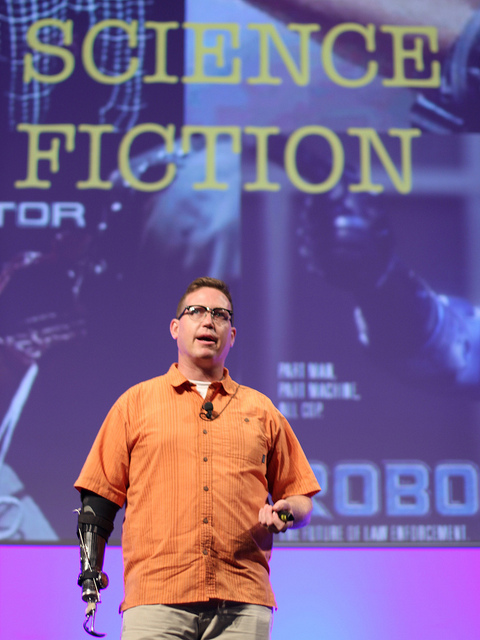
 Before he lost his arm serving as a Marine in Iraq in 2005, Jonathan Kuniholm was pursuing a PhD in biomedical engineering. Now as a founder and president of the Open Prosthetics Project Kuniholm is working to make advanced, inexpensive prosthetics available to amputees around the globe through the creation and sharing of open source hardware designs.
In a keynote talk at LinuxCon and CloudOpen North America this month in Chicago, Kuniholm will discuss how the health care industry and the Linux and open source communities can work together to improve medical devices that are otherwise too specialized or expensive to develop. Here he discusses the current state of his initiative, the role of collaborative development in innovation, and how the Linux community can contribute to the Open Prosthetics Project.
Linux.com: How are open source and collaborative methods being applied to prosthetics?
Jonathan Kuniholm: In short, they aren’t, at least in the way that they are to large and successful software projects.
I’ll explain. We have a fledgling effort on openprosthetics.org, and our openprosthetics.ning.com site has been pretty successful as a patient community, but the majority of our and others’ efforts that have used open source suffer from the same problem that many such projects have: They have failed to attract a real community of user-contributors and seem to begin and end with the initial posting. An example would be all of the press over the last two years on 3D-printed prostheses. Most of the projects that have been written about in the media aren’t even actually available for download, and if they are, they’re not able to withstand further scrutiny. Someone needs to write a peer-reviewed article testing some of these designs.
That said, we do have a functioning open hardware/software project, the Myopen, which is used by two neural research labs, has recent commits and some wider interest. Because of the expense and complexity of the hardware, we are not aware of any independent builds of the hardware.
What are some of the other challenges facing your project?
One issue is the truly confusing state of licensing and IP protection for open source hardware. Essentially every effort to brand and create licenses for open source hardware has ignored the legal realities of the problem, and has relied on requirements that are unenforceable or have no legal basis. A great example is the MakerBot, which has gone closed and been acquired by the major player in the industry, without even resulting in limited contributions to the design as with OSX/BSD.
A second, and perhaps the most important issue is that open source cannot necessarily create market pressure where there isn’t any. While the approach does give users a chance to “scratch their own itch,” it’s no surprise that open development would suffer from the same or even greater scarcity of resources than traditional commercial development, which has been scant in prosthetic arms.
An obvious solution to this problem is for government, which has recently been the only game in town as far as prosthetic arm research funding, to look to open source and architecture to increase the impact of the spending they are already doing. While it represents a nearly insignificant portion of the spending over the last decade, an in-progress project that I helped envision is attempting such an approach and I’m hopeful that we’ll see an impact soon.
Why is open collaboration a good model for designing new prosthetics, and for the health care industry in general?
It’s clear that open source is a very good, if sometimes messy way, to progress further in development, taking advantage of as many of the best ideas along the way, even if it may take longer sometimes to reach maturity.
How is the Open Prosthetics project involved?
We serve mainly as a location on the Internet to discuss the issues, and a matchmaker for interested individuals. All of this has been done so far with pretty unsuitable tools, something we’re looking to change.
How did you personally become involved in this effort?
The OPP was the brainchild of my partners at my now defunct design firm, following my injury in Iraq. They noticed before I did what a sad state upper limb prosthetics were in, realized that we were unlikely to get rich solving this problem (they were right) and that we had nothing to lose by trying to share ideas in a way new to the industry. I’ve kept at it.
How can the Linux community contribute?
I’d love to see more folks interested in helping rewrite our software on the Myopen project to free us from Matlab. If we could get over the “activation energy” barrier that currently requires academic or other access to something like $20,000 of toolboxes to run by creating a prototyping environment (say in Java), I think that we’d see more widespread use of the software in labs, and potentially even commercially. Unfortunately, because there is hardware involved, we need folks willing to both spend on and engage with the hardware in order to get us over the other barrier, which is dev kit access to the hardware, which currently doesn’t exist. I’d be interested in talking to anyone who might be able to help attack either problem.
Another thing perhaps even more appropriate to this community might be to help us improve the tools that we have available to collaborate and organize people and information about this niche area of interest. I’ll be posting before the conference a spec document that I’ve prepared for some funded web development that we hope will update OPP’s web presence for the first time since we created the project.
Can you give us a short preview of your LinuxCon keynote, what will you discuss?
I’ll start by making the case for Public Interest Design in support of orphan medical communities like prosthetic arms. Despite calls to action from many sides, meaningful and well-funded efforts at design in the public interest remain much more rare than they should be. Even those funded by foundations justifiably focus on the most pressing utilitarian goals: clean water, sanitation, and preventable and widespread disease.
But significant problems for insignificant numbers of people remain. “Medical orphans” have been targets for policy encouraging drug development, with limited success. Where those who suffer from rare medical conditions are orphaned for want of a medical device, we have yet to see a policy solution. I will outline a few ways that governments, corporations and individuals might help to create an environment where solutions to such problems might be more likely, or even inevitable, through a spectrum of measures of varying degrees of difficulty. I invite you to help me add to this list.
I want to focus on the things that members of the Linux community might do to help. Specifically, we could use help with our web redesign, a complex and deep integration of the VIVO semantic ontology and social networking tools into a single URL community at openprosthetics.org, and through software and hardware development on the Myopen project.
I’m looking forward to meeting you all.

