
Over at Model View Culture, Adam Saunders interviews Karen Sandler, executive director of the Software Freedom Conservancy (SFC) and formerly the executive director of the GNOME Foundation. Sandler talks about SFC, the Outreach Program for Women, as well as being a cyborg: “I was diagnosed with a heart condition and needed a pacemaker/defibrillator, and none of the device manufacturers would let me see the source code that was to be literally sewn into my body and connected to my heart. My life relies on the proper functioning of software every day, and I have no confidence that it will. The FDA generally doesn’t review the source code of medical devices nor can the public. But multiple researchers have shown that these devices can be maliciously hacked, with fatal consequences. Once you start considering medical devices, you quickly start to realize that it’s all kinds of software that is life and society-critical – cars, voting machines, stock markets… It’s essential that our software be safe, and the only way we can realistically expect that to be the case over time is by ensuring that our software is free and open. If there’s catastrophic failure at Medtronic (the makers of my defibrillator), for example, I wouldn’t be able to fix a bug in my own medical device.“
Chromebooks Emerge as Major New Linux Force on Notebooks
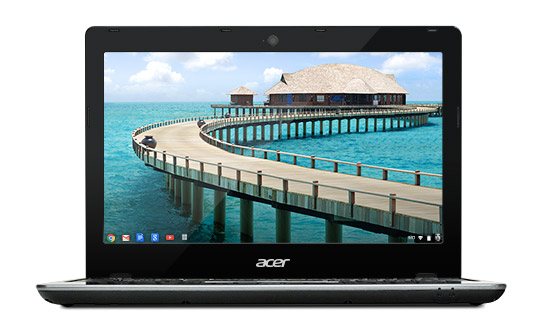 The Linux faithful have mixed opinions on the success of Google’s Linux- and Chrome browser based Chrome OS. The lightweight OS came along years after Fedora, Ubuntu and other Linux distros, and shares relatively little of their mainstream Linux codebase. Some dismiss it as a limited, browser-only platform — a complaint often applied to Firefox OS — while others warn that Google is co-opting and subjugating Linux, a process already begun with Android.
In the other camp are Chrome OS boosters like long-time Linux chronicler Stephen J. Vaughan-Nichols of ZDNet, who welcomes more open source competition for Windows, no matter what the source. All in all, though, watching Chrome OS surpass Ubuntu and the gang in market share is kind of like watching your kid brother win the trophy you always dreamed of.
Love it, loathe it, or laugh at it, Chrome OS keeps on advancing. According to a Google blog post this week, more than 1 million Chromebooks were sold to schools in the second quarter alone. A July 14 study from research firm NPD Group estimates that Chromebook sales within the U.S. Commercial Channel increased 250 percent year-over-year, representing 35 percent of all channel notebooks sales. For the three weeks ending June 7, the figure moved to 40 percent, says NPD.
Chromebook profits are also spreading to more companies. Acer, which sells the only $199 Chromebook, the C720, has jumped from 7 percent to 31 percent of total Chromebook and Chromebox sales from May 2013 to May 2014, estimates NPD, while Samsung has dropped from 88 percent to 48 percent. Meanwhile, Dell halted sales of its education-oriented Chromebook 11 after it quickly sold out.
Is all this enough to threaten Windows? Microsoft seems to think so. Earlier this month, the software firm said it was working with partners like HP to develop a new line of low-cost Windows-based laptops for the holiday season, starting with a $199 HP Stream model. Showing its concern about the Chromebook invasion, Microsoft even posted a Windows-friendly comparison chart between Windows notebooks and Chromebooks, pointing to the limited printing and gaming support in Chrome OS, and lack of extras like Skype and Microsoft Office. Yet, Google has had success arguing other merits, including low price, ease of learning, low maintenance, and the real Windows killer: better security.
The global market share for the entire desktop PC segment is less clear, especially as research firms have taken to including mobile devices in their breakdowns of computing devices by OS. NetMarketShare still places Linux at only about 1.6 percent of desktop market share in 2014, only slightly better than years past. However, Linux users have long claimed the NetMarketShare tally has underrepresented Linux, even before the Chromebook arrived.
Microsoft wakes up and smells the Chrome
NPD, which noted an overall rebound in the sluggish PC market this year, predicts that Chromebooks will soon face greater competition. “The next test for Chrome will clearly be the most difficult, as both Apple and Microsoft get more aggressive in pricing and deal making over the next few months,” stated NPD Group VP Stephen Baker.
We’ve seen this movie before. Back in 2008 and 2009, Linux briefly represented about 20 to 30 percent of the market for low-cost, small-screen “netbook” notebooks. But then Microsoft finally took the threat seriously, and cut its prices on Windows XP. It also exerted pressures on vendors and retailers and spun some good old-fashioned FUD to crush it.
Microsoft may well slow the Chromebook invasion, but it’s not likely to kill it. Five years later, Microsoft has less clout over PC manufacturers, and consumers are faced with far more computing choices, including a variety of phones, phablets, tablets, smart TVs and other devices . Relatively few of these run Windows. Also, Linux netbooks lacked a clear competitor of the kind Redmond always faced with Apple’s Mac. Intel came closest to being a champion, as it pushed the Moblin and Meego Linux platforms for netbooks while also encouraging Windows netbooks. But Intel was still a close ally to Microsoft, and didn’t care what OS the netbooks were running as long as they ran on Atom processors.
As Chromebooks emerge as a major new Linux force on notebooks, the platform has made another baby step toward touchscreen laptops, convertibles, and tablets. On July 21, Google announced a new stable channel update for Chrome OS that includes pinch to zoom support and a touch-ready window manager. The first touch-enabled Chromebook was Google’s own Chromebook Pixel, which starts at $1,299, but the improved touch support suggests a more competitively priced model may appear before the holidays.
SAP Stamps Cloud Foundry and OpenStack with Meaningful Endorsements
 SAP may not be on every individual user’s radar, but the company is a giant global force in running enterrprise back-end systems, new forays into the cloud and other new platforms, and managing enterprise class applications. Now, SAP has announced that it is committing to Cloud Foundry and OpenStack, providing a clear path forward for an open cloud ecosystem.
The company will become a sponsor of Cloud Foundry, a leading open platform-as-a-service (PaaS), and the OpenStack Foundation, which helps deliver OpenStack.