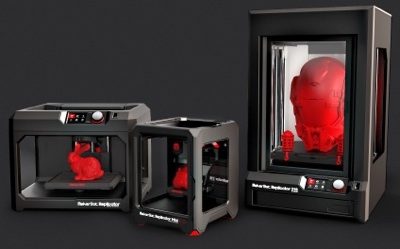
Earlier this month, Home Depot began selling MakerBot’s Linux-based 3D printers in a handful of stores across the U.S. after a 3-month trial run online. The big box pilot is not only testing consumer appetite for 3D printing hardware, but also the viability of open source design among a general population of consumers.
Together with the Replicator printers’ relatively small size and price tag, MakerBot’s design software and online Thingiverse community lower the barrier to creation and sharing for thousands of professionals and hobbyists alike. As a result, the MakerBot open source design community has quickly grown – though not without some difficulties.
In May, MakerBot faced accusations that it had patented open source printing improvements created by its own community. The controversy has since died down and MakerBot looks back on it as a lesson for any growing open source-based startup.
“I think the most important lesson from recent events is that it is critical to keep an open dialogue with all our customers as well as the 3d printing community writ large, and be prepared to honestly address concerns on both sides of the fence,” said Anthony Moschella, vice president of product at Makerbot, via email.
Moschella will present a keynote talk on “Innovation in a 3D Printing Community” at LinuxCon and CloudOpen North America, Aug. 20-22 in Chicago. Here he discusses how MakerBot uses Linux, how it enables innovation, their takeaways from the patent controversy, and the role of the community in growth and innovation.
Linux.com: How does Makerbot use Linux and open source?
Anthony Moschella: Our new 5th generation Replicator products all use embedded Linux (mainline Linux 3.8, to be exact.) Embedded Linux was a powerful force multiplier in our development cycle. It let us build a very feature-rich product and bring it to market quickly. We leveraged a ton of open source tools to prototype and iterate on our development system far quicker than we could if we were developing strictly in C. Also, most importantly, running Linux on our devices allows us to iterate in the field and add functionality for customers as our ecosystem evolves.
Why does the open source model work for 3D printing?
Users of 3d printers tend to be creative explorers. The applications are almost limitless, and MakerBot users are engineers, architects, industrial designers, hackers, teachers, students and hobbyists. The nature of 3D printing encourages a “sharing” culture. It’s native to the basic idea of 3d printing: the power to create on your desk, free of constraints. So we try to create tools to encourage people to do just that: create without limits, and then ideally, share their creations. Our web portal Thingiverse.com has hundreds of thousands of 3d printable models that free under creative commons to be used, printed, shared and remixed.
What are some of the benefits and pitfalls of the open source model?
The benefits are clear: the collaborative sharing nature leads to innovation and faster development. An active and engaged community of users is a powerful support network for architects and developers. The pitfalls are that openness can lead to buggy drivers, IP issues, and occasional scalability challenges.
What has been your take-away lesson from the recent outcry over a Makerbot patent application?
This has been a continuing challenge for us throughout MakerBot’s history. As we’ve grown from a five-person operation of hobbyists and enthusiasts to a 550-person consumer product company with a global footprint, our role in the 3d printing community has changed. Its impossible to keep the hard core hobbyists and hackers happy as we work to make 3d printing accessible to everyone.
The LinuxCon audience is no doubt acutely aware of the challenges of growing hardware startups, open-sourced or not. I believe that open source and closed source can coexist peacefully, and that there is plenty of room in the marketplace (and mindspace for both). I think anyone who looks closely at the actual details will realize pretty quickly that MakerBot engineers are not and have never “stolen” or patented other people’s technology, nor have we ever tried to discourage innovation in the open-source 3d printing community. I think the most important lesson from recent events is that it is critical to keep an open dialogue with all our customers as well as the 3d printing community writ large, and be prepared to honestly address concerns on both sides of the fence.
Can you give us a short preview of your LinuxCon keynote, what will you discuss?
I’m going to talk about how Linux is a powerful development tool, and how critical embedded Linux has become in bringing fast-cycle consumer products to market! Also, I will talk a little about the excitement and promise of 3d printing and what’s coming next.
Register now to attend LinuxCon and CloudOpen.

 The details were unclear back in late June, but it looked like Mozilla may have been playing some role in delivering a competitor to Google’s popular Chromecast dongle, with Mozilla’s based on the Firefox OS platform. The rumors abated shortly after they arose, but some people missed the fact that Mozilla confirmed the news in a recent blog post, noting the following: “Mozilla is working with Panasonic to develop next generation SmartTVs running Firefox OS, and Abitcool will launch an HDMI streaming device later this year that allows the user to fling content from compatible mobile or Web apps to an HDTV.”