
Home Blog Page 1427

The Linux Supercomputers We Secretly Fear Will Become Sentient

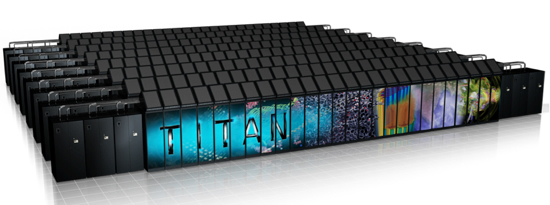
Titan-supercomputer

Every year, the Top 500 list of the world’s fastest supercomputers is released. A list filled with machines containing tens of thousands of nodes and capable of cranking out enough petaflops per second to make your head spin.

And, of course, this list is absolutely dominated by machines powered by Linux.

This is awesome. But, really, we all know this. Let’s dig a little deeper into these Goliath computers that will, someday, become sentient and rise up against their human creators.

Let’s start with the #2 ranked supercomputer – The Titan.

This Cray-built beast of a computer lives in Tennessee at the Oak Ridge National Laboratory and takes up 4,352 square feet. Which, for those of you who are curious, is roughly 6.8 times the size of my first apartment – and approximately infinity times larger than the kitchen in that apartment (give or take a foot).

Want to build this computer for yourself? No problem. It uses an off-the-shelf AMD Opteron 16 core, 2.2 GHz CPU. 35,040 of them. Which begs the question, what sort of actual performance do you get from more than 560,000 CPU cores? 17.5 million petaflops. That’s what you get.

So what does that actually mean? What can you do with 17.5 million petaflops that you can’t do with a fancy, quad core i7 desktop PC?

Well, for starters, it can run a particle simulator that can handle things way down at the quantum level (specifically the Large-scale Atomic/Molecular Massively Parallel Simulator, aka “LAMMPS”). OK. That’s cool I guess. Definitely produces some crazy–looking videos. But I just don’t run quantum level particle simulations all that often. I need to know how well this sucker runs Portal.

The AMD Phenom II (quad core), clocked at 3.40 GHz – a very respectable desktop CPU – can run Portal (at 1600×900) at roughly 59 frames per second. That particular CPU can crank out something in the ballpark of 39 gigaflops.

Now. Assuming the only factor that contributes to the frame-rate of a game is the number of Floating-point Operations Per Second (FLOPS) – that means that Portal, when running on the Titan, should be able to hit 26,474,358 frames per second.

“But, Bryan!” I hear you say. “They can’t possibly have a screen nice enough to showcase that sort of awesomeness!”

Au contraire, mon frère! Those crazy kids down in Tennessee have built EVEREST (the “Exploratory Visualization Environment for Research and Technology”) – which includes a 33-foot wide, 37 megapixel, stereoscopic 3D screen.

You know. For research. Wink, wink, nudge, nudge. Hold on a moment. I’m going to go let my wife know that I need a 60” 4K TV set. Because science and particles and stuff.

OK, let’s slam on the brakes and drop down the list a bit to the #21 ranking supercomputer in the world – NASA’s Pleiades.

Now, I say “slam on the brakes,” but this SGI-built, SUSE-powered beauty still manages to push through 1.5 petaflops like a hot knife through butter (we’re talking room temperature butter … not that stuff from the fridge that can’t be cut with a laser cannon and causes you to slaughter your poor, defenseless toast).

In other words, it probably runs Portal fairly well. But what, pray tell, is NASA using such a rig for?

To do amazing NASA space stuff. That’s what.

Bryan LundukeThe Pleiades is involved in the search for Earth-like planets (the Kepler Mission). For its role in that, most stellar, project the Pleiades receives high-resolution images of more than 200,000 stars. It then calculates the size and location of the planets orbiting those stars. It does this every half hour. No coffee break.

Every. Half. Hour. It takes me longer than that to drive to my closest Trader Joe’s.

To date, it has discovered 1,235 planets. Five of them possibly “Earth-like” (similar size and within a habitable orbit around their star). When it gets bored of being off-the-charts awesome, sometimes Pleiades likes to run simulations on the formation of the Milky Way Galaxy. You know, just to kinda … clear its head.

We’ve just talked (briefly) about two of the coolest computers on the planet. And there are 498 more on that mind-bending list. I’ll leave you with one final thought:

The total number of petaflops produced by all of the supercomputers on this list, combined, is roughly 274 – with roughly half of all the total speed being generated by the top 20 computers.

I’m sure there’s an allegory in there somewhere about class inequality and the French Revolution, but all I keep thinking about is the (obviously imminent) human-robot war.

Read more of Bryan Lunduke’s columns, here:

The Battle of the OpenStack Distros Begins (Bring Popcorn)

Why Linux Works for Government

Why Arguing That Windows is Better Than Linux Makes You Look Silly
The First openSUSE Asia Summit is Announced…

The first ever openSUSE Summit in Asia will take place in Beihang University, Beijing on October 18th and 19th, 2014. We aim to promote the use of openSUSE and other free open source software in the region. We will have a serious of talks, discussions and workshops that will induct non-regular and regular users into the openSUSE Project. The goals of the Summit is to provide a platform for everyone to use and understand openSUSE so that it becomes easier for them to contribute. It is also a great platform for Asian contributors and users who have been interacting online with each other face to face. Participants can also take this opportunity to learn about various technologies and also share their experience with others.


Read more at openSUSE News

Pick of the Bunch: Console Internet Applications

There are so many great console based internet applications that it would be impossible for a single article to cover them all. Instead, I have compiled this roundup of 9 console applications that I am always using. Why? Because they are, in many situations, superior replacements for their GUI equivalents. Here is a roundup of the 9 console applications that I use frequently.

<A HREF=”http://www.linuxlinks.com/article/2014071308032016/ConsoleInternetApps.html“>Read article</A>

LibreSSL Crypto Library Leaps From OpenBSD to Linux, OS X, More

First cross-platform version of cleaned-up OpenSSL fork

The OpenBSD project has released the first portable version of LibreSSL, the team’s OpenSSL fork – meaning it can be built for operating systems other than OpenBSD.…

Read more at The Register

Red Hat Pulls the Strings on Server Management with Satellite 6

Red Hat is now testing the latest iteration of its Satellite server management technology with a beta release of Satellite 6.

“Satellite 6.0 is far more than the next release of Satellite 5; Satellite 6.0 is a totally new generation of Systems Management from Red Hat,” David Caplan, principal product manager, Red Hat Satellite, told ServerWatch.

Read more at ServerWatch.

Home Depot’s Wink Home Automation Lineup Includes Lights, Thermostats

Wink aims to reach the masses through a partnership with Home Depot that will cover a range of home automation products.

Read more at eWeek

11 Ways LXLE Linux Will Make You Forget All About XP

Windows XP’s long run may have finally come to an end, but that doesn’t mean your XP-era hardware has to go too. No indeed: There are numerous options available in the Linux world, and one shining example is LXLE.

A brand-new LXLE 14.04 made its debut a few weeks ago, and it’s packed with new features while remaining lightweight and speedy. With an XP mode among several other desktop options, this zippy OS needs less than a minute to boot and get online. Don’t try that on your Windows machine.

Read more at PC World.

As Chef Gets Bigger, It’s Learning How to Appease Its Open Source Community

Chef, the open source configuration management company, found itself the recipient of a strongly worded blog posting last week by a former employee named Noah Kantrowitz, who claimed that Chef is not really acting like an open source company (at least according to Kantrowitz). While these debates over open source have been going on for years, Kantrowitz’s post and Chef’s subsequent response by its chief development officer Adam Jacob, highlighted the difficulties open source companies face when they start getting big.

Kantrowitz, who worked for Chef (then known as Opscode) as a lead web developer from 2011 through 2013, wrote that he has witnessed a shift in the way Chef has been operating over the years that led him to question whether or not the company is interested in maintaining its open source ideals. In an interview, Kantrowitz said that while his blog posting’s headline was “intentionally inflammatory†(the title was “Chef is not Open Sourceâ€), he wanted attention pointed to the fact that Chef’s community engagement is not what used to be when Chef was first getting off the ground.

Read more at GigaOM.

Join Us in Honoring IT Heroes for SysAdmin Day, Win Free Tickets to LinuxCon & CloudOpen

sysadminday2014 According to the 2014 Linux Jobs Report, SysAdmins are the highest in demand position among Linux professionals. Fifty-eight percent of hiring managers said this year they are most aggressively seeking Linux SysAdmins followed by Linux application developers at 45 percent.

There is no doubt that as Linux has grown to support the world’s most advanced technology infrastructure that we need more SysAdmins to support it. Also, the role of the SysAdmin is gaining in significance in every organization. Today SysAdmins contribute to important strategic discussions about their companies’ futures, and their work is very often a critical component in enabling organizational growth. SysAdmins are our IT heroes.

That’s why this year The Linux Foundation is honoring some of its very own SysAdmins in celebration of SysAdmin Day 2014 by profiling them here in Linux.com. So far in this series we’ve introduced Ryan Day and Andy Grimberg.

We also want to honor your SysAdmins. We want to hear about the amazing things they’re doing to support the infrastructure and projects your companies are working on. Or, tell us about  the time(s) they stepped in and solved a problem so big you thought you were pretty much toast.

Just email the Linux.com editors atThis e-mail address is being protected from spambots. You need JavaScript enabled to view it
about why your SysAdmin should be recognized. Submissions are due by SysAdmin Day, July 25. Two individuals will be chosen by the Linux.com editors to be profiled in the weeks following SysAdmin Day and both the submitters and the SysAdmins who are chosen will receive free tickets to LinuxCon and CloudOpen North America taking place in Chicago August 20-22, 2014.

Don’t let your hero go unrecognized!


Interoperability Key to Health Care IT Success

Two organizations said the government’s approach to health care IT provides regulators an opportunity to adapt its health IT certification program.

Read more at eWeek