
Cloud is illusory; there’s still hardware somewhere on the other side of the mist.
Read more at Enterprise Open Source Toolkit
Clement Lefebvre has announced the release of Linux Mint 17 “KDE” edition: “The team is proud to announce the release of Linux Mint 17 ‘Qiana’ KDE. Linux Mint 17 is a long-term support release which will be supported until 2019. It comes with updated software and it brings….
 If you mention OpenSSL to many people, the first thing that comes to mind is the notorious Heartbleed bug that surfaced in April and can possibly allow hackers to compromise encrypted systems and connections.
But OpenSSL is actually one of the most influential open source projects ever, and had a sterling reputation until its involvement in the Heartbleed debacle.
Now, Google is developing its own version of OpenSSL that will be especially relevant for its own platforms and applications. Welcome to BoringSSL.
Adam Langley, a Google software engineer, confirmed on his personal blog that in addition to creating BoringSSL, Google will contribute its changes to the OpenSSL open source community and leverage bug fixes from that team.
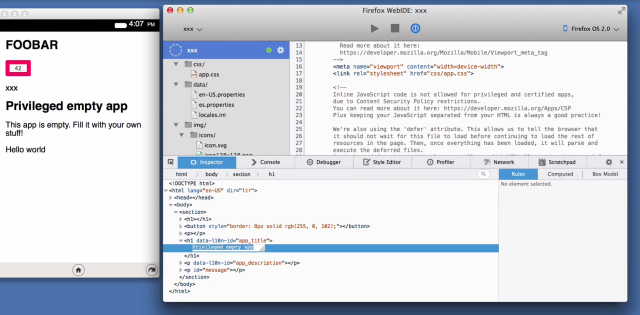
Browsers have long contained development tools to help debug and diagnose problems when authoring Web content, but Mozilla is taking Firefox to the next level. Nightly builds of the browser now contain a development environment, WebIDE, for creating, testing, and deploying Firefox OS apps.
With WebIDE, developers will be able to create new applications from scratch, package them for distribution, deploy them to both the Firefox OS simulator and real Firefox OS hardware, and remotely debug them—all from within the browser and without the use of additional tools.
 While the details are unclear at this point, it looks like Mozilla may have some role in delivering a competitor to Google’s popular Chromecast dongle, based on the Firefox OS platform. Several sites have been reporting that Mozilla has been secretly developing the streaming device in conjunction with a partner.
A Twitter post by a Mozilla developer evangelist helped fuel the headlines, but Recode and other sites are reporting that Mozilla is adamant that it is not working on the device directly, although a partner could be.
 In late 2010 and throughout 2011, however, we noticed a shift in the HPC market as new workloads such as digital media, various financial services applications, new life sciences applications, on-demand cloud computing services and analytics workloads made their way onto HPC servers. We are now seeing another new trend developing in the HPC space with the introduction of ultra-dense servers.