Home Blog Page 1457

Linode Unveils $10/Month Linux Cloud Hosting Plan with SSD Storage

In celebration of its 11th anniversary, cloud host Linode has slashed its prices. Users can now purchase hosting plans on Linux-powered servers with SSD storage starting at $10 per month.

The offering was made possible through a $45 million upgrade of Linode’s infrastructure back in April 2014, which brought SSD storage to the company’s servers, as well as Intel(INTC) Xeon E5 2680v2 Ivy Bridge processors, more RAM and higher network throughput.

Read more at The VAR Guy.

Best Practices Selecting an HPC Cluster

Wyoming Supercomputing CenterEverything from life sciences to the financial industry are relying on HPC clusters to perform complex and critical operations. Moving forward, there will be a lot more reliance on various HPC systems. So the all-important question comes in – How do you select, deploy and manage it all? Fortunately, IBM, Intel and NCAR have teamed up to explain their view on best practices selecting an HPC cluster using the process behind building the NCAR Wyoming Supercomputing Center.

 
Read more at insideHPC

GLAMOR Support Enabled Within Debian Experimental

As some good news for Debian users running a Radeon HD 7000 series or newer graphics card where the GLAMOR 2D acceleration support is required, GLAMOR support has been enabled within the Debian experimental repository…

Read more at Phoronix

Linux Terminal: the tee command

The command “tee” it’s one of the basic commands that you should find in any system, yet it’s not so popular or use, this command reads standard input and writes it to both standard output and one or more files, effectively duplicating its input. It is primarily used in conjunction with pipes and filters. The command is named after the T-splitter used in plumbing.

Read more at Linuxaria.

SCSI Multi-Queue Performance Appears Great For Linux 3.17

Building upon the major blk-mq work for the multi-queue block layer, the SCSI multi-queue code is now in good shape according to its developers, is delivering very promising performance results, and should be merged into the Linux 3.17 kernel cycle…

Read more at Phoronix

Inspired by Lego, Fuelled by Creativity: Linux-Based Kano Kit Wants to Get Kids Hacking Again

With the Raspberry Pi and its modular programming language at its heart, Kano is hoping to inspire kids to get involved with programming.

Fedora 21 Has Avoided A Delay For Now

Last week it looked like Fedora 21 might be delayed to allow more time for some ongoing work within the Fedora Server Working Group. Fortunately, a delay has been avoided for now…

Read more at Phoronix

My Recent Linux Journey

A journey from Windows through doubt, frustration and despair to relief and a finally joy. This journey started on 31 May 2014 the day after the release of Linux Mint 17 “Qiana” Cinnamon and finished on the 17 June 2014. I worked on this continually for 8 or more hours a day over this time can’t work at the moment so I had time on my side.

I was excited at the prospect of the new Mint 17 “Qiana” Cinnamon release I had been waiting for a while I was running Petra with Cinnamon for some time with limited success just minor crashes delays and freezes was busy then so I didn’t have the time to spend on it. I have been interested in Linux for some time and on another older PC some years ago ran with Mandrake and also SUSE.

My System

Mainboard Asus P6X58D Premium with 64 bit architecture

BIOS Version/Date American Megatrends Inc. 1501, 10/05/2011

Processor Intel(R) Core(TM) i7 CPU 950 @ 3.07GHz, 3068 Mhz, 4 Core(s), 8 Logical Processor(s)

Socket LGA 1366 with water cooling

Memory 32 G DDR 3 1600MHz Comprising 4x Corsair Vengeance Ver 2.12 1.50 v sticks

Power supply Sea sonic X series Model SS 750 KM Active PFC F3

Display NVIDIA GeForce GTX 560 Ti 1 GB DDR5

On windows 8 this card has diver issues with propriety drivers after the 314.22 desktop driver

Hard Drives Model Seagate ST31000528AS 1TB

Mounted as sda ( Partioned for different storage options movie’s Digital Photos etc) this is connected to a 3gb data port on the main drive

Model Western Digital WDC WD1002FAEX-00Y9A0 1TB

Mounted as sdb (this drive held my windows 8 operating system and was partioned to run linux behind it with Root Swap and home partions) the other factor with this drive was it is connected to a 6g Sata port on the mainboard

Model Western Digital WDC WD1002FAEX-00Y9A0 1TB

Mounted as sda ( Partioned for different storage options movie’s Digital Photos etc) the other factor with this drive was it is connected to a 6g Sata port on the mainboard

All of this is wrapped up in a nice Lain li allow modular type case. I use Logitech peripherals such as

Wireless (Mouse keyboard headset) and speakers

So with a fresh download of Linux Mint 17 Cinnamon burnt to a live dvd via power iso 5.7

my journey commenced, I partitioned sdb behind the windows partition ( where mint 16 had been ) expecting to be done in no time and happy and excited to explore

the latest version, well how wrong could I be. Things did not go at all well the install was fine but as I started into the system to personalise there were continual freezes lock ups and restarts (hard reboots) I read all I could an could not find any of the same issues except for my NVIDIA driver so I tried using generic one then slowly moved up but the same things continued to happen I could not get 10 minutes use out of the system.

So I re-downloaded the ISO file and re burnt it figuring something had gone wrong in that process but again the same issues raised their heads. I was not feeling at all happy at this point. Liking mint so much I decided to try the mate version after a few more hours of reading. This time I set the partitions up on sdc and download another ISO different desktop so things just might go better for me and they did for a while but then again once I had customised to the way I wanted given just a few crashes and hard restarts along the way mint mate to became unusable.

Not being one to give up and liking the Ubuntu / Mint way of installing packages I then tried several other distros to see if I could get a working Linux system, however to my dismay that was not to be. After using every version of Ubuntu L K I then tried Open suse for sure this would work another download. The system installed but would not boot past x so it just had to be my Graphics card.

I had another one here an older ATI card so I changed that and tried Pclinuxos this came close to working but still the same issue I put my NVIDIA card back in and tried a few more distros like Bodhi no joy there the live dvd would not even work. Onto Magei 4 and through Makulu Mate but no joy by this time it was its easier to forget linux than it is to proceed. I tried one more distro Lxle I set this one up on sda the Seagate drive it configured my NVIDIA card along the way and the distro seemed to work with my system or at least it did for a while, along the way through all this I had to reconfigure my windows boot loader to get the windows system to boot so it was a learning experience. However once again the system was not good.

I remembered that my system was over-clocked so I changed the memory settings and it seemed to work a little better but not much very long lag times and still system freezes. By this Time I am really thinking it will never happen I had used acronis for years to back up windows 8 and it had served me well so I was not really afraid to do anything as as I always had a fail-safe (well I thought so). After hitting the “return the system to default” in the bios I found out my fail-safe no longer worked and I had just crashed my whole system. Despair had set in.

So a day to rebuild my windows system then not to be beaten I tried Lxle again mainly because of the way it installed I had also installed it on my latop and it was the only Distro to pick up the wifi and use it during the installation. So back to it and to my ultimate surprise it installed well and ran even better. Wow this seems great then I went to open some files stored on other drives and to my surprise I could not see either of the two western digital drives sdb sdc on the system. Thinking of what had gone right with the install and why I couldn’t see the other drives I read my motherboard manual and figured out I had those two hard drives connected to the 6gb sata connectors was this why I could not see them. A few checks of the bios and a quick change to have the drives recognised as AHCI as opposed to IDE and my whole system opened up.

I have now reinstalled Linux Mint 17 Cinnamon on my Seagate drive sda and the system runs perfectly. So now joy in fact I have written this on LibreOffice Writer. After spend so much time thinking my NVIDIA card was the issue I have solved to problem and I am not sure what exactly it was. I just wanted to share my experience as sometimes it can get frustrating but if you work through the issues you will find as I have a Linux system that works on pair if not better than windows and is far more enjoyable. My laptop remains with Lxle.

Which Linux Distribution Powers HP Helion Cloud? [VIDEO]

Prior to Helion, HP had another OpenStack cloud effort that is now being rebased with a different Linux distribution at its core. In a video interview, Bill Hilf, VP Product Management for HP Cloud, explains what role Linux plays within a cloud platform like HP Helion.

HP Helion uses its own version of Linux based on the the open-source Debian Linux operating system at its core, which is a shift away from Ubuntu Linux, the Linux distribution previous iterations of HP’s cloud efforts had been using.

Read more at ServerWatch.

MIPS Takes on ARM in the Internet of Things

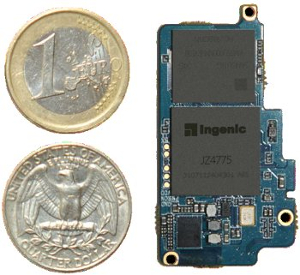
ingenic newtonImagination Technologies has launched a campaign to turn the 30-year-old MIPS architecture into an Internet of Things platform.

The IP designer’s recent moves include the establishment of a Linaro-like “Prpl” industry group for MIPS, as well as collaborations with Oracle and Qualcomm on MIPS-focused Java and OpenWRT Linux development, respectively.

It’s also nurturing MIPS-based IoT platforms like Ingenic’s Xburst-based Newton module or Ineda Systems’ Dhanush Wearable Processing Unit system-on-chips, and it’s optimizing its FlowCloud cloud development platform for IoT.

Already, MIPS is widely used in smartwatches, such as the new Android-ready SpeedUp Smartwatch-S, and it supports Google’s upcoming Android Wear platform, claims Imagination.

Unlike the server and mobile markets where x86 and ARM architectures, dominate, respectively, the emerging IoT world of low-power, wireless-enabled gizmos is wide open. IoT, which includes wearable, home automation, industrial devices, and more, ranges from microcontroller-based systems running real-time operating systems to a devices based on more advanced, yet still low-power applications processors, which typically run Linux.

New MIPS SoCs

The latest development on the MIPS IoT front is the Dhanush Wearable Processing Unit (WPU), which was announced with the help of Imagination. This Linux-ready SoC is based on 32-bit MIPS MicroAptiv and higher-end InterAptiv cores, designed for wearables with 30-day battery life. The 180-person startup is launching with $17 million in funding from companies including Qualcomm and Samsung, with volume shipments due by this fall. Four different Dhanush WPU models, three of which run Linux and one that runs Android, all integrate a sensor hub CPU subsystem. They support a Bluetooth LE for the lower-end models, on up through Bluetooth and WiFi for higher-end models.

Other MIPS SoCs targeting IoT include the XBurst from Ingenic. The Beijing-based chipmaker has had more success than any other MIPS licensee in expanding into the Android market, mostly in budget mobile devices running XBurst. Ingenic has developed its own Newton module based on the 1GHz XBurst-family JZ4775 processor. The Newton is designed for higher-end IoT devices, and Imagination hinted that it could appear in Android Wear products later this year, as well as non-wearable devices.

Rebranding for IoT

Meanwhile, older MIPS-based WiFi SoCs are also being rebranded for IoT. For example, Ralink’s RT5350 SoC forms the basis for a new VoCore COM claimed to be the smallest in the world. The module runs the lightweight, low-power OpenWRT Linux on a 360MHz MIPS 24K core, and integrates WiFi and an Ethernet switch.

A French company called WeIO is using Qualcomm’s MIPS-based, WiFi-enabled Atheros AR9331 in an IoT oriented, open source WeIO module. The COM is equipped with a HTML5 programming interface and Python-based Tornado web server to let you control objects from any device using only a web browser. The Atheros AR9331 is also used in the OpenWRT-ready Arduino Yun hacker SBC.
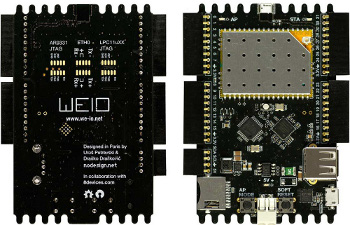
weio module

Collaborating on standards

Qualcomm’s interest in pushing Atheros into IoT led it to join Imagination’s Prpl organization, which is somewhat reminiscent of Linaro. Prpl aims to develop standardized Linux code for MIPS for applications ranging from IoT to the datacenter. The group will contribute code upstream to a variety of Linux distros, as well as Android. Qualcomm will contribute a carrier-grade version of OpenWRT optimized for MIPS.

Other founding Prpl members include Broadcom and Cavium, both of which manufacture 64-bit carrier-grade MIPS SoCs, with their XLP and Octeon families, respectively. Other members include Ikanos, Ineda Systems, Nevales Networks, and PMC. Imagination is also pursuing a separate partnership with Oracle to develop a MIPS-optimized version of Java.

As part of its outreach to IoT developers, Imagination is integrating its FlowCloud cloud prototyping platform into development boards that target IoT. FlowCloud defines the messaging between MIPS-based embedded devices and cloud services, enabling the prototyping of applications including security, health monitoring, energy management, and content delivery.

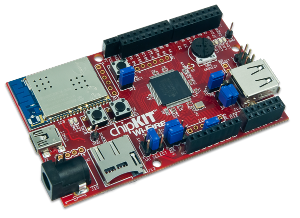
On May 22, Imagination announced FlowCloud support for Digilent’s Arduino-compatible chipKIT WiFire development board, which combines Microchips’ 32-bit PIC32MZ MCU with a MIPS MicroAptiv CPU. Although the chipKIT board doesn’t run Linux, Imagination said it will announce FlowCloud support for other MIPS-based Android/Linux development boards in the near future.chipkit WiFire
MIPS vs. the IoT Competition

Imagination Technologies is known primarily for its PowerVR GPUs for mobile devices, but acquired MIPS over a year ago. It announced a new generation of 32-bit Series 5 Warrior-P MIPS processors last October.

Despite the fact that more than three billion MIPS-based devices have shipped to date, often in consumer electronics devices such as set-top boxes, its market share in 32-bit consumer electronics is eroding, thanks in large part to the success of fellow U.K.-based IP supplier ARM. MIPS largely missed out on the mobile device market, which is more competitive than ever. IoT and wearables offer greater hope, however.

ARM is the IoT leader, although it’s not a dominant position. Its IoT focus starts with its large and growing share of the microcontroller (MCU) market where ARM licensees field Cortex-M and more powerful Cortex-R MCUs. Both architectures can run the stripped-down uClinux, but they are primarily RTOS platforms.

ARM is also ahead in Linux-ready applications processors. Its aging, but power-efficient ARM9 architecture still regularly appears in new IoT focused modules, single board computers, and end-product gizmos based on SoCs from Atmel and others.

Atmel switched from ARM9 to Cortex-A5 for its recent SAMA5D3 SoC. The Cortex-A5 is much faster than an ARM9, but uses only a third the power of a single-core Cortex-A9. The SAMA5D3 runs at a reasonably lean 200mW in active mode and 0.5mW in low-power mode.

A gap in the market

Yet, so far, Cortex-A5 has seen fairly limited adoption, and ARM has yet to spin a new design that can beat that footprint while also running a full Linux distro. Last October, ARM announced plans to develop an embedded version of ARMv8 that will add virtualization and lightweight Linux support to an upcoming version of its Cortex-R MCU. The ARMv8-R architecture is 32-bit, but borrows features from the 64-bit ARMv8-A, including hardware-based virtualization and a more advanced MPU. Initially, however, the new Cortex-R processors will target automotive computers rather than IoT, and will not likely to ship until 2015.

The lack of a spot-on IoT SoC design from ARM offers a gap in the market that Imagination hopes to exploit with its low-power MicroAptiv chips. While the MIPS-optimized OpenWRT is not as comprehensive as Debian, it’s much more sophisticated than uClinux.

Intel is trying to exploit the same gap with its new line of Linux-ready, Pentium-compatible Quark processors. The low-power CPUs, which are integrated in Intel’s open source Galileo SBC for IoT, will also appear in a future version of Intel’s IoT-focused Edison module. The first round of Edison modules, however, will run on an Atom E3800, Intel’s solution for higher end IoT.

The battle is on for the processors that will run the next smartwatch or WiFi-enabled toaster. Later this year, we’ll get a better idea how MIPS is doing when we see the first batch of Android Wear devices.