 Imagination Technologies has launched a campaign to turn the 30-year-old MIPS architecture into an Internet of Things platform.
The IP designer’s recent moves include the establishment of a Linaro-like “Prpl” industry group for MIPS, as well as collaborations with Oracle and Qualcomm on MIPS-focused Java and OpenWRT Linux development, respectively.
It’s also nurturing MIPS-based IoT platforms like Ingenic’s Xburst-based Newton module or Ineda Systems’ Dhanush Wearable Processing Unit system-on-chips, and it’s optimizing its FlowCloud cloud development platform for IoT.
Already, MIPS is widely used in smartwatches, such as the new Android-ready SpeedUp Smartwatch-S, and it supports Google’s upcoming Android Wear platform, claims Imagination.
Unlike the server and mobile markets where x86 and ARM architectures, dominate, respectively, the emerging IoT world of low-power, wireless-enabled gizmos is wide open. IoT, which includes wearable, home automation, industrial devices, and more, ranges from microcontroller-based systems running real-time operating systems to a devices based on more advanced, yet still low-power applications processors, which typically run Linux.
New MIPS SoCs
The latest development on the MIPS IoT front is the Dhanush Wearable Processing Unit (WPU), which was announced with the help of Imagination. This Linux-ready SoC is based on 32-bit MIPS MicroAptiv and higher-end InterAptiv cores, designed for wearables with 30-day battery life. The 180-person startup is launching with $17 million in funding from companies including Qualcomm and Samsung, with volume shipments due by this fall. Four different Dhanush WPU models, three of which run Linux and one that runs Android, all integrate a sensor hub CPU subsystem. They support a Bluetooth LE for the lower-end models, on up through Bluetooth and WiFi for higher-end models.
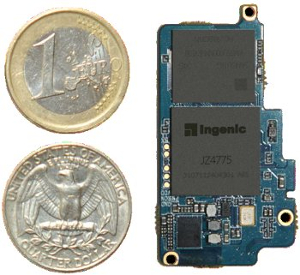
Other MIPS SoCs targeting IoT include the XBurst from Ingenic. The Beijing-based chipmaker has had more success than any other MIPS licensee in expanding into the Android market, mostly in budget mobile devices running XBurst. Ingenic has developed its own Newton module based on the 1GHz XBurst-family JZ4775 processor. The Newton is designed for higher-end IoT devices, and Imagination hinted that it could appear in Android Wear products later this year, as well as non-wearable devices.
Rebranding for IoT
Meanwhile, older MIPS-based WiFi SoCs are also being rebranded for IoT. For example, Ralink’s RT5350 SoC forms the basis for a new VoCore COM claimed to be the smallest in the world. The module runs the lightweight, low-power OpenWRT Linux on a 360MHz MIPS 24K core, and integrates WiFi and an Ethernet switch.
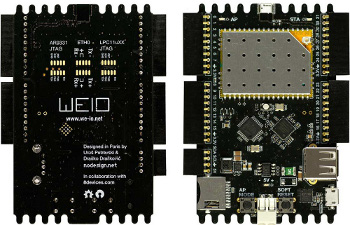
A French company called WeIO is using Qualcomm’s MIPS-based, WiFi-enabled Atheros AR9331 in an IoT oriented, open source WeIO module. The COM is equipped with a HTML5 programming interface and Python-based Tornado web server to let you control objects from any device using only a web browser. The Atheros AR9331 is also used in the OpenWRT-ready Arduino Yun hacker SBC.
Collaborating on standards
Qualcomm’s interest in pushing Atheros into IoT led it to join Imagination’s Prpl organization, which is somewhat reminiscent of Linaro. Prpl aims to develop standardized Linux code for MIPS for applications ranging from IoT to the datacenter. The group will contribute code upstream to a variety of Linux distros, as well as Android. Qualcomm will contribute a carrier-grade version of OpenWRT optimized for MIPS.
Other founding Prpl members include Broadcom and Cavium, both of which manufacture 64-bit carrier-grade MIPS SoCs, with their XLP and Octeon families, respectively. Other members include Ikanos, Ineda Systems, Nevales Networks, and PMC. Imagination is also pursuing a separate partnership with Oracle to develop a MIPS-optimized version of Java.
As part of its outreach to IoT developers, Imagination is integrating its FlowCloud cloud prototyping platform into development boards that target IoT. FlowCloud defines the messaging between MIPS-based embedded devices and cloud services, enabling the prototyping of applications including security, health monitoring, energy management, and content delivery.
On May 22, Imagination announced FlowCloud support for Digilent’s Arduino-compatible chipKIT WiFire development board, which combines Microchips’ 32-bit PIC32MZ MCU with a MIPS MicroAptiv CPU. Although the chipKIT board doesn’t run Linux, Imagination said it will announce FlowCloud support for other MIPS-based Android/Linux development boards in the near future.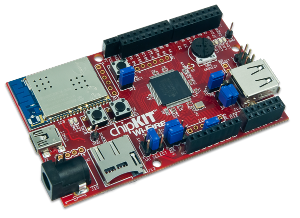
MIPS vs. the IoT Competition
Imagination Technologies is known primarily for its PowerVR GPUs for mobile devices, but acquired MIPS over a year ago. It announced a new generation of 32-bit Series 5 Warrior-P MIPS processors last October.
Despite the fact that more than three billion MIPS-based devices have shipped to date, often in consumer electronics devices such as set-top boxes, its market share in 32-bit consumer electronics is eroding, thanks in large part to the success of fellow U.K.-based IP supplier ARM. MIPS largely missed out on the mobile device market, which is more competitive than ever. IoT and wearables offer greater hope, however.
ARM is the IoT leader, although it’s not a dominant position. Its IoT focus starts with its large and growing share of the microcontroller (MCU) market where ARM licensees field Cortex-M and more powerful Cortex-R MCUs. Both architectures can run the stripped-down uClinux, but they are primarily RTOS platforms.
ARM is also ahead in Linux-ready applications processors. Its aging, but power-efficient ARM9 architecture still regularly appears in new IoT focused modules, single board computers, and end-product gizmos based on SoCs from Atmel and others.
Atmel switched from ARM9 to Cortex-A5 for its recent SAMA5D3 SoC. The Cortex-A5 is much faster than an ARM9, but uses only a third the power of a single-core Cortex-A9. The SAMA5D3 runs at a reasonably lean 200mW in active mode and 0.5mW in low-power mode.
A gap in the market
Yet, so far, Cortex-A5 has seen fairly limited adoption, and ARM has yet to spin a new design that can beat that footprint while also running a full Linux distro. Last October, ARM announced plans to develop an embedded version of ARMv8 that will add virtualization and lightweight Linux support to an upcoming version of its Cortex-R MCU. The ARMv8-R architecture is 32-bit, but borrows features from the 64-bit ARMv8-A, including hardware-based virtualization and a more advanced MPU. Initially, however, the new Cortex-R processors will target automotive computers rather than IoT, and will not likely to ship until 2015.
The lack of a spot-on IoT SoC design from ARM offers a gap in the market that Imagination hopes to exploit with its low-power MicroAptiv chips. While the MIPS-optimized OpenWRT is not as comprehensive as Debian, it’s much more sophisticated than uClinux.
Intel is trying to exploit the same gap with its new line of Linux-ready, Pentium-compatible Quark processors. The low-power CPUs, which are integrated in Intel’s open source Galileo SBC for IoT, will also appear in a future version of Intel’s IoT-focused Edison module. The first round of Edison modules, however, will run on an Atom E3800, Intel’s solution for higher end IoT.
The battle is on for the processors that will run the next smartwatch or WiFi-enabled toaster. Later this year, we’ll get a better idea how MIPS is doing when we see the first batch of Android Wear devices.