 Black Duck recently released the results of the 2014 Future of Open Source Survey, our eighth annual collaboration with North Bridge Venture Partners, looking at open source software (OSS) trends, opportunities, key adoption drivers and community engagement.
In reviewing this year’s data, one of the most important trends is clear: open source has reached the point of proliferation and democratization, leading to its ever increasing use as a strategic asset.
In today’s organizations, open source contributes to the development of the most significant technologies. Companies have come to understand the many advantages that OSS can provide – the ability to create faster, cheaper and more secure products than they could have by constantly reinventing the wheel in closed-source development environments.
Quality Without Question
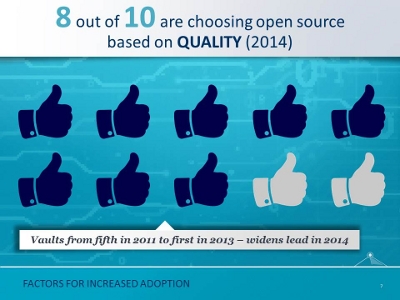
Through the years, we’ve seen a shift in the factors respondents consider most important for adopting open source. In 2011, quality was ranked fifth in terms of importance, lagging behind traditional considerations like freedom from vendor lock-in and low acquisition costs.
Today, quality is ranked as the top factor for increased open source adoption, with eight out of ten respondents choosing open source based on quality alone. In three short years, open source software has proven to be more than just the cheaper alternative in the eyes of the business and tech community; instead, value is now seen in its superior, innovative capabilities.
In fact, 80 percent of respondents said competitive features and technical capabilities were the most important factors when choosing open source over proprietary software. Seventy-two percent chose OSS because it is more secure. As the saying goes, “many eyeballs make all bugs shallow.”
Despite the recent security exposure caused from OpenSSL’s Heartbleed bug, Linus’ Law remains fundamentally true: open source projects typically cultivate an environment of more eyeballs to spot bugs and more “great minds” to collaborate and innovate than that of proprietary systems. The fact is, companies are readily recognizing this and turning to open source for more than just its traditional benefits of lower cost and access to code.
 Open source is now playing a crucial strategic role in most top technology companies.
Return on Participation
Not only are more companies strategically adopting and using open source software, but increasingly, enterprises are also “walking the walk” when it comes to open source by actively participating within the OSS community.
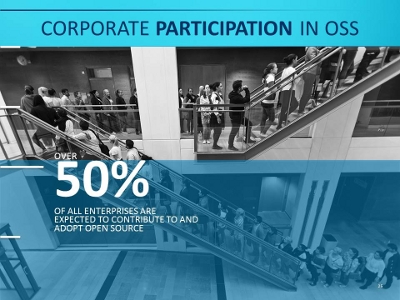
The Future of Open Source Survey found that 56 percent of corporations are expected to contribute to open source projects within the next two to three years. When asked why they engaged with OSS communities, 45 percent said to gain or retain a competitive advantage.
Not surprisingly, companies with over 1,000 employees cited the potential to influence a project’s direction as a top-three benefit of contributing back to the community. This enlightened self-interest is spurring greater contributions and an increased return on participation, benefiting not only these companies, but OSS communities and consumers as well.
The Open Source of Everything
Since open source has become ubiquitous, famously “eating the software world,” it now touches many aspects of our professional and personal lives. When asked which industries OSS technology was leading, the top new and evolving industries – cloud computing/virtualization (63 percent), content management (57 percent), and mobile (52 percent) – were cited as key areas where OSS is driving the most innovation.
The education (76 percent), government (67 percent) and health care (45 percent) sectors are expected to be most impacted by open source in the near future. As OSS becomes more ingrained in our everyday lives, it is only natural for it to begin disrupting these overarching industries that are part of our social fabric. They also tend to be the most cost-constrained, constantly forced to do more with less.
Consumer awareness of open source is another factor that continues to rise in the survey, estimated to climb from top five to top three in terms of importance. The influence of the Internet of Things (IoT) and the 25 billion devices expected to be connected by 2015 cannot be ignored. Most of the smartphones, tablets and wearables available today are based on open source technologies. We’re already seeing the rise of collaborative communities like the AllSeen Alliance, which focuses on enabling IoT through the establishment of open platforms, frameworks and standards. OSS is already having an impact on IoT, and IoT will have a huge impact on many industries and all of our everyday lives.
Managing Logistical Challenges
The proliferation and democratization of open source has organizations increasingly using, adopting, and contributing to OSS to gain strategic advantages – better, faster, cheaper, and more innovative products and services. Yet, in order to maximize the many benefits of open source, enterprises must properly understand the value of their open source assets and take steps to implement policies and processes for consuming it, tracking it, indexing it and ensuring its security. These processes help enterprises better manage and optimize the flow of open source code in the company.
The path to the future is open and the organizations who strategically use and manage OSS will be the ones to shape it.
Lou Shipley is the President and Chief Executive Officer of Black Duck Software, bringing over 25 years of experience as an enterprise software executive to the company. He is a veteran of five Massachusetts software startups: Avid, WebLine (Cisco), FairMarket (Ebay), Reflectent (Citrix) and VMTurbo. Lou was President and CEO of VMTurbo, Inc., and Reflectent Software (acquired by Citrix Systems in 2006), both of which served the enterprise and financial services industries.
After the Reflectent acquisition, Lou served as General Manager of the Citrix Management Systems group, and then took on the role of General Manager of the Citrix Virtualization and Cloud Products Group. He worked as an Entrepreneur-in-Residence at Highland Capital Partners in 2002. Prior to Highland, Lou served as Vice President of Worldwide Field Operations for WebLine Communications, a customer contact center software company acquired by Cisco Systems in 1999 for $325 million.
Before WebLine, Lou served as Vice President of Americas and Pacific operations at Avid Technology. He joined Avid when the company was a startup and oversaw its growth to over $450 million in revenue. Lou also founded and served as President of Avid Japan KK. Lou serves as Chairman of the Board of CustomerGauge and is an advisor to AppFirst and Unidesk Software.
He holds a BA in economics from Trinity College and an MBA from Harvard Business School. He is a lecturer at the MIT Sloan School of Management, where he teaches the course “Technology Sales & Sales Management.”

 Mirantis