 Attendees of Re/code’s Code Conference this week saw all manner of futuristic gizmos, from Microsoft’s real-time Skype Translator to Google’s latest, electric-powered self-driving car, which lacks a steering wheel or brakes. Presumably, Google’s new prototype still runs Linux, like its earlier, Ubuntu-based autonomous Prius.
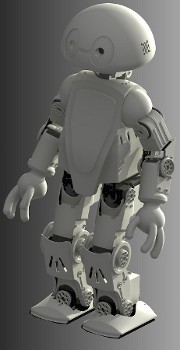
Intel couldn’t quite match those sci-fi revelations, but it had some magic of its own to share at Code. CEO Brian Krzanich showed off an open source Linux robot kit called Jimmy, as well as a sensor-laden Smart Shirt for health monitoring. Both devices are based on its Linux-ready Edison computer-on-module. Presumably, the products run on the Atom E3800-based version of the Edison rather than the originally announced Quark-based version, which is still on the schedule for future release. In either case, it’s highly likely the products use Linux.
In a further sign that Krzanich is pushing his company beyond business as usual, Intel announced its first licensing partnership for Atom processors. In 2015, China’s Rockchip will spin off variations on a new quad-core Sofia Atom processor aimed at low-end Android tablets (see farther below).
Smart Shirt Due this Summer
First out the door will be the Smart Shirt, which is expected to ship this summer. When Intel announced its Edison module at CES in January, the company briefly mentioned a wearable was coming, but offered no details. Intel did, however, show a prototype of an Edison-based baby monitor, and promised a smartwatch and other Edison-based devices.
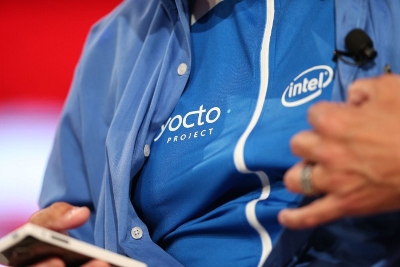 When he demo’d the Smart Shirt at Code, Krzanich wore the high-tech garment, seen here with the Yocto Project logo on it. Developed in collaboration with AIQ Smart Clothing, the wearable is packed with sensors that can track your heart rate, EKG, and other vital signs. It can even attempt to determine your emotional state, says Intel. The shirt can survive a rain shower, but you need to remove the Edison module and battery before you wash it, he added. According to PCMag, Krzanich said the shirt uses a specialized silicon-based product called Gossmer.
Jimmy the Open Source, Humanoid Robot
After unveiling a non-working version of his Jimmy robot design last September at the Maker Faire, and revealing more details at April’s Inside 3D Printing New York, Intel futurist Brian David Johnson brought a functioning version to the Code Conference. Jimmy joined Krzanich and Walt Mossberg on stage where the robot spoke and did a little dance with the help of his articulated limbs.
The dancing version of Jimmy demonstrated on stage was an advanced, Intel Core-based version for researchers that will sell for $16,000. Intel will work with a third-party to manufacture the robot. Krzanich also showed a smaller version that will sell for $1,600. Both products will ship by the end of the year in kit form, complete with open source licensing and schematics.
The robot is mostly comprised of 3D printed parts, so the price could be reduced for those who want to print their own parts. Within five years, Intel expects hobbyists will be able to build their own Jimmy-based robots for less than $1,000.
Hardware designs for the robot, which was developed with the help of artist Sandy Winkelman and designer Wayne Losey, both students at Olin College, will be posted at an already-launched, Intel-backed 21st Century Robot community website. Currently, there are only sketches, but full schematics will arrive by fall.
The robot project is being promoted with the help of a fiction book penned by Johnson called 21st Century Robot, which will be published this fall by Make. In writing the sci-fi tale, Johnson was able to formulate the attributes he wanted in a personal robot.
Jimmy can speak and sing, and although his fingers are not articulated like his elbows and knees, he can bring you a drink. The Edison module gives him built-in Internet access, including the ability to tweet. He also has speech capabilities, and can translate languages. All this is controlled by smartphone apps, which Intel plans to eventually support with an app marketplace.
Jimmy isn’t the first open source humanoid robot, as it follows pioneers such as Aldeberan Robotics’ Linux-based, Nao, as well as the Arduino-based InMoov. Yet, Jimmy will be more fully open source than Nao, and unlike InMoov, it’s mobile.
Rockchip Extends Intel’s reach in Mobile
At Code, Mossberg asked Krzanich about Intel’s progress in mobile devices, and he responded with unusual candor for a tech CEO: “We missed the tablet and the phone,” Krzanich responded, as quoted by PCMag. “We missed that transition.”
Yet, Intel refuses to surrender, he added, noting that the company had sold about 10 million tablet chips, and hopes to ship in 40 million tablets this year, representing about 15 percent of the market. PCMag suggests Intel is selling those chips at a major discount in order to gain share. That would help explain the surprisingly low price for the Android-on-Atom based Toshiba Excite Go tablet announced this week. The 7-inch tablet will go on sale in July for $110, complete with a quad-core Atom Z3000 processor of the latest 22nm Bay Trail generation.
Also this week, Intel announced another attempt at breaking into the low-cost tablet market when it revealed a licensing deal with fabless Chinese chipmaker Rockchip. Intel said Rockchip will spin its own version of Intel’s upcoming, 14nm (“Airmont”) Sofia Atom processors for entry level Android tablets. Intel will also release its own version of the chip.
The deal involves a newly revealed quad-core version of the Sofia, which was previously announced as a dual-core chip aimed at entry-level Android smartphones. Sofia is the first Intel chip with an integrated baseband. This will initially be 3G in the Rockchip product due in early 2015, as well as the first Sofia-based smartphones, but a 4G LTE version is expected by mid-2015.
The Sofia is also novel in that it involves a third-party foundry, TSMC. Intel hopes to eventually bring fabrication in-house, as per usual. However, it is partnering with TSMC on the manufacturing end and Rockchip on the design and marketing end in order to make up for lost time in the mobile market.
Desperation? Perhaps. But, along with the recent forays into robots, wearables, and Internet of Things devices, it suggests that Krzanich is shaking up Intel and looking for new opportunities. And as Intel looks toward the future, those opportunities increasingly look more like Lintel than Wintel.

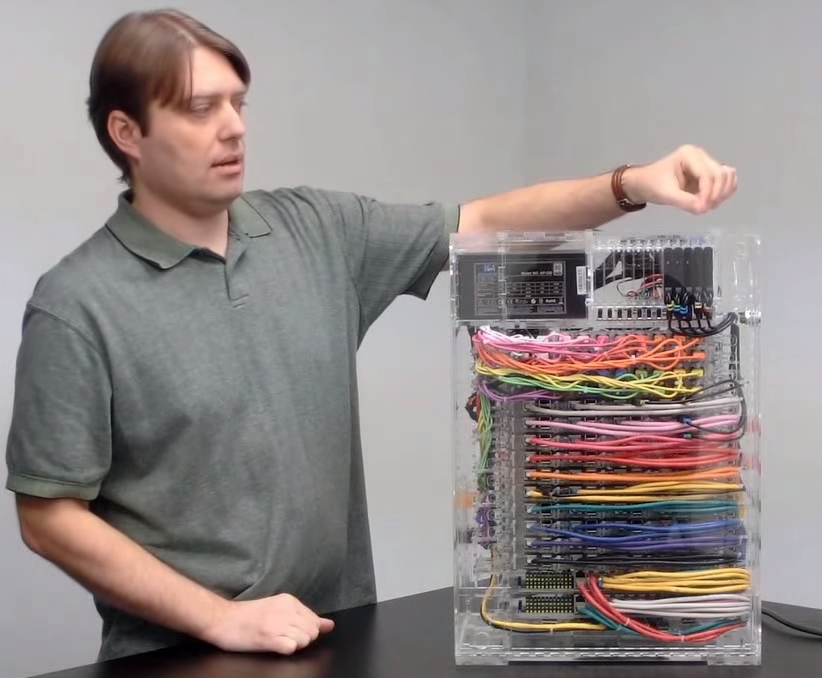 Engineer David Guill’s latest project is by no means the first Raspberry Pi supercomputer, but it may just be the most beautiful.