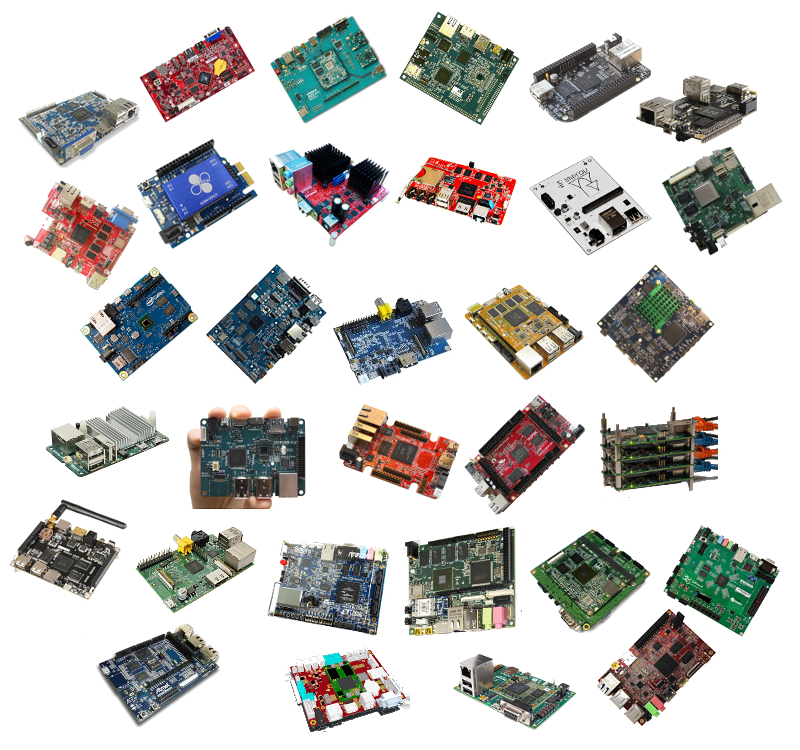
 On May 8, we asked our readers to choose their favorite Linux- or Android-ready hacker single board computers, and the results are in. Not surprisingly, the highest ranked SBCs were the Raspberry Pi and BeagleBone Black, but some other entries on the reader-generated Top 10 list were unexpected, as were the responses to some of our follow-on questions.
Among other findings, survey respondents valued open source support more than cost, performance, and other criteria. Three out of four respondents identified themselves as makers/hobbyists rather than commercial developers, and home automation was the most common intended application for the boards, followed by education.
The 10-day SurveyMonkey survey — a joint project with LinuxGizmos.com — asked readers of both publications to choose their top three Linux or Android-based open-spec single-board computers from a list of 32. Some 777 readers responded, and most answered the other questions, as well. Five respondents were randomly selected to receive a Linux Foundation shirt, hat, mug, or USB drive (see farther below for a list of the winners).
It was not required that respondents have direct experience with a board, yet almost 73 percent of the 734 first choices were based on first-hand experience. Hands-on users comprised 46 percent of the second-place choices, and one third of the third-place choices. Some 43 respondents wrote in their own candidates.
We applied the Borda count method to weight the ranked choices. Each score was calculated as follows:
(Number of first-choice votes)x 3
+ (number of second-choice votes) x 2
+ (number of third choice votes)
= TOTAL SCORE
Top 10 open spec SBCs
The weighted results for the first two winners — Raspberry Pi Model B (1,136) and BeagleBone Black (814) — were hardly surprising, nor was their significant lead over the rest of the pack. Although the OLinuXino, Cubieboard, and Odroid projects each had two SBCs on our list, even when the scores are combined none of the projects come close to our top two.
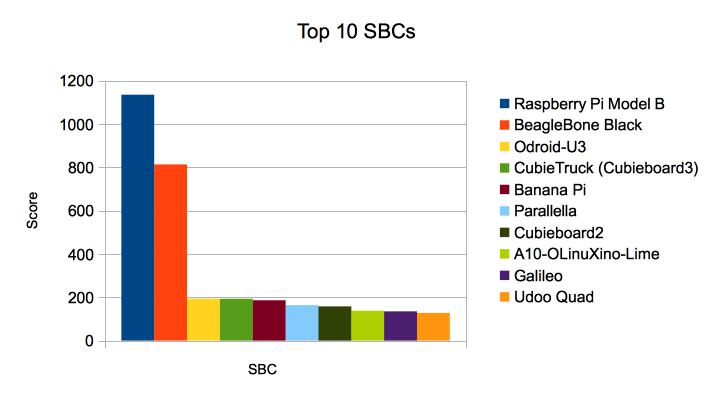
It was also not surprising that third-place Odroid-U3 (194) and fourth place CubieTruck (193) made our top 10. Like the Pi and BeagleBone, these are both backed by strong, independent hacker communities, and unlike the top two projects, they are just as suitable for Android as they are for Linux. The Odroid-U3 offers an excellent price/performance ratio ($59 for a quad-core Exynos4412 system-on-chip), while the $89 CubieTruck provides an exceptional mix of interfaces to back up its dual-core Allwinner A20 SoC.
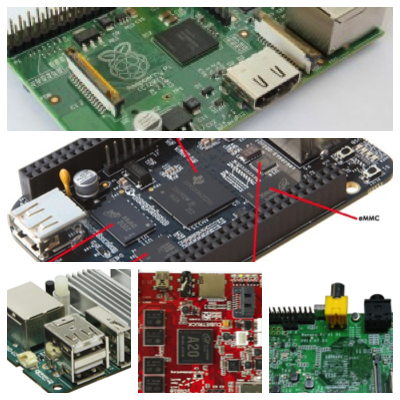
The surprise came with the no. 5 vote given to a new Raspberry Pi clone called the Banana Pi (186 points). The score was based less on hands-on usage than many of the other boards, which is not surprising considering the recent ship date. However, assuming the build quality and support meet expectations, Lemaker.org’s project appears to have a hit on its hands.
Parallella’s position at no.6 (164) was also somewhat unexpected, considering its specialized nature. Adapteva’s $99 board, which mixes an ARM/FPGA Xilinx Zynq SoC with its own Epiphany coprocessor, can be used solo, but is designed primarily for server clustering and parallel programming research.
Less surprising was the 7th place, $59 Cubieboard2 (158), built around an Allwinner A20, or the 8th-ranked, $42 A10-OLinuXino-Lime (138), which features an Allwinner A10. Nor was it a shock that the Udoo Quad made the list at No. 10, beating out the similarly Freescale i.MX6Quad-based Wandboard Quad, which ranked 14th.
In 9th place was the sole non-ARM based SBC of the top 10: Intel’s Quark-based Galileo. The popularity of the $60, Arduino-compatible Galileo reflects an increasing interest in the Internet of Things (IoT).
View the slideshow of our Top 10 Open SBC winners.
More notable boards
There were only five serious contenders among the rest of the pack. At number 11 we find an x86-based 86Duino board, followed by the ARM-based Odroid-XU, A10-OLinuXino-Micro, Wandboard Quad, and Radxa Rock, all of which scored over 100 points. The next ranked SBC, the older Hackberry A10, scored a 65. All of our candidates received at least six points, which was the total for the last place Cosmic+.
Those who surmise correctly that the first choices are more heavily based on hands-on experience than the second or third, may choose to create their own revised top 10 list based solely on first choices. (Then again, quite a few respondents appear to have used more than one board.) Based on first-place, unweighted scores alone, the list remains the same for the first four SBCs, but changes slightly after that. The unweighted ranking would be RasPi, BB Black, Odroid-U3, CubieTruck, and then Parallella, A10-OLinuXino-Lime, A10-OLinuXino-Micro, Radxa Rock, and Udoo Quad.
Only three of the boards listed on our previous Top 10 list, published in August 2013, made it to this year’s official list (Raspberry Pi, BeagleBone Black, and Cubeboard2). Only the first two were on our Top 7 list in June 2012, and it was the original BeagleBone, not the newer Black version. Those lists, however, were created via editorial judgment (or lack of such) rather than a survey.
A few trends are reflected in the data. First, although price was only the fifth leading criteria in users’ rankings (see farther below), five of the top 10 boards cost under $50 — or four if you include the recent $10 price increase for the latest BeagleBone Black. Of the rest, only the $135 Udoo Quad costs over $100.
Allwinner leads the way among the processors used in the top 10. Four of the top 10 and eight of the 32 boards showcase Allwinner A10 or dual-core A20 SoCs. Other popular processor choices include the Freescale i.MX6, used on five of the 32 boards, and various Samsung Exynos flavors, which combine for four entries. Texas Instruments, Rockchip, and Xilinx also represented multiple entries.
Survey respondents advised us of several other boards that probably would have fit our requirements, and we’ll keep them in mind for our next SBC survey. These include Acme System’s Foxboard and Terra SBC, FriendlyARM’s Mini2440 and Tiny4412, and the Carambola board. In addition, several respondents listed older boards like the PandaBoard ES and BeagleBoard-xM, which we left off the list along with other older SBCs that had either showed little community activity or had clear successors. As noted in our survey invitation story, there were a number of announced products that would probably have made the cut, including the MinnowBoard Max and Arduino Tre, but had not yet shipped.
Open source tops criteria ranking
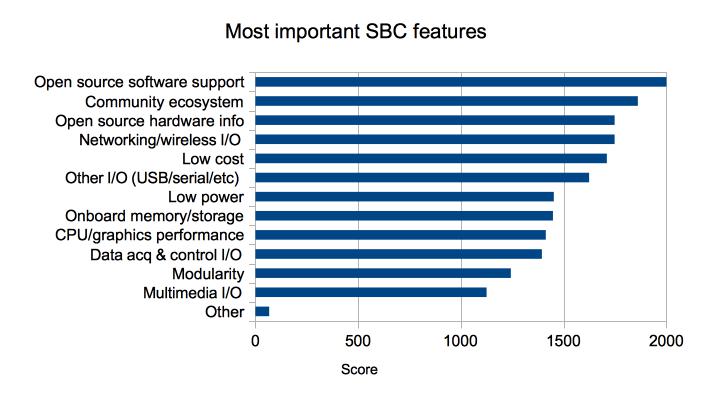
Somewhat cynically, we had imagined low cost might top our multiple-choice list of criteria for buying an open-spec SBC. However, price ranked fifth out of 12 choices. Instead support for open source software, community ecosystem features, and open hardware lead the way. Since all these boards provide Linux and/or Android images, made available under an open source license, we imagine the ranking is partially about the type of license, but mostly about the quality of the code and the sort of components and development tools that are included.
Similarly, although all the boards were provided with a minimum of community basics like a forum and open tech support, there’s a huge gap between what’s offered by say, a BeagleBoard.org and most projects. There are a number of otherwise estimable SBCs with limited communities and overworked developers who struggle even to publish timely documentation.
Indeed, among the “other” criteria categories listed by readers, documentation and ease of use lead the way. This also applies to the degree of openness in the hardware designs. A schematic and a Creative Commons license are great, but respondents were also voting on how well the hardware was documented with manuals, annotated images, tutorials, videos and the like.
 A surprise here was the high ranking of networking/wireless I/O, which tied with open source hardware for third and fourth place. It would seem that users would rather have built-in WiFi, and perhaps Bluetooth, than use up their precious USB ports. Then again, considering low cost received the same ranking, there’s a bit of a trade-off there.
After “Other I/O” in sixth place, there’s a considerable gap before the next entries: low power and onboard memory. The relatively low ranking of CPU/graphics performance, combined with the last place ranking for multimedia I/O, suggests that for the most part, our readers are not looking to build media players. One of the leading “other” categories was small size, which reflects the respondents’ no. 1 intended application: home automation.
Home automation and education lead the way
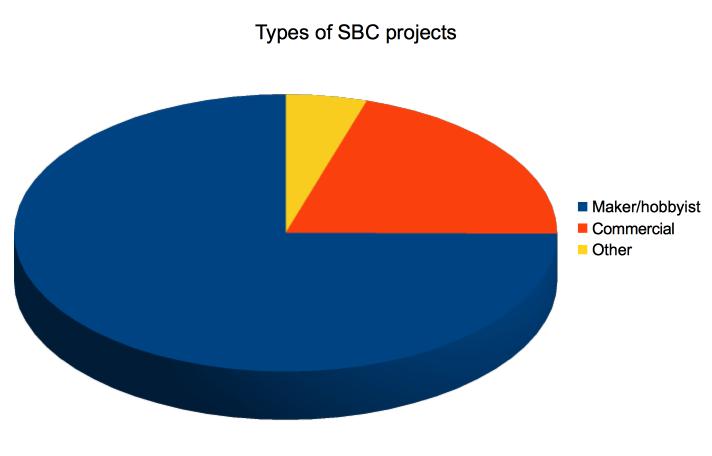
Some 74.9 percent of respondents said they were “Maker/hobbyists” vs. 20.3 percent involved in commercial prototyping or production. The fact that one in five respondents were commercial developers reflects the growing impact the open board movement has had on the traditional embedded industry. Two years ago, we imagine the percentage would have been much lower. Almost 5 percent chose “other”, suggesting that some users fit both roles. Most of the other roles listed, however, were academics conducting research, as well as educators and parents using the boards as educational tools.
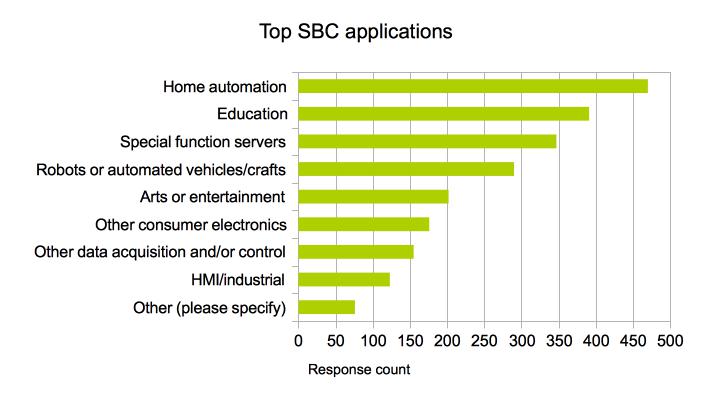
In a separate question, asking respondents to choose between eight application categories, education was ranked at 51.5 percent, second only to home automation at 61.9 percent. Special function servers and robots took up the next two slots at 45.7 and 38.2 percent, followed by art and entertainment, other consumer electronics, and data acquisition and control, all in the 20’s. HMI/industrial was last, at 16.2 percent, a figure that we imagine would have been lower in years past.
The 76 respondents that chose to list an application as “other,” reflect the incredible diversity of the open board movement. Although some of these probably fit into existing categories, many stand alone. Listed applications include Linux desktops, thin clients, XBMC media players, medical devices, weather stations, amateur and SDR radios, wearables, IoT gizmos, and automotive computers. Two particularly intriguing applications are “fish tank control” and “mining.”
Popularity rankings
Here are all 32 open SBCs listed by: overall weighted score (first, second, and third-place votes). View the full survey results here.
Top 10
1. Raspberry Pi Model B — 1,136 (243, 148, 111)
2. BeagleBone Black — 814 (154, 138, 76)
3. Odroid-U3 — 194 (38, 31, 18)
4. CubieTruck — 193 (36, 28, 29)
5. Banana Pi — 186 (18, 41, 50)
6. Parallella — 164 (32, 16, 36)
7. Cubieboard2 — 158 (21, 27, 41)
8. A10-OLinuXino-Lime — 138 (30, 20, 8)
9. Galileo — 135 (11, 30, 42)
10. Udoo Quad — 128 (19, 24, 23)
Others
11. 86Duino/86Duino One — 121 (16, 26, 21)
12. Odroid-XU — 116 (16, 27, 14)
13. A20-OLinuXino-Micro — 110 (20, 18, 14)
14. Wandboard Quad — 109 (15, 24, 16)
15. Radxa Rock — 105 (19, 19, 10)
16. Hackberry A10 — 65 (7, 14, 16)
17. MinnowBoard — 60 (6, 10, 22)
18. Arndale Octa Board — 47 (9, 7, 6)
19. SAMA5D3 Xplained — 47 (9, 7, 6)
20. i.MX6 Rex — 43 (3, 9, 16)
21. ZedBoard — 43 (3, 10, 14)
22. Gizmo — 36 (6, 5, 8)
23. APC Rock — 28 (0, 7, 14)
24. BD-SL-i.MX6 (SABRE Lite) — 26 (5, 4, 3)
25. RIoTboard — 17 (2, 5, 1)
26. IGEPv5 Community Edition — 15 (1, 2, 8)
27. MarsBoard RK3066 — 14 (1, 2, 7)
28. PhoenixA20 — 11 (2, 0, 5)
29. Sockit Development Kit — 11 (0, 2, 7)
30. Improv — 10 (0, 3, 4)
31. Arndale Board-K — 9 (2, 1, 1)
32. Cosmic+ — 6 (0, 2, 2)
More information on the 32 boards in the contest, including links to project sites may be found in Linux.com’s initial contest coverage. To view a slide show of the top 10 SBCs, click the Gallery link above.
Drawing Winners
Congratulations to the five winners of our drawing for cool Tux and Linux Foundation gear:
Adrian Kummerlaender
Andrews Moro
Vikram Narayanan
Charles Steinkuehler
Robert Voinea.
And thanks again to all who participated in the survey!

