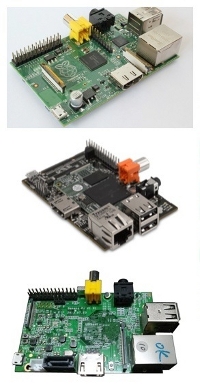
 Ever since the Raspberry Pi burst onto the scene in 2012, open source hardware projects have been promoting their Linux-ready hacker boards as offering faster, more capable alternatives. Considering the Pi’s 700MHz ARM11 processor and relatively modest feature set, that’s not such a stretch, but matching the $35 price is another story. If you can’t match the price, what you really need to get the attention of Pi-lovers looking for a bit more oomph is to look and act like a Pi.
That’s the strategy of two new Raspberry Pi clones: Lemaker.org’s Banana Pi and SolidRun’s HummingBoard. The two SBCs closely approximate the size, I/O, and port placement of the RasPi. They also provide identical 26-pin expansion headers to support RasPi add-on modules.
The new boards add a few new features, as well as much faster processors and more RAM. The Banana Pi, which is available for about $49 plus $27 shipping from China, moves up to a dual-core, Cortex-A7 based AllWinner A20 system-on-chip clocked to 1GHz. Its ARM Mali-400 GPU is a modest upgrade from the RasPi’s VideoCore IV GPU.
Comparing the options
The as-yet-unpriced HummingBoard, due to ship in May, offers an even faster quad-core, Cortex-A9 Freescale i.MX6 SoC clocked to 1GHz. Its Vivante GC2000 GPU is also considered an upgrade. The HummingBoard features 2GB of RAM, or four times that of the RasPi and twice that of the Banana Pi. The Banana Pi is a standard single board computer (SBC) like the RasPi, while the HummingBoard adopts a modular approach, combining the HummingBoard baseboard with a MicroSOM computer-on-module that holds the processor, memory, and wireless radios. In this way one could presumably upgrade or downgrade to other processors, such as single- or dual-core versions of the i.MX6.
The module/baseboard approach is quite common in the world of commercial COTS embedded development, and is now beginning to migrate to open source SBCs. In fact, earlier this month the Raspberry Pi Foundation announced a COM version of the RasPi without real-world I/O ports called the Raspberry Pi Compute Module. The module plugs into a separate IO Board that provides some ports and other expansion interfaces.
While the Banana Pi is being marketed as an alternative to the Pi, the HummingBoard is designed principally as a development platform for SolidRun’s similar, community-backed CuBox mini-PCs. Yet, it operates as a standard SBC in ways that should be very familiar to RasPi owners. As with the Banana Pi, the 26-pin expansion connectors and layout of CSI camera inputs and other features should enable hardware compatibility, although it’s unclear to what extent this would be plug and play.
Other similar features on the Raspberry Pi, Banana Pi, and HummingBoard (RasPi, BaPi, and Hum-B?) include HDMI ports, as well as LVDS, CSI, and analog audio interfaces. You also get dual USB 2.0 host ports and micro-USB power inputs. They all offer Ethernet ports, although the RasPi provides Fast Ethernet (10/100Mbps) while the others advance to gigabit Ethernet.
As shown in our partial spec comparison chart, below, storage options differ, with the Banana Pi adding SATA, and the HummingBoard adding mSATA. In addition, the Banana Pi tosses in a micro-USB OTG port and user buttons while the HummingBoard adds an SPDIF digital audio port and mini-PCI-Express and FlexCAN expansion.
The Banana Pi and HummingBoard are not the first Pi clones. A Gooseberry SBC appeared back in 2012 to help fulfill the backlog for the real thing, but this effort seems to have faded now that the Raspberry Pi Foundation has begun to catch up with demand. More than 2.5 million Pi boards are now in circulation, doing everything from teaching computer education to running robots, lawns sprinklers, lighting equipment, and EEG headgear for dogs.
BeagleBone Black Rev C adds to flash — and price
The BeagleBone Black is trailing far behind the Pi in sales, but it’s still one of the most popular hacker SBCs. A burst in demand over the last six months has led to some of the same fulfillment issues that have previously plagued the Pi. Earlier this month when announcing the new BeagleBone Black Rev C, which doubles eMMC flash to 4GB and shifts from a Yocto-based Angstrom Linux build to Debian, BeagleBoard.org announced that it was expanding manufacturing to Premier Farnell’s Element14, which is also one of the Raspberry Pi manufacturers.
Sadly, the price of the Linux-ready BeagleBone Black has risen from $45 to $55, partly to offset the extra 2GB in flash. This should also provide the margins necessary to invest in manufacturing at Beagleboard.org’s chief manufacturing partner CircuitCo, and thereby improve fulfillment, says the project.
BeagleBone sales took off last year with the arrival of the Black model, which added significant functionality while also dropping the price from $89 to $45, only $10 over the price of a Pi. Beating the $50 mark is not an easy task, and few boards accomplish it. The Pi has managed its $35 price (or $25 for the simpler Model A) due to huge volumes, as well as by offering older components and fewer extras than most hacker SBCs. As long as Pi sales stay hot, the Raspberry Pi Foundation will be in no hurry to rush out an upgrade.
Below is a comparison of the key differences between Raspberry Pi and its clones.
| |
Raspberry Pi Mod. C |
Banana Pi |
HummingBoard |
| Processor |
700MHz, 1-core ARM11 |
1GHz, 2-core Cortex-A7 |
1GHz, 4-core Cortex-A9 |
| RAM |
512MB |
1GB |
2GB |
| Ethernet |
10/100 |
10/100/1000 |
10/100/1000 |
| IR receiver |
No |
Yes |
Yes |
| Comp. RCA |
Yes |
Yes |
No |
| Storage |
SD |
SD, SATA |
MicroSD, mSATA |
| MicroUSB OTG |
No |
Yes |
No |
| SPDIF digital audio |
No |
No |
Yes |
| Mini-PCIe |
No |
No |
Yes |


 The
The