
Home Blog Page 1541

New Features Coming To Xubuntu 14.04 LTS

Much of our talk about Ubuntu 14.04 LTS on Phoronix is in regards to the default Unity-based desktop given that it takes the largest share of *buntu users, but for the Xubuntu 14.04 LTS release this week there’s several interesting changes for this Xfce spin worth noting…

Read more at Phoronix

Development Release: Smoothwall Express 3.1 RC5

Neal Murphy has announced the availability of the fifth release candidate for Smoothwall Express 3.1, a Linux-based operating system designed for firewalls and routers: “Smoothwall Express 3.1 fifth release candidate available. A note about previous RCs: if you are running RC1, RC2, RC3, RC4 or an earlier RC5…

Read more at DistroWatch

Batten Down the Hatches, Ubuntu 14.04 LTS Due in TWO DAYS

Admins dab straining server brows in advance of Trusty Tahr’s long-term support landing

Ubuntu has announced that the latest long-term support release of its Linux distribution will be available in two days.…

Read more at The Register

Rugged Android Fleet Computer Offers 3G, GPS, CANbus

Micronet announced a rugged touchscreen fleet computer that runs Android 4.x on a TI Sitara AM3715 SoC, and features optional GSM 3.5G, GPS, and CANbus. Micronet’s A-317 fleet computer updates the A-307 device that shipped last August. Both of these software-compatible devices are low-end complements to the long-haul oriented CE500 series fleet computers, says Micronet, […]

Read more at LinuxGizmos

Red Hat Deepens Its Container Commitment – Docker Front And Center

Red Hat is today deepening its relationship with, and support of, Docker, the initiative that is taking Linux containers and re-popularizing them for the cloud age. Alongside its support of the initiative, Red Hat is also putting its money where its mouth is – Docker, the commercial entity behind the Docker.io open source project, is jointly announcing with Red Hat that the companies are working together on interoperability between Docker’s hosted services – the value-add that Docker is adding to basic containers – and Red Hat certified container hosts and services.

Red Hat has already committed fairly deeply to Docker – since first embarking on their Docker foray last year, Red Hat has extended Docker for inclusion into RHEL as well as packaging Docker on Fedora and developing a container certification program. With this extension, Red Hat is further committing to Docker via a few different initiatives…

Read more at Forbes.

Linux Module Controls Micro-Helicopters

Gumstix announced an “AeroCore” MAV (micro air vehicle) controller board that runs NuttX on a Cortex-M4 MCU, plus Linux on a Cortex-A9-based DuoVero COM. The AeroCore MAV control board is principally run by a separately available Yocto Linux-based DuoVero Zephyr or DuoVero Crystal computer-on-module (COM) that plugs into the board. The AeroCore itself includes an […]

Read more at LinuxGizmos

Learn How to Contribute to the Linux Kernel, Take the Eudyptula Challenge

Little Blue Penguin Eudyptula

If you want to contribute to the Linux kernel but aren’t sure where to start, the Eudyptula Challenge could be a great way to test your programming skills and learn how to participate in the kernel community.

The Challenge, which appeared online about a month ago at http://eudyptula-challenge.org/, was created by an anonymous hacker (or hackers) going by the name Little Penguin as a way to get more developers involved with the Linux kernel. It’s modeled after the Matasano Crypto Challenge – a collection of 48 exercises that teach participants how cryptography systems are built and how they’re attacked. The Eudyptula Challenge isn’t a tutorial, says Little Penguin, but you will get a good idea of how the whole kernel contribution process works by completing the challenge.

Challenge participants sign up by sending an email to Little, who sends them a series of programming tasks commonly employed by Linux kernel developers. Participants receive one task at a time and must complete it before Little Penguin sends the next. There’s no winner of the challenge, but those who successfully complete all 20 tasks in the challenge are well on their way to being Linux kernel contributors.

We recently reached out to Little Penguin via email to learn more about the challenge. You can sign up for the challenge by sending a (non-HTML) email to little at eudyptula-challenge.org.

What is the Eudyptula Challenge?

The Eudyptula Challenge is a series of programming exercises for the Linux kernel. These exercises start with a very basic “Hello world” kernel module, and move up in complexity from there.

Why did you create the challenge?

The idea came to us after a long night of drinking in which it was determined that if the Linux kernel was to survive, it would need new programmers to fix all of the bugs that were recently added after a long night of drinking.

When does it start and how long does it last?

It starts whenever you want it to start. Just follow the directions on the website for how to join and your first task will be sent to you through email. There are currently 20 different tasks to complete. If you can finish all of them, a new set is currently being worked on to satisfy the people who have completed them who are asking for more.

Everything goes through email? There isn’t a web form to use?

Yes, kernel development is done all through email, so setting up an email client to properly send Linux kernel patches is a skill that all kernel developers need to learn. Also, the back and forth process of submitting patches and code and responding to review all through email is exactly how it happens for all kernel developers. This challenge tries to duplicate the Linux kernel development experience as closely as possible.

Who should take the challenge?

Anyone who is interested in programming a set of different tasks relating to the Linux kernel.

What do I need to know before I can participate?

You need a strong knowledge of C in order to participate. Also, this challenge is not a tutorial. There will be some hints on how to complete the tasks, and pointers on where more information can be found, but it requires a lot of work on your own.

If I’m totally new to Linux kernel development, will this teach me how to contribute?

Yes, a number of the tasks involve getting patches accepted into the Linux kernel tree itself. By the end of the challenge, you will have the skills and understand how to contribute to the kernel.

Is there a winner? What do I get for completing it?

There is no “winner”, as this is not a timed set of tasks starting all at once. A number of people have already completed the current set of tasks, and new people are signing up to take it every day.

It is rumored that the Linux Foundation might be providing a “prize” for everyone who completes the challenge. You will just have to complete it to find out for yourself as to what that prize is.

Does completing the challenge mean I’m qualified to be a kernel maintainer?

You will be qualified to point out any problems with kernel development issues that your favorite maintainer is causing. That’s usually way more fun than actually being a kernel subsystem maintainer.

Will this look good on my resume? Will it help me get a job?

It can’t hurt to have on your resume, but I doubt anyone will know what it is. As for getting a job, there are so many Linux kernel developer jobs out there, if you complete all of the tasks, there is no reason why you shouldn’t be able to easily find a position doing this full time.

Why do you think you’ve seen such a strong response to your challenge already? We hear you’ve had 2,000 people participate already.

There has been a huge response to the challenge, much larger than I ever imagined. There are currently just over 2,400 people taking the challenge, with more signing up every day.

A lot of times, people just don’t know what they want to do when it comes to programming in the kernel. This set of tasks forces them to poke around in a huge number of different places through the kernel source tree. Without a specific task, most people don’t think to look into how these areas of the kernel works.

We also heard that a university programming group set up a hack fest where their members all worked on the challenge over a weekend, how did that go?

The challenge is meant to run on an individual basis, so the university group had to work on the individual tasks on their own. They had a group of about 10 people, working all in the same location. None of the developers were able to finish all of the tasks in one weekend, but it sounds like they had an enjoyable time trying to do so.

Red Hat Enterprise Linux 7 Release Candidate Arrives

But where’s the final release of Red Hat’s flagship Linux server distribution?

Intro to Linux Training Opens Up a World of Commands

Intro to Linux This month marks my two-year anniversary of working for the Linux Foundation as the digital content editor for Linux.com. It’s been an amazing two years and I’ve learned a lot about Linux and the open source community. But I still have a long way to go, especially in my technical know-how.

I’m continually amazed by the depth of knowledge and skill of the people I meet at Linux Foundation events – not to mention the talented professionals I work with here on staff. They’ve inspired me to learn more and this year I resolved to take some formal training, starting with our Intro to Linux online course earlier this year.

Now offered for free as a Massive Open Online Course (MOOC), Intro to Linux is aimed at enterprise users and covers everything from Linux philosophy and history to the boot process, command-line operations and networking. In the class I took, my fellow trainees ranged in skills and experience from total Linux beginners who were interested in starting IT careers to seasoned systems managers who were switching from Windows to Linux.

My goal was to gain a deeper understanding of the operating system, demystify the command line and maybe find some new ways of using the software that I hadn’t thought of before.

I’ll admit it was an intense class. The instructor covered a lot of ground at a fairly rapid pace, but I never felt overwhelmed. He regaled us with fun and interesting tidbits of Linux trivia as well as useful tips, such as why you should be very careful not to accidentally add a space after the / when you use rm -rf to remove a directory (it will erase everything and the system will crash.)

The benefit of training was immediate for me. I learned many practical skills including how to navigate the filesystem, manage users and permissions, package and compress files, and even write a basic shell script. But even more important to me was coming away with a sense of how I might better optimize my setup for both work and home life, with more practice and experience.

I’ve begun to prefer using the command line for simple things like installing applications and reading files. And I find myself daydreaming of setting up my own home network and web server. Or more simply, searching my files for specific snippets of text. (I’m an editor, after all!)

The class also gave me an appreciation for the differences and similarities between distributions. Our instructor moved seamlessly between OpenSUSE, CentOS and Ubuntu and demonstrated how to accomplish many of the tasks in all three distros.

I’d highly recommend taking the introductory course to anyone, hobbyist or professional, who wants to quickly gain a more technical understanding of Linux and become more adept at using the command line. And with the Linux Foundation’s recently announced partnership with edX, everyone has free access to the course and training materials through the MOOC. There’s no excuse not to try it!

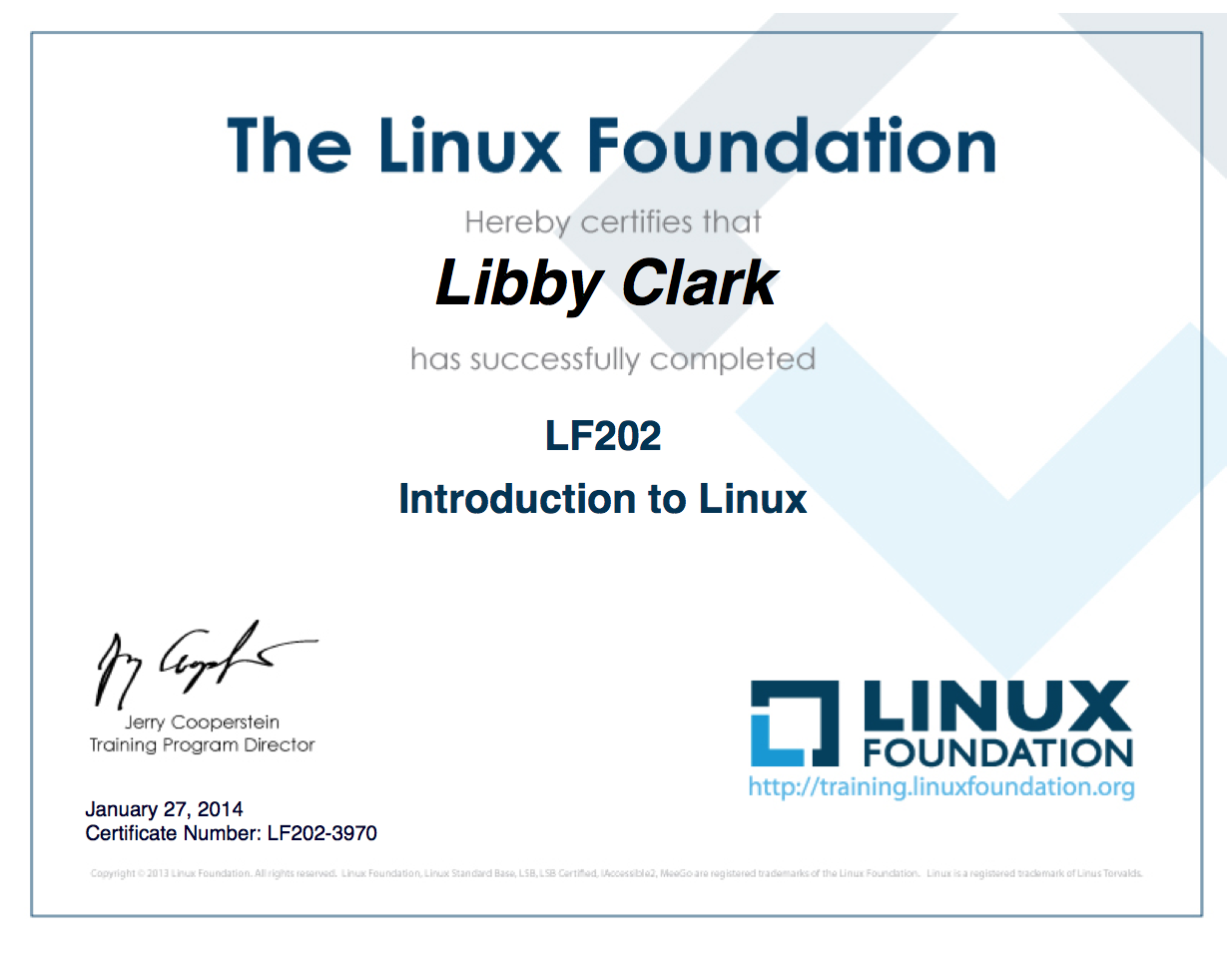
Now that I’ve finished the class (and proudly printed my certificate of completion) I find myself asking: “what will I do next?” The possibilities are endless.

For answers to your quesitons on the free Intro to Linux course from edX, see the summary of our recent Twitter chat with Linux Foundation Executive Director Jim Zemlin and edX CEO and MIT professor Anant Agarwal.

More Evidence That the Linux Wars Have Moved to OpenStack

It’s sort of funny that the press release announcing the new Ubuntu Linux 14.04 LTS release  seems as focused on Ubuntu OpenStack as on Linux per se. It’s studded with partner testimonials from Cisco, Mellanox, NTT Software, Brocade lauding Ubuntu OpenStack. But then again, that makes sense given that the vendor battlefield has shifted from core operating system to core cloud infrastructure, where Canonical OpenStack has gained traction with Hewlett Packard and other big cloud providers.

Not surprisingly, Canonical founder Mark Shuttleworth, (pictured above) who bankrolled then nurtured Ubuntu Linux from the cradle, is promoting the Ubuntu Linux/Ubuntu OpenStack tandem as the best foundation of next-gen clouds.

Read more at GigaOM.