
Andrew “bunnie” Huang has announced an effort to crowdfund an open laptop. They are ARM-based “hacker laptops” (and desktops) where the display opens “the wrong way” to facilitate access to the hardware inside. It runs Linux, of course, and all of the hardware design is freely available. “To be clear, this is not a machine for the faint of heart. It’s an open source project, which means part of the joy – and frustration – of the device is that it is continuously improving. This will be perhaps the only laptop that ships with a screwdriver; you’ll be required to install the battery yourself, screw on the LCD bezel of your choice, and you’ll get the speakers as a kit, so you don’t have to use our speaker box design – if you have access to a 3D printer, you can make and fine tune your own speaker box.” (Thanks to Paul Wise.)
Tiny Boards Stoke the Market for Wearables and IoT
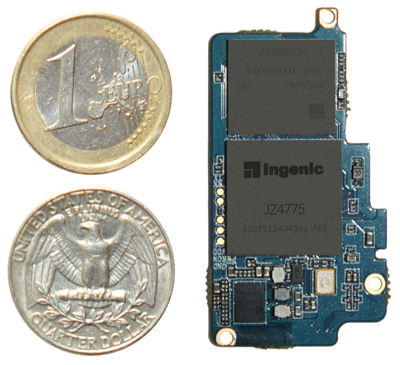 How do you get from a brilliant idea to a wearable computer or Internet of Things gizmo? Several computer modules have hit the scene recently that promise to expand the scope of lightweight computing devices to a broader field of manufacturers.
This week, Beijing-based Ingenic Semiconductor was the latest to jump into the wearables market with a MIPS-based Ingenic Newton module that runs Android 4.4 or Linux 3.08. The tiny (38 x 22mm) board goes head to head with Intel’s Linux-ready Edison module for wearables, which Intel amended last week to incorporate the Intel Atom instead of the lower-power Quark. Like the Newton, the Edison has expanded from a wearables-only focus to include a broader array of low-power Internet of Things (IoT) devices.
In the coming months, Freescale plans to ship a tiny, module-like Wearables Reference Platform (WaRP) single board computer aimed at wearables. The community-backed, $149 WaRP runs Android on a single-core, ARM Cortex-A9 Freescale i.MX6 processor. The module also integrates a sensor hub and a microcontroller for motor control.
Expect to see more such modules and SBCs in the months to come, especially on the ARM side. The devices aim to match up with a growing number of frameworks for low-cost IoT devices. On the firmware side, we have Google’s Android Wear and Samsung’s Tizen Wearable SDK platforms for wearables. IoT consortia, meanwhile, could spin more specifications, including The Linux Foundation’s AllSeen Alliance and the new Industrial Internet Consortium.
On April 2, Microsoft got into the act by announcing an IoT and wearables platform called Windows on the Internet of Things or Windows on Devices, depending on the report. Believe it or not, Microsoft’s maker-oriented SDK will be free. Could it — my heart be still — be open source? Microsoft showed off an Intel Galileo board as a potential development platform. The open source, Arduino-focused Galileo currently runs Linux on Intel’s Quark.
Like most computer-on-modules the Edison, Newton, and WaRP, lack much in way of the real-world I/O you’d find on an SBC. Yet, they pack in numerous functions and interfaces that should make life easier for OEM partners. Giant consumer electronics companies like Samsung and LG will likely choose to build their own wearable innards rather than tap such modules, but the devices should open up wearables and IoT to smaller companies. With the help of carrier boards, some open source hardware projects may be able to use them as well.
Here’s a closer look at the Newton and revised Edison, the two platforms announced over the last week.
Ingenic’s Newton
The Newton announcement was made by Imagination Technologies, which licenses MIPS IP to Ingenic for processors such as the Newton’s 1GHz XBurst JZ4775. Better known for its PowerVR GPUs, Imagination acquired MIPS a year ago, and has released the first of a new generation of MIPS-based Warrior processors.
Imagination hinted, but did not quite declare, that the Newton would support Android Wear. The ambiguous wording was explained by a PC World story that quotes Imagination’s Alexandru Voica. “Android Wear is still in development so we can’t claim full compatibility yet,” said Voica. “We are, however, the only CPU IP supplier on the list of Google ecosystem partners, so the MIPS architecture is fully covered.”
On Ingenic’s product page, wearables are just one of many listed applications. These include health care, home appliances, security, biometrics, industrial control, and consumer electronics.
The Newton can play 720p video and is capable of running a smartwatch for more than 30 hours, says Ingenic. The module is equipped with 3GB of DDR1 RAM, 32GB of eMMC flash, and a touchscreen LCD interface. WiFi, Bluetooth 4.0, NFC, and FM radios are supplied, along with audio, USB, and serial interfaces. Sensors include 3-axis gyroscope, accelerometer, and magnetometer devices, as well as temperature, humidity, and pressure sensors. There’s even an ECG biosensor for healthcare and fitness.
Edison swaps Quark for Atom
Intel demonstrated an Edison prototype at the January CES show, featuring a new dual-core version of Intel’s low-energy, IoT-focused Quark processor. Last week, however, Intel announced a change in plans. The Quark-based Edison is still under development, but the initial version due this summer will instead run on an unnamed, dual-core Atom CPU clocked at 500MHz. It’s unclear whether the new Quark has been delayed or if Intel received vendor feedback asking for a more robust processor.
The new Atom is based on the same power-stingy, 22nm “Silvermont” architecture used in Intel’s new Atom Z34xx (“Merrifield”) and Atom E3800 (“Bay Trail-I”) processors. It still won’t be as energy efficient as the 32nm Quark, but it’s likely to be faster and more feature rich.
The switch in processors results in a slightly larger footprint than the originally announced “SD card size.” In addition to the pre-existing WiFi and Bluetooth, the new Edison will add an extra MCU and over 30 I/O interfaces. Intel also plans to add support for Yocto Linux, Node.js, and Python, and will offer Arduino extensions. As a result of all these additions, Intel is now supporting “small form factor devices,” as well as wearables.
The Edison module emerged from an Intel research center in China. On April 2, Intel announced an Intel Smart Device Innovation Center in Shenzhen aimed in part at wearables. Intel also tipped a $100 million Intel Capital China Smart Device Innovation Fund.
Can One Size Fit All?
The question remains whether the Edison or Newton can each support the wide variety of wearable and IoT form-factors and applications. Wearables range from relatively dumb smartwatches and fitness bracelets to high-end eyewear computers like Google Glass. IoT is even more diverse, ranging from sensor-driven industrial devices to home automation gizmos like Google’s Nest.
Ingenic addresses this challenge by offering a modular design combined with customization services. The Newton’s OEM customers can ask to remove unwanted sensors or other features before slotting the modules into their next smartwatch, smart toaster, or sensor device.
The breadth of the wearable and IoT markets may have also figured in Intel’s decision to spin two different Edison models. The initial Atom based device will likely target higher end wearables and IoT devices while the Quark based model could go after lower end devices like mass-market smartwatches.
Although Intel dwarfs Ingenic in size, the latter arguably has the head start. Ingenic has already shipped its XBurst chips in three Android smartwatches, including the Geak Watch. It’s still anyone’s game.
One Engineer’s Hands-on Experience with KVM at Collaboration Summit
Arturo Gutiérrez Loza is a Computer Systems Engineer at Dell in Guadalajara, Jalisco, México. Arturo’s current position is a Systems Administrator Sr Advisor in the Dell Infrastructure Services Delivery area, working on process, procedures and tools improvements and knowledge management initiatives. Prior to this Arturo was Systems Administrator Advisor managing UNIX and Linux environments for the health care Industry.
 In the last five years I have experienced a few professional transitions, changing employers from a Software Engineering role to System Administrator role, and from developing and/or testing software for “Legacy” operating systems and proprietary software to infrastructure services delivery using large scale UNIX and Linux customer environments. I have gone from only imagining what challenges Systems Administrators have in developing systems management software, to actually knowing them first hand. Now in the last year, I have a new job working on process, procedures and tools improvements and knowledge management activities for UNIX and Linux Infrastructure Delivery at Dell.
Some of my stronger skills are on operating systems running on Power Systems (AIX and IBM i). From 2006 until 2013 I participated as a speaker and an attendee at Power Systems technical conferences, sharing experiences using “i” and AIX operating systems with Power Systems Community. However, businesses have been migrating workloads from “Legacy” operating systems to Linux successfully. For that reason one of my objectives for this year was to attend a Linux community conference to improve the depth of my skills on Linux.
In late February I got an invitation from the Linux Foundation staff to attend Collaboration Summit 2014, an exclusive invitation-only event in Napa, CA. Knowing that open source Linux virtualization technologies are getting mature, I also decided to take a one-day KVM workshop and attend some of the Open Virtualization sessions at the summit.
Hands-on with KVM
Kernel-based Virtual Machine (KVM) is an open source hypervisor that provides enterprise-class performance, scalability and security to run Windows and Linux workloads.To get started with KVM I used my work business-class laptop. To avoid changing the internal encrypted Windows disk setup, I used an external USB 3 portable disk to perform a CentOS 6.5 Linux Install, selecting “Virtualization Tools” and “Virtualization Platform” group installs. Other popular distributions will also include these virtualization tools like Red Hat, Fedora or Ubuntu.For detailed instructions you can consult the Kernel Based Virtual Machine project site.
Performance was very good during the workshop, running the main Linux CentOS image with KVM hypervisor installed, a small custom linux distribution provided by the Instructor as a guest operating system, and a Desktop Debian 7.4 I installed as guest operating system to put more stress workload on the setup. That was just one day of testing, but I am happy with the initial results. In the future I will be doing more proof-of-concept installs to push KVM technology to the limit and continue learning about it.
During the Linux Collaboration Summit sessions, open virtualization track, the message I got from speakers and other attendees was that KVM is ready for business to virtualize Linux workloads in the datacenter.
More open virtualization technologies
Some open virtualization technologies with more active development that are using KVM as a foundation include:
In addition to this, other virtualization technologies also mentioned at the summit were:
- LXC (LinuX Containers) that is an operating system-level virtualization method for running multiple isolated Linux systems (containers) on a single control hosts.
- Docker: Open Source project to automate the deployment inside software containers.
That gives us a lot of open source virtualization technologies to review, use and learn in the future.
In addition the the open virtualization track, I can mention that first day keynotes provided a very good overview about Linux development trends and a good understanding on how the open source community collaborates.
Others interesting sessions I was able to attend where about how to go from an Idea to a Corporate Sponsored Open Source Project and Open Source Compliance, among others.
In summary, Linux Collaboration Summit was a great way to understand how the Linux Kernel and Open Source community collaborates and I look forward to collaborating with them in the future.