
A Hackett Group study found that analytics, business alignment and talent were the biggest issue for IT execs for 2014.
Read more at Enterprise Open Source Toolkit
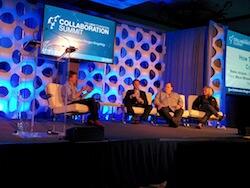 Companies are increasingly turning to collaborative software development to build their products and services and speed innovation, keynote presenters at Collaboration Summit told us this morning. But how does this process actually happen? Open source directors from Intel, Citrix and the OpenDaylight Foundation shared some of their secrets of collaborative development in an afternoon panel discussion, moderated by Linux Foundation Executive Director Jim Zemlin. Below is an edited version of the conversation, which covers the rise of open source foundations, how to attract top engineering talent, how to manage open source developers, and more.
Jim Zemlin: How would you describe what you do?
Neela Jacques, OpenDaylight Executive Director : I try to get an industry that’s bitterly competitive to work in a way that’s completely different from the last 20 years. To set aside some resources and work together on something without a direct ROI. I also work closely with developers to tackle the biggest problems in the industry and release great code.
Mark Hinkle, Director of Open Source Solutions at Citrix : I run Citrix’s open source business office. We develop ecosytems around open source projects that benefit our business interests, including Xen Project, OpenDaylight and Apache Cloudstack. We also do user enablement and developer relations, and educate partners on how to work with open source communities.
Mauri Whalen, Core System Software Director at Intel: I manage a team within Intel that’s part of the Open Source Technology Center. We make sure Linux-based operating systems run best on Intel architecture.
Zemlin: How do you manage developers who are influential in their communities? How do you decide how they spend their time and define the boundary between company and the project?
Mauri Whalen: It’s the business first. I look at Intel’s road map 12-18 months out and make sure Linux runs best on it. Past that you need to make sure open source developers have a lot of creative freedom. So we do have some flexible time for people to work on their own projects. It also involves a lot of open communication.
Neela Jacques: It doesn’t work to be a boss and tell other people what to do. It’s about being able to enroll people into a vision – listen to the community and try to tease out the common views. You don’t manage these folks – you show the challenges that exist, the possible solutions and facilitate people working together.
Mark Hinkle: Understanding your end game is critically important. Sometimes it may be to facilitate shared collaboration across companies. In that case governance and bylaws are importantso it’s vendor netural and they can collaborate. Others are aimed at user adoption. In that case you want to allow people with a single voice to make a difference, like plugins in a Firefox or Chrome browser, you have to allow all the discreet elements to collectively make the browser really powerful.
Zemlin: Some people have been critical of the recent rise of these open source foundations. Is open source a groundswell that happens from the bottom up, or is it a grand scale collaboration between large scale organizations?
Mark Hinkle: I do think there’s a rise of the vanity foundation and the reason it happens is it helps to have name recognition. The Linux Foundation has a strong success rate in Linux, but when you get to OpenDaylight, it’s hard to see the connection between Linux and this open source collaboration. That is a problem for awareness. If a developer drops code in the world and nobody’s there to see it, does it make a difference? Other than that singular reason I don’t think it’s necessary.
Mauri Whalen: You have to take advantage of when developers have good ideas to keep creativity and innovation going and brew that. You have to figure out if you want to try to make a business out of them and put Intel’s name behind them. Having foundations and specifications and standard APIs has it’s place and time, but allowing the creative minds to come out is still worthwhile.
Neela Jacques: The real question is : Can you boy-band an open source project? No, I don’t think you can. At the heart of every open source project is a singer songwriter. What you can do as a foundation is to get the songwriters together. There’s a support system to get it recognized. A set of smart executives can see a trend in the industry but they recognize that for something like OpenDaylight to work it can’t be controlled, it can be only be supported. You have to build frameworks and structure to enable grassroots efforts to thrive.
Mark Hinkle: It depends on the situation. Sometimes you’re looking to facilitate collaboration across partners, sometimes it’s to facilitate lower operation and deleopment costs, sometimes because you want to drive massive adoption and create an opporunity to support them in a commercial way.
Zemlin: What’s the most important element in enabling mass collaboration? Is it the bylaws, the tech development structure?
Mark Hinkle: It’s all about the ability for distributed contribution to the project. If you look at the Linux kernel, the actual kernel development happens among a small percentage of the users. Core development requires a high degree of coordination that doesn’t scale for mass collaboration. Mass collaboration allows collective intelligence to reign.
Mauri Whalen : There are different levels of documentation and bylaws with each project. Take Tizen for example, we’re primarily collaborating with Suamsung. They’re both a competitor and a partner so we need a neutral space to do these things. But it’s like most projects internally, you need a high degree of transparnecy and openness.
Neela Jacques: It’s three things: governance, culture and sweat equity. Governance helps answer questions with competitors. Culture is the trust that builds up between individuals where you don’t even ask the questions even more. And with sweat equity people have to be willing to help.
Zemlin: In every key sector of tech, whether it’s the Internet of Things or SDN or the cloud, big foundations are coming together and investing resources in building a huge new technology. There is a boy band factor to that in that the project is manufactured to answer a problem. The question is, who will be our Linus Torvalds? Which model works better – the benevolent dictator or the open board structure?
Mark Hinkle: It needs to be someone who is loving and touchy feely and soft spoken like Linus Torvalds. No seriously, it has to be someone who is solving a problem that’s very personal to them and has massive impact in their life. It has to be someone with passion in it. There are boy band open source projects – that’ happening prominently these days. It has to be driven by people who have a personal skin in the game, with a reason to do this who can be as tenacious as a rabbid penguin to do this.
Zemlin: You would argue Linus is a unique guy. What if you can’t find these people or to get started you have a technical steering committee?
Mark Hinkle: You can still have that, but maybe there’s a group of people who have a passion around that. Brett Salisbury is one of the reasons I think OpenDaylight will be successful, even though there is a foundation. You don’t need the foundation but you need those people.
Zemlin: How do you find these people who can be passionate and technically smart and successful?
Mauri Whalen: We go to a lot of conferences and talk to people. It’s also keeping things challenging and interesting to people and not putting people in a box. You need strong visionaries in the wild west. Once you start building that type of culture people gravitate toward it. They like to work in that environment.
Zemlin: How is it going for lack of Linus Torvalds in OpenDaylight? You have a technical steering committee.
Neela Jacques: It works just like many organizations. Every once in a while you ave a visionary leader that’s perfect for the task. But when you don’t have that you get multiple individuals who step up. It works because it’s a group of folks who believe in the vision that we can change how networking happens.
Zemlin: Since we can’t name who the next Linus Torvalds will be, can we name what the next big mass collaboration will be?
Mark Hinkle : I think it’s the class of projects : 3D printing and prosthetics. The idea that you can democratize a low-risk medical device that has a huge return on quality of life is what the next non-IT related collaboration will be.
Mauri Whalen: I go back and forth because the wearables and internet of things is big. But going back to the cloud and datacenter I think there’s still tons of room for innovation.
Neela Jacques: I’m bullish on OVS and Docker, but I’m really intrigued by Cloud Foundry. Developers need a good PaaS that saves them time.
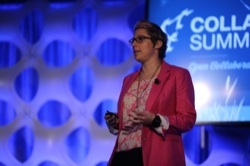 Open source and collaborative software development has evolved in recent years to become an essential part of technology industry innovation, said Linux Foundation Executive Director Jim Zemlin in his opening keynote at Collaboration Summit today.
While the world’s largest tech companies are spending billions of dollars a year on internal research and development (R&D) in order to innovate, many are also investing in what Zemlin calls external R&D through open source collaboration. These companies have reported lower development costs and shorter time to market for their products and services, he said citing data from the Linux Foundation’s Collaborative Development Trends Report released today.
“This form of development is so powerful it is ushering in a new era of how the tech industry in particular collaborates,” Zemlin said, “not just around Linux but around every existing, or in particular, new layer of the technology stack.”
The AllSeen Alliance is building the AllJoyn software platform for the Internet of Things that enables peer-to-peer communication between all kinds of devices, from mobile phones and tablets, to home appliances, cars and sensors. To do this, they must bridge communications not only between different brands, but between industry verticals, said Liat Ben-Zur, senior director of product management, at Qualcomm and chairperson of AllSeen Alliance, in her morning keynote.
“The vision we have is huge. To achieve the goals I’ve laid out of what the Internet of Everything can and should be, Qualcomm can’t do this alone,” Ben-Zur said. “We want the companies that are experts in all of those fields to help define that roadmap… This is something we really need to have as a collaborative project.”
In the networking industry, cloud computing and virtualization have brought massive changes to the datacenter that companies must now rapidly adjust to. But collaboration through standards bodies has been slow and can become political, said Chris Wright, director of software-defined networking at Red Hat and an OpenDaylight board member, in his morning keynote. OpenDaylight is redefining the networking industry through collaborative development, he said, by creating a common open source code base on which companies can then compete with their own differentiated products and services.
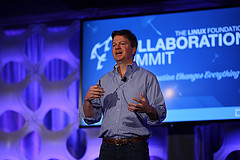 “It’s open source projects that are driving the technology behind all of this innovation,” Wright said.
Five years ago companies collaborated mostly by setting standards. They’d work together to write specifications that provided a level of interoperability and it was up to each company to implement it. Open source development has usurped that and companies now exchange code instead of, or in addition to, standards, Zemlin said.
This open source collaboration goes beyond paying software developers to work on open source projects and creates a new level of open source “professionalization,” he said. Leading edge companies have created positions and departments that manage the process of external collaboration itself.
Companies such as Intel, Samsung and Google have dedicated positions and teams already in place to manage the standards and practices around using and contributing to open source projects and are on the cutting edge of this form of external research and development. Their external R&D managers help decide which aspects of the technology to release as open source and what to keep for internal use. They also create a seamless process for contributing code as well as integrating open source code into products and services.
The rise of open source and collaboration has also led to the creation in recent years of numerous open source foundations, such as the AllSeen Alliance and the OpenDaylight project (both Linux Foundation collaborative projects) and many others, to act as a neutral place for companies to invest in open source technologies and do collaborative development at an industrial scale.
Open source software was first introduced in the enterprise by developers who used it in secret. CIOs and other managers would assert there wasn’t any open source within their walls only to uncover multiple skunkworks projects built on and with open source. Over the last decade, the use of open source software and tools has gone mainstream and today developers and managers alike understand and reap the benefits. Today no one gets fired for using open source.
 But while using open source is an old hat, the active formation of open source projects is relatively new. For instance, Linux was started by developers and then later was adopted by enterprise. Today a new trend is emerging: companies understanding that to keep pace with a fast-changing market they need to form and participate fully in open source projects from the beginning. Companies are learning that they can leverage external R&D with their own internal efforts to produce software faster and cheaper.
Companies in diverse industries across the globe are increasingly joining together to share development resources and build common open source code bases on which they can diversify their own products and services. These methods are dramatically disrupting the way technologies are being built and distributed: Linux, OpenStack, Hadoop, OpenDaylight and more are changing the way developers and business managers approach the world’s most complex technology challenges.
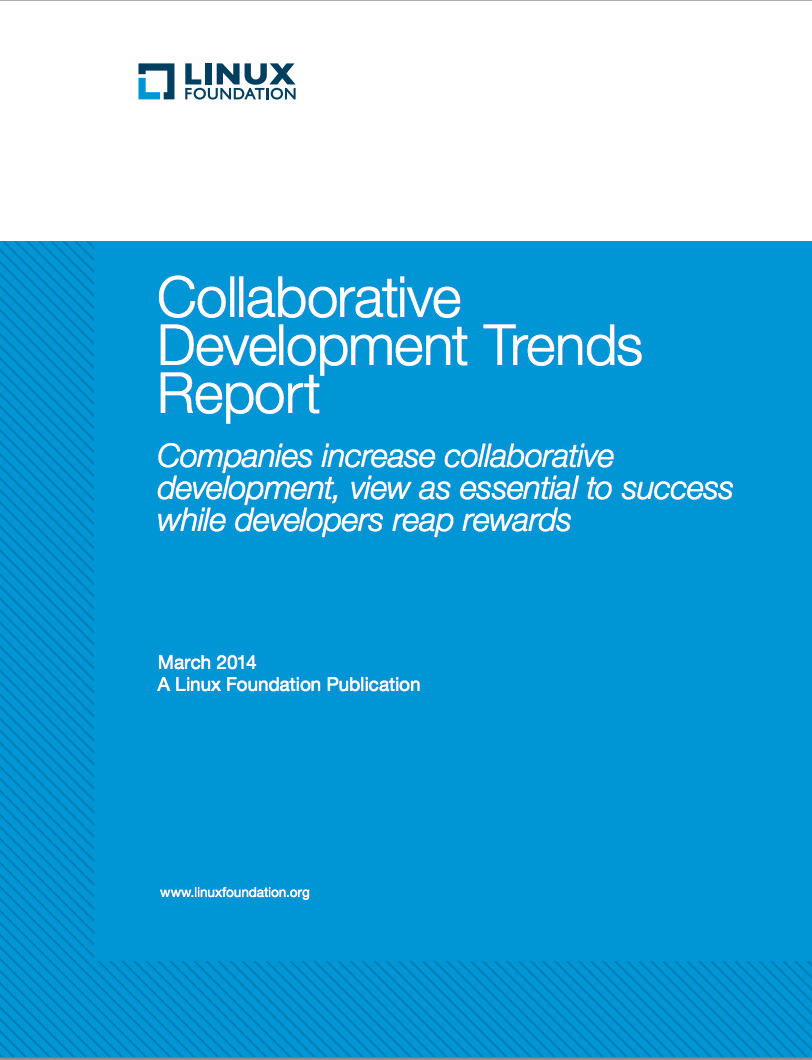
We now have data to confirm and illustrate this trend in more tangible terms. The Linux Foundation today is releasing the first-ever Collaborative Development Trends Report at our annual Linux Foundation Collaboration Summit. It surfaces new data that helps us understand how developers and business managers are working collaboratively to leverage open source to its fullest extent.
We’ve witnessed this disruption over the last few years as more and more companies, organizations and individuals have come to us for guidance on how best to set up a collaborative software project. The way Linux is built has now become the template for companies who want to start new software projects, because the method is proven and the benefits are many.
The business managers and executives surveyed for the report said they’re enjoying benefits such as faster time-to-market, reduced R&D costs, better relationships with customers and partners, improved product quality, competitive edge, increased organizational transparency and increased ability to recruit and retain talent. Developers, too, are winning with exposure to new tools and development practices, significant growth in their skill set, and a large, strong knowledge base from which to draw expertise and support.
Companies are also finding collaborative development to be an effective way to navigate a changing market. Just as Linux helped the enterprise market quickly adapt to a cloud-based world, collaborative development is helping the consumer electronics market deliver on the promise of the Internet of Everything; the networking space build more intelligent, software-defining networking infrastructure; and the mobile computing industry to reach far beyond fancy phones. One need not look further than the Linux Foundation Collaboration Summit itself for even more evidence of the diverse industries and technologies now involved in collaborative development.
A few years ago at this same event we released a video that illustrates the way Linux is built. It’s fitting that we are releasing a report this year at the event that illustrates how projects being created today borrow best practices from this model to accelerate product innovation and share R&D investments. The Linux kernel community pioneered this approach to software development and its success is an inspiration.
To download today’s report, please visit: http://www.linuxfoundation.org/publications/linux-foundation/collaborative-development-trends-report-2014
You can get the bullet points in the news release here: https://www.linuxfoundation.org/news-media/announcements/2014/03/linux-foundation-releases-first-ever-collaborative-development