
Based on the open-source ownCloud Community Edition, ownCloud 6 Enterprise Edition offers the cloud’s flexibility with on-premise business data control.
Read more at Enterprise Open Source Toolkit
 “The team at the Graduate School of Computer and Information Sciences wanted to give the computer a nickname – a name that would not only convey the super computer’s enormity in terms of size; but a name that would definitively link the super computer to NSU. Our mascot is the “shark” and the Megalodon, is the largest prehistoric shark known to man.”

Open source makes a lot of sense in rural areas and in third world countries. Lightweight and open source systems that are easy to use, and which allow normal users to become power users and contribute back to the open source community, can be ideal for countries like Cameroon, located in middle Africa.
Marc Stephan Nkouly, the manager of a successful Cameroon cyber cafe, is growing his business into a hub for education, entertainment, and entrepreneurialism, with the help of the up-and-coming open source operating system Peppermint. Open source technologies help to level the playing field and build a worldwide community of contributors to and users of tools that are providing new educational opportunities, resources, and jobs.
Puppy Linux 5.7 “Slacko” edition, a small and fast distribution built from and compatible with Slackware’s binary packages, has been released as the “flagship” Puppy release. From the release announcement: “Slacko Puppy is built from a ‘Puppy builder’ system named Woof, which can build a Puppy Linux distribution….

I love Docker, it’s a fantastic concept, and so far the execution and progress of the project has been flawless. I also love FreeBSD; FreeBSD is a clean and powerful system with advanced features like Dtrace, ZFS, and Jails. Combine the two and it sounds better than chocolate and peanut butter. With the recent version 0.9 release, Docker announced the infrastructure support to glue the two together, along with KVM, OpenVZ, Solaris Zones, and nearly any other environment for application isolation through an execution driver API.
The execution driver API support allows third parties to extend Docker to customize the environment of the container Docker builds. From what I can tell, the FreeBSD execution driver hasn’t been built yet, but I imagine it is not too far away. I envision that the (admittedly imaginary) FreeBSD driver would also take advantage of ZFS and the ability to create snapshots, clones, and the other ZFS goodness. The Docker FreeBSD driver could take the setup and possible complexity out of building and releasing FreeBSD Jails, opening up powerful technology to a wider audience.
Jes Sorensen is a Linux kernel engineer on the Platform Enablement Team at Red Hat, where he primarily works on Software RAID. He is also co-chairing Linux Plumbers Conference and works on WiFi device drivers when he has time.
 He has worked on the Linux kernel and userland for more than 20 years, in areas including KVM, the kernel-based virtual machine, high speed networking, Linux/ia64, Linux/m68k, the system libraries (glibc) and high-end NUMA systems.
This is article aims to continue our popular series on kernel developer work spaces. Previous posts featured kernel developers Shuah Khan, Steve Rostedt andGreg Kroah-Hartman. Is there a particular kernel developer you’d like us to feature? Let us know in the comments, below. Thanks!
Linux.com: What do you like most about your work space?
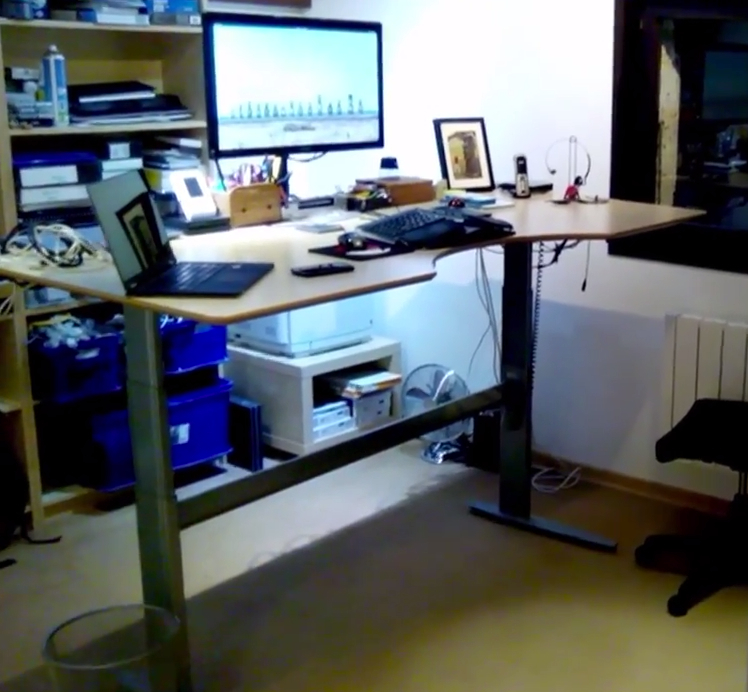
Jes Sorensen: My electrically adjustable elevation desk, which allows stand up or sit down and work as I feel like, not having to drive out when waking up and finding a foot of fresh snow on the ground outside, and of course my Jura J9 espresso machine (no kernel developer can function without one of these).
What do you like least?
Sorensen: I am terrible at building up a mess on my desk and leaving piles of gear all over it. Obviously, my office is *always* as tidy as it shows in the video, honest!!!
What’s the oddest work space you’ve ever used?
Sorensen: I don’t remember any particular odd space, but I would probably say the basement networking electronics lab at CERN back when I wrote the first parallel HIPPI drivers. Alternatively the Linuxcare Ottawa office, when the electrician crossed some wires resulting in sparks flying out of all the electrical sockets and everybody scrambling out of there in a panic.