Home Blog Page 1613

Verizon Signs Up To Cloudbees PaaS, Has Anyone Told Pivotal?

One for the “It’s Complicated†Facebook relationship status. Verizon is today announcing that CloudBees Platform as a Service will be available on the Verizon cloud. The Verizon Cloud, for those who don’t recall, was announced in October and is now in public beta. It includes an IaaS platform, Verizon Cloud Compute, and an object-based storage service, Verizon Cloud Storage, alongside a Cloud Foundry PaaS. But more on that later.

CloudBees, something of a secondary player against a backdrop of Cloud Foundry and OpenShift getting the bulk of the attention, is spinning this move as Verizon choosing them due to their openness (as opposed to other PaaS products from Heroku, OpenShift and EngineYard). So that makes sense I guess, where’s the complication?

Read more at Forbes.

Dear Car Makers: Please Hire People Like This

The interfaces in modern cars are, with rare exception, awful.

It’s almost absurd, really. The car is one of the most expensive things that people buy for themselves. It’s massive. It’s got a power supply that lasts for days… and yet, it’s one of the least “smart” devices in our lives. A three-year old tablet headed for the recycling bin puts the stock interface in most cars to shame.

The operating systems are slow, and often bug-riddled. If there’s a touchscreen, it’s almost certainly a crappy, low-res screen using yesteryear’s touch technology.

Read more at TechCrunch.

Ubuntu Touch Gets Grip on Its First Phone Makers

Android rival Ubuntu will be in “mid- to high-end” phones built by BQ and Meizu, the first manufacturers to commit to the British-made operating system. [Read more]

Read more at CNET News

It’s about the User: Applying Usability in Open-Source Software

Open-source software developers have created an array of amazing programs that provide a great working environment with rich functionality. At work and at home, I routinely run Linux on my desktop, using Firefox and LibreOffice for most of my daily tasks. I prefer to run open-source software tools, and I think most Linux Journal readers do too. But as comfortable as the open-source software ecosystem can be, we’ve all shared or heard the same comments about some of our favorite Linux programs:


  • “___ is a great program, once you figure out how to use it.”

  • “You can do a lot in ___, after you get past the awkward menus.”

  • “You’ll like using ___, if you can learn the user interface.”


That’s the problem. No matter how powerful the program, that functionality is lost if people have to figure out how to use the program in order to unlock its secrets. Typical users with average knowledge should be able to operate a general-purpose program. If a program is hard to use, that suggests the problem is with the program, not with the user.

Read more at Linux Journal.

Red Hat Increases its Focus on OpenStack Partnerships

Red Hat originally made a name for itself as the only U.S.-based public company exclusively focused on open source, as it has proved that its Linux-focused strategy could be very profitable. But the company’s future is increasingly being tied to cloud computing and OpenStack in particular. This week, Red Hat marks two years of collaborating with contributors and developers on key OpenStack.org projects “to bring OpenStack from a project to a product.” 

Mike Werner, senior director of Global Technology Partner Programs at Red Hat, has delivered a look back and some thoughts about the future of his company’s involvement with OpenStack. In particular, he notes that partnerships are key to driving OpenStack forward:


Read more at Ostatic

Debian 9.0 Reportedly Codenamed Zurg

The next Debian release, 8.0, is codenamed Jessie, but succeeding that will be Debian 9.0 “Zurg” in a few years time…

Read more at Phoronix

GTK+ 3.11.7 Uses New Wayland Methods

GTK+ 3.11.7 has been released for this week’s GNOME 3.12 Beta…

Read more at Phoronix

Who Helps Your Linux Distribution run smoothly? Thank a Packager Today

open source developers

The people behind the scenes who work tirelessly to make your Linux distribution run smoothly are the packagers. The vast majority of Linux packagers are volunteers who dedicate their evenings and weekends to create and maintain the gears of the Linux distributions they love.

read more

Read more at OpenSource.com

Storage Policies: Coming to an OpenStack Swift Cluster Near You

OpenStack storage policies

OpenStack Object Storage (code named Swift) has a fairly frequent release schedule for improvements and new capabilities but naturally, there is always significant gravity around integrated releases for any OpenStack project. Even though the Havana release was very big for OpenStack Swift, with new support for global clusters, the upcoming Icehouse will be the biggest release yet for the OpenStack Swift project.

read more

Read more at OpenSource.com

As Tech Jobs Increase, Linux Skills Top Priority List for Hiring Managers


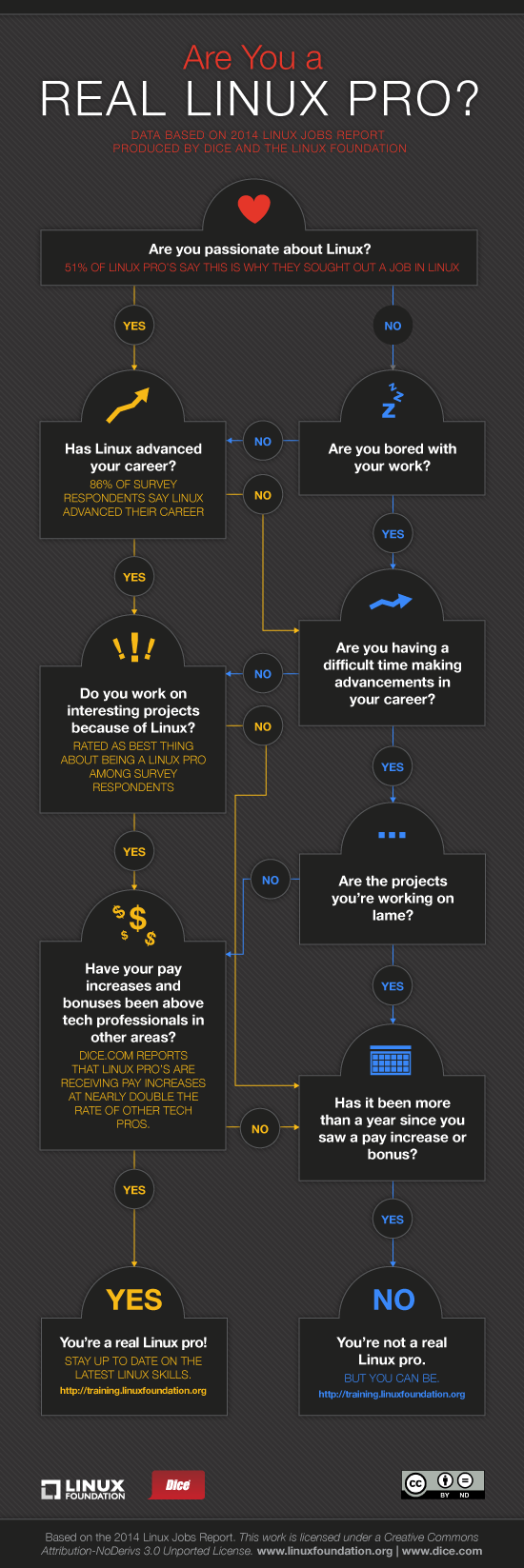
Are you a real Linux pro?US News & World Report recently published its annual ranking of the world’s “100 Best Jobs,” which orders the best occupations by demand, salary and employment rate, among other factors. For the very first time, Software Developer ranked #1 on the list, and systems administrator positions, from computer systems analyst to database administrator and more, ranked among the top 20.

If software developers and SysAdmins are the foundations for the new job economy, then Linux and open source are the brick and mortar.

Over the last decade, Linux has become the common platform for the software and systems that run our daily lives. In fact, 64 percent of the 4,000+ developers and IT pro’s we recently surveyed together withDice.com for the release of today’s 2014 Linux Jobs Report said they chose to work with Linux because of its pervasiveness in modern day technology infrastructure. Linux developers and SysAdmins are behind Android phones and devices, car infotainment systems, 3D printers, supercomputers, Facebook, Amazon, Netflix, Chromebooks, TVs and even crock pots. 

It’s no wonder that this year’s Linux Jobs Report shows demand for Linux professionals is higher than ever. Companies like Amazon, Facebook, Google, Netflix, IBM, Intel, Samsung and Texas Instruments, among others, are looking to employ professionals with these skills to help them drive technology innovation.

The report shows that 77 percent of hiring managers are prioritizing hires for Linux jobs above other openings, and nine in 10 plan to hire Linux pros in the next six months – – and they’re planning to hire more of them. This year’s survey saw a three-point increase in the number of hiring managers planning to hire more Linux professionals than before. 

The proof? Eighty-six percent of professionals surveyed said knowing Linux has advanced their careers. There’s no debating that. In fact, you might say that combined with the U.S. News & World Report ranking, this report finally confirms what Linux developers and SysAdmins have long held true: Linux jobs really are the best around.

If you’re wondering if you qualify to be a “real Linux pro,” check out the few questions on the graphic to the left to see where you rank. And, to download the complete report, please our Linux Foundation Publications website.