SolydXK started last March as the unofficial Linux Mint Debian Edition with KDE. Though there had been speculation that an official KDE version of the popular desktop distribution would surface, ZDNet wrote recently, SolydXK co-founders Arjen Balfoort and Amadeu Ferreira took it upon themselves, with the support of other Mint community members, to actually build it.
 Now less than a year later, Balfoort says SolydXK has gained esteem within the Linux community, thanks in part to some early positive reviews. In addition to supporting a home edition aimed at inexperienced users and Debian fans alike, they’re starting to develop professional support and services for business customers who are interested in using SolydXK on the desktop. The home edition will serve as a testbed for features in the business edition.
“The first year was focused on the early adopters, people from within the Linux community interested in what SolydXK has to offer: a stable base, with an attractive desktop, and a well structured update process to keep the system up-to-date,” said Balfoort, a business consultant and former Microsoft developer. “They make the core of our community, and spend a lot of time in making SolydXK better with each release.
“While development, and interface design is a continuous process, we need to focus on how to jump that (Geoffrey Moore’s) “chasm” in the coming year,” he said. “To accomplish that, we are going to market SolydXK outside the Linux community.”
Here Balfoort discusses how the distribution got started; how he built it; the community support behind it; lessons from starting a new open source project; and his vision for the Linux distribution as an ideal desktop for small and medium sized businesses and nonprofits.
Why did you create SolydXK?
Balfoort: During my working experience I have had many opportunities to see how enterprises manage their business processes with, and often without, the help of IT. When the environment changed for whatever reason, the necessity arose to change these processes. I found it rather surprising that the board of directors did not see the value of IT as being an intrinsic part of the business strategy. IT is considered as inevitable expenses, and not a part that is responsible for the ROI (Return On Investment). I also realized the steel grip of vendor lock-in, that lead to a form of snow-blindness: considering open source solutions as being part of your business IT architecture was not even considered, and licensing fees, maintenance costs, and replacement costs were seen as costly, but inevitable facts of life.
When I asked what was the argument for replacing the desktops, the answer was always that the current Windows version was out of date, and needed to be replaced…with the new Windows version. A quick survey made me realize that a large part of those desktops were used for simple office tasks, and that most specialized tools were browser-based, but still IT management did not consider any alternatives. That moment of astonishment made me want to learn more about what open source had to offer, how open source projects were organized, and what the added value for businesses could be. Being a Microsoft business consultant, I started within my comfort zone: the operating system.
How much experience did you have with Linux before you started the project?
Before I started the unofficial LMDE KDE, I had little to no experience with Linux. I already had a long career as a Microsoft consultant, and before that as a Microsoft developer, but Linux was quite new to me. The day I became a member of the Linux Mint forum (January 18, 2012) was the day I first installed Linux. I was still a Linux newbie when I started my “LMDE Homebrew” thread on the Linux Mint forum in June the same year. SolydXK co-founder, Amadeu Ferreira, was one of the first who started helping. He has a long experience with Linux, and in-depth knowledge of Debian in particular. SolydXK was born on March 1, 2013. So, you might say I had a pretty steep learning curve, and SolydXK wouldn’t have come this far if not for the help we received from our community.
How did you build it?
SolydXK was built with a lot of help from our community, patience, perseverance, and a healthy dose of pigheadedness. However, if you are referring to the technical aspects of the project, I would need to divide the project into the operating system itself, and the update pack process. The operating system is based on a regular live Debian testing ISO without a desktop environment. From there I added the packages that were decided by the community, adapted the configuration for a best out-of-the-box experience, created a design that would appeal to the target public, and developed software to fill in the gaps.
You cannot have a solid distribution without the right support, and one of our main concerns was the update process. How were we going to distribute our custom packages, and how would we be able to ensure a stable update process? Part of that update process is the repositories, from where all packages are distributed to our users. DTP (Development, Testing, Production) environments were set up for each repository, with a total of six repositories. All this is needed to keep the update process maintainable, and to minimize risk of breakage during upgrades.
What is your vision for the distribution now and where does it fit into the Linux ecosystem?
SolydXK’s home editions were primarily created to be a low-maintenance Linux distribution for the inexperienced user. They also serve to attract those important early adopters, the people with in-depth knowledge of the Linux system, and particularly Debian’s inner workings. They make up the core of our community, and they provide us the possibility to deliver a solid, up-to-date system with a unique upgrade system.
This is the perfect environment to find out what works, and what doesn’t. Technical issues are tackled far before Debian stable switches to a new stable version. The chosen software set, is decided within the community, and the same community proposes configuration changes to realize a better out-of-the-box experience.
All this collected knowledge is used to shape the Business Editions, and the coming support, and services. While Red Hat targets enterprises, SolydXK targets small, and medium sized businesses, and non-profit organizations with the Business Editions.
Who is the community behind SolydXK?
SolydXK was created within the Linux Mint community, and was known at that time as “The unofficial LMDE KDE”. We started SolydXK with just a handful of Linux Mint forum members. It was only because of some very positive reviews by Dedoimedo, Quidsup, and Full Circle Magazine that SolydXK became known within the Linux community.
How has your work in open source software informed your business work and vice versa?
With my experience I’m now able to better inform my customers about the importance of community centered business thinking, and that there are viable alternative open source solutions. It is important to understand that money is not a good motivation to choose an open source solution, and that giving something back to the community does not mean you’re losing control over the chosen open source solution.
Are you working on SolydXK full time now? How will SolydXK develop as a business?
Although I would love to spend all my time on SolydXK, it is unrealistic to do so at the moment. SolydXK is still a very young project. It’s slowly getting more attention within the Linux community, but outside the Linux community, it is blissfully unknown. We are now at the beginning of what is known as Geoffrey Moore’s “chasm”. The first year was focused on the early adopters, people from within the Linux community interested in what SolydXK has to offer: a stable base, with an attractive desktop, and a well structured update process to keep the system up-to-date. They make the core of our community, and spend a lot of time in making SolydXK better with each release.
While development, and interface design is a continuous process, we need to focus on how to jump that “chasm” in the coming year. To accomplish that, we are going to market SolydXK outside the Linux community, develop professional support, and services for businesses, and organizations. We need to find our first middle sized organizations that are contemplating changing their desktops, but don’t know where, and how to start. We also need to find partners to guarantee continuity. We’ll need marketeers, project leaders, developers, knowledge of international law, sponsors, and much, much more.
What have you learned about the Linux community and open source development in your first year?
The community is the heart of any open source project. From the beginning I knew that I had to carefully, and patiently keep working on creating a community where it is safe for beginning Linux users to ask their questions. Communities are fluid entities: individuals come, and go as they please. They bring with them an enormous diversity in experience, knowledge, and personality. An open, and democratic decision process is one of the major tools to encourage people to help shape the project.
Often the open source development process is compared with those of commercial companies where the latter has development focus, and Linux has not. This, in my eyes, is a misconception. Commercial business models focus on profit maximization through competition, where business processes are centered around the organization, and decisions are made by a board of directors. Linux focuses on collaboration, and diversity, where business processes need to add value to the community that gives Linux reason for existence, and decision making is a complex democratic process.
Comparing Linux to commercial companies, or considering these companies as competitors, is focusing on something that is not inherent to the heart of Linux: the community. Open Source projects exist because it has a heart, not a wallet that needs to be filled. It does not mean you cannot make a profit with open source, or Linux. It means that our motivation is not profit maximization, but adding value to the community. If making profit adds more value to the community, then making profit is part of our business strategy.
What advice would you give a developer interested in building their own distribution?
In the estate agency business, the mantra “location, location, location” is used to describe what is important. For any kind of business, but in particular for a starting business when the team is still very small, the mantra “focus, focus, focus” is more adequate. Open source projects often have a technical focus because the founders have a technical background. A single focus on technique will only endanger the continuity of the project on the long run. Make it clear what your motivation is, for whom you started the project, what you want to achieve, and how you plan to realize your stated goals. Only when that is clear, you can decide on the technical aspects of the project, and the processes that support the project.
What is your business pitch to companies outside the Linux community who are looking to change operating systems?
SolydXK is a stable, and secure operating system, and is a viable alternative for small, and medium sized businesses, non-profit organizations, and home users. SolydXK is not hardware intensive, and uses little hardware resources, which makes it suitable for even the older systems in your organization. SolydXK needs to be installed just once throughout the system’s live-cycle, and upgrades are thoroughly tested by our testing team, and made available in quarterly periods thus minimizing the risk of breakage to an absolute minimum. Support is given through our community’s forum, and this year we’ll professionally extend support, and services in the following areas:
-
Extended repositories life cycle, beyond Debian’s stable cycle.
-
Extensive support during stable transitions.
-
Advise on community centered thinking within (parts of) the organization.
-
Advise on, and realize open source middleware solutions, and enterprise integration.

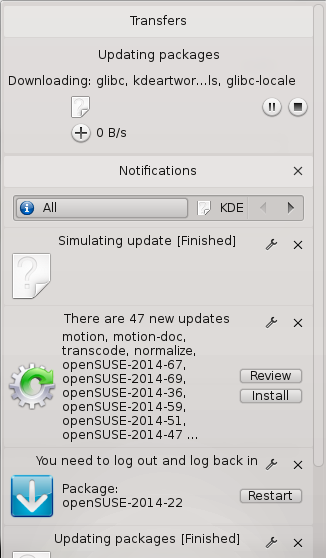
 Most distro reviews go no deeper than a quick look at a live CD/DVD, or a quick tour in a virtual machine, some commentary on the colors, a few screenshots, and done. Linux distro installers have been the best of any operating system for years now, so there is little point in discussing installation, and colors? Is it a mystery that we can change the colors? openSUSE 13.1 was released in November 2013, and I decided to use it for 30 days before reviewing it. Well, time got away from me and here it is nearly 60 days, so it has had a thorough pummeling at my brutal hands.
 default for a human user. So you’ll need to use the
 How focused has Samsung become on Chromebooks–portable computers that run Google’s cloud-centric Chrome OS?
  All over the technology arena, the Command Line Interface (CLI) still commands attention. As a case in point,