Home Blog Page 1643

Italy is Latest to Promote Open Source Software in Public Procurements

open source software in government

In December, the Italian government issued final rules implementing a change to procurement law that now requires all public administrations in the country to first consider re-used or free software before committing to proprietary licenses. Importantly, the new rules include an enforcement mechanism, which can, at least in theory, annul decisions that do not follow these procedures.

read more

Read more at OpenSource.com

How to Evaluate the Sustainability of an Open Source Project

Tools for evaluating project sustainability

Sustainable open source projects are those that are capable of supporting themselves. Simply put, they are able to meet their ongoing costs.

However, from the viewpoint of selection and procurement, sustainability also means that the project is capable of delivering improvements and fixing problems with its products in a timely manner, and that the project itself has a reasonable prospect of continuing into the future.

Elsewhere on our site you can find articles describing some of the many formal approaches to evaluating open source software as part of the Software Sustainability Maturity Model.

read more

Read more at OpenSource.com

FreeBSD 10.0 Final Released

FreeBSD Logo

After an extended series of beta releases, the FreeBSD team has released version 10.0 of the venerable operating system. FreeBSD 10.0 contains major improvements in the kernel, better hardware support, improved virtualization, root on ZFS, and many more welcome changes. As promised, this release removes more GPL licensed components, replacing them with BSD licensed equivalents, most notably replacing gcc with clang as the default compiler. The choice of the FreeBSD team to distance themselves from the GNU project and their philosophy on licensing is controversial, but further differentiating FreeBSD from Linux may be just what the system needs to regain its popularity.

Full release notes are available here. Where Linux has been the wild kid on the block, FreeBSD was always the wiser, more grounded older brother. Unfortunately, the wild kid was also the more popular one, gaining the attention of developers and corporations alike. Over the years the two systems have both matured, and Linux adopted the stability of its older sibling, while constantly gaining in popularity. In the past few years, Linux equivalents to FreeBSD Jails like LXC have developed to be both reliable and sophisticated. Further, tests run by FreeBSD developers have shown FreeBSD to be slower than Linux in real-world tasks.

 
Read more at Ostatic


Linux 3.14 Kernel Gets A Power Supply Notifier

The battery update to the Linux 3.14 kernel provides a new power supply notifier…

Read more at Phoronix

PiPad: The Raspberry Pi Tablet

You can’t buy a PiPad, but you can turn your Raspberry Pi into a tablet with some odds and ends and elbow grease.

How Linux Foundation Events Have Evolved


https://www.youtube.com/watch?v=-WUeelICQ2U?rel=0″ allowfullscreen=”true” frameborder=”0″ width=”300″ height=”247

Today we released our 2014 global event schedule. Back in 2007, we created The Linux Foundation Collaboration Summit because I could see a unique opportunity to bring together the developers, industry leaders and end users (largely from the enterprise) who were creating this thing we called Linux. We knew that face-to-face collaboration amongst disparate yet aligned groups could reap great rewards. Soon we were adding developers and companies from the world of mobile, then embedded computing, then cloud computing, then automotive to events first in North America, then Asia, then Europe. Basically everywhere Linux has gone, we have gone.

Seven years later, we are expanding to areas where our involvement doesn’t spring solely from our work with Linux. Industries and technologies of all kinds have discovered that collaborative software development works better in most cases than the proprietary models of old. We feel it’s our obligation to help spread the gospel of collaborative development far and wide and to enable other community groups, like The Apache Software Foundation or the kernel development community, to focus on what they do best and leave the event organizing to us.

I am proud to see our events become places where tomorrow’s technologies are being built today, in such areas as the Internet of Things, open networking, cloud computing, automotive software and mobile devices. Having organized more than 60 events around the world in the last few years, we are humbled to provide the neutral venues where much of this technical work is advanced.

We’re excited about the new events on our schedule: ApacheCon and CloudStack Collaboration Conference North America. These events are right around the corner, taking place in Denver in April. Please get your CFPs in by February 1. ApacheCon is more than doubling its tracks this year, and there are more opportunities than ever to share your work and learn from others.

If you are an open source developer, a DevOps pro, a Linux SysAdmin or a business person in an industry touched by open development, we have events that will help you build great things. I hope to see you at one or more of our events this year. From Napa to Chicago and Dusseldorf (and more), there are many great cities to explore while helping to change the world one line of code at a time.

Who Makes the Best Disk Drives?

Finally, someone with enough volume to test significant numbers of drives comes clean. There are drives to buy and drives to avoid.

A Collection of Secret Linux Humor

Who says Linux nerds can’t be funny? Enjoy this collection of amusing man pages and prank programs.
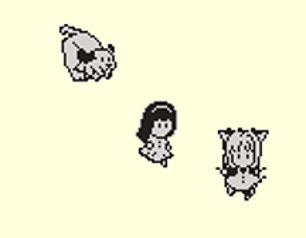
fig-1

Oneko the Cute Cursor-Chasing Kitty

oneko launches a tiny kitty cat that chases your mouse cursor. oneko has a number of options: -towindow makes the kitty climb to the top of the active window. -name [name] gives the kitty a name, like Spot. Then you can launch a second kitty to chase Spot:

$ oneko -name Spot
$ oneko -toname Spot

Other options include -tora for tiger stripes, -dog-sakura to run Sakura Kinomoto instead of a cat, and -tomoyo for Tomoyo Daidouji. Whoever they are.

xmoontool – Moon For The Sun / Werewolf Early Warning System

XMoontool is a fun antique program that still runs on modern Linux systems. The original moontool was written by John Walker (founder of Autodesk and co-author of AutoCAD) in 1987 for the SunView windowing system for SunOS. Then Ron Hitchens did some work on it, and in “September 1993- reported to Motif (as God intended) by Cary Sandvig”, which meant it could run on X11. This history is in the source code, in xmontool.c.

The current version, 3.0.3, dates back to 2006, and its age shows in jaggedy fonts and non-standard installation directories. It’s a source build so you will need a build environment (the build-essential package on Debian/Ubuntu/etc.) You’ll also need libXt-dev and libnova-dev. Run make and make install from the source directory, and both the executable and man page install into /usr/X11R6/ directory. What /usr/X11R6/ directory, you ask? The one that the xmoontool installer will create for itself, because that was reserved for X Window System, Version 11 Release 6 which is so obsolete it’s mummy dust.

Ron Hitchens wrote the man page which contains gems like the title, and these wise words of advice:

“…it displays a graphical representation of what the moon would look like right now if you were to go outside and look at it. (Go on, try it, the fresh air may do you some good)…For those who are lycanthropically inclined, the open window tells you when the next full moon will occur. This may or may not be something you’ll want to know.”
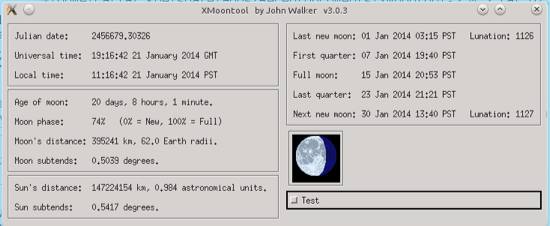
fig-2-xmoontool

xmoontools shows its age in its jaggedy fonts and tiny low-res moon image. Mr. Hitchens was kind enough to share some tips for anyone who wants to update and modernize it. When you examine the source files you won’t find any moon pictures because the icon images are bitmaps that were written out as ASCII numbers, and then compiled into the C source code.

“The imagery was not intended to be re-scalable, it was designed specifically for the 64×64 icon size. If I remember correctly, the code basically calculates where the shadow should fall on the image, then copies pixels one-by-one from the moon image, setting the ones in shadow to black (or dark blue for color) in the copy. If one were to make a more modern version, you’d probably build a mask and layer that over the image instead (in those days, we had exactly on bit per pixel on screen). It should be fairly easy to scale the calculations to compute the shadow for any sized image.

“If you really want to modernize it, I’d suggest starting with a more modern UI toolkit and new, higher resolution moon images. Once all the X Windows or SunWindows code is separated out, the remainder basically boils down to deciding how much of the moon to show. There are many ways to do that. The code in moontool/xmoontool is quite primitive because in those days we didn’t have a lot of pixels or memory to work with, or many useful image manipulation libraries, so we had to fondle the bits ourselves.”

If you decide to try this, please let us know the results in the comments.

Silly Man Pages

While we’re on the subject of humorous man pages, try the funny-manpages and asr-manpages packages. asr-manpages were collected from the old Usenet group alt.sysadmin.recovery. Which still exists, by the way, on Usenet and Google Groups. You’ll probably think that a lot of these are just plain dumb, but hopefully you’ll find some chuckles, and maybe get inspired to write your own silly man page. funny-manpages contains these joke man pages:

man 1fun date
man 1fun echo
man 1fun gong
man 1fun grope
man 1fun party
man 1fun rescrog
man 1fun rtfm
man 1fun rm
man 1fun tm
man 1fun xkill
man 1fun baby
man 1fun celibacy
man 1fun flog
man 1fun uubp
man 1fun condom
man 1fun flame
man 1fun xlart
man 6fun sex
man 3fun strfry
man 1fun egrope
man 1fun fgrope

asr-manpages has these:

man 8fun guru
man 8fun nuke
man 8fun bosskill
man 8fun knife
man 8fun pmsd
man 8fun ctluser
man 8fun luser
man 2fun people
man 1fun lart
man 1fun c
man 1fun slave
man 1fun sysadmin
man 1fun think
man 1fun whack
man 3fun chastise
man 8fun axe
man 8fun chainsaw
man 8fun cutter
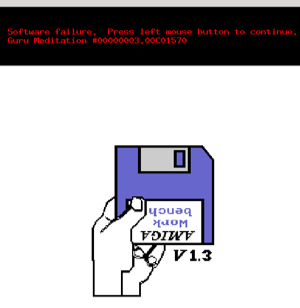
fig-3-software-failure-2

None of these are real commands; they’re just joke man pages, which is why they’re set apart with the special section names. What, you say, you didn’t know that man pages have section names? Indeed they do, because all the man pages on your Linux system are part of a single giant manual. There are eleven sections, and it is good to know this because many commands have multiple man pages in the different sections, so you need to specify the section to get the one you want. More rarely they’re two different commands, like man 1 apt and man 8 apt. Read man 1 man to learn all about finding, reading, and formatting man pages, and man 7 man to learn how to write a man page.

BSOD Screensaver

The BSOD screensaver, which is part of Xscreensaver, still makes me do a doubletake even when I know it’s running. It displays kernel panic and scary warning messages from all kinds of operating systems: Windows, Linux, Atari, Mac, Apple, Solaris, and many more (figure 3). It’s very configurable and lets you choose the operating systems, duration of each screen, and various color effects.

xjokes Messes With Your Screen

xjokes is a harmless collection of pranks that flash on your screen and then disappear. xjokes includes four commands: yasiti, blackhole, mori1, and mori2mori1 and mori2 are especially alarming, because they cover your screen with images of a girl winking at you (figure 4).

blackhole briefly blanks the screen, and yasiti looks like a little four-toothed spinning blade in the center of the screen. If you’re not into pranks you could use these as reminders to get up and take a break by creating cron jobs to run them at scheduled intervals, like this example that runs mori2 every hour during work hours on weekdays:

$ crontab -e
# m h    dom mon dow   command
  0 8-17 *   *   1-5   /usr/games/mori2

If you want to get creative you can hack the source code and use your own images. The source code is simple, so you can easily find all references to the image files and change them to your own image. Then recompile and see how it looks.
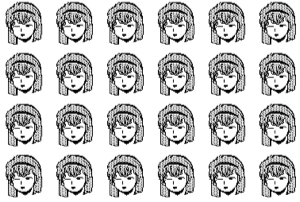

fig-4-xjokes-2

Phablets Are Officially A Thing, With 20M Shipped In 2013

God help us. Phablets are officially a thing.

According to Juniper Research, phablets are expected to hit 120 million units shipped by 2018, up from the estimated 20 million phablets shipped last year (2013).

Samsung validated the trend with the super-sized Galaxy Note series, which has gone on to be surprisingly successful for the Korean electronics giant.

The growth in the space is obvious when you look at Samsung’s numbers.

Read more at TechCrunch.

A Better Alternative to Code Reading

I have started code reading groups at the last two companies I’ve worked at, Etsy and Twitter, and some folks have asked for my advice about code reading and running code reading groups. Tl;dr: don’t start a code reading group. What you should start instead I’ll get to in a moment but first I need to explain how I arrived at my current opinion.

As a former English major and a sometimes writer, I had always been drawn to the idea that code is like literature and that we ought to learn to write code the way we learn to write English: by reading good examples. And I’m certainly not the only one to have taken this point of view—Donald Knuth, in addition to his work on The Art of Computer Programming and TeX, has long been a proponent of what he calls Literate Programming and has published several of his large programs as books.

Read more at Peter Seibel’s blog.