
Canonical is prepraring to land their first 3.13-based Linux kernel into the archive for the Ubuntu 14.04 LTS “Trusty Tahr” release…
Read more at Phoronix
Following a recent trend in network attached storage (NAS), Amahi, the open source home server software based on Linux, has added remote network access using its new mobile app for iOS and a forthcoming Android app.
The apps are the latest evolution in Amahi’s open source business model as the company grapples with how to scale up. Users will pay a subscription fee for streaming from their home server remotely over the internet – to, say, watch movies from outside their home network – via the free app.
“It’s a secure and easy way for users to access their files wherever they are… no VPN needed,” said Amahi Founder Carlos Puchol. “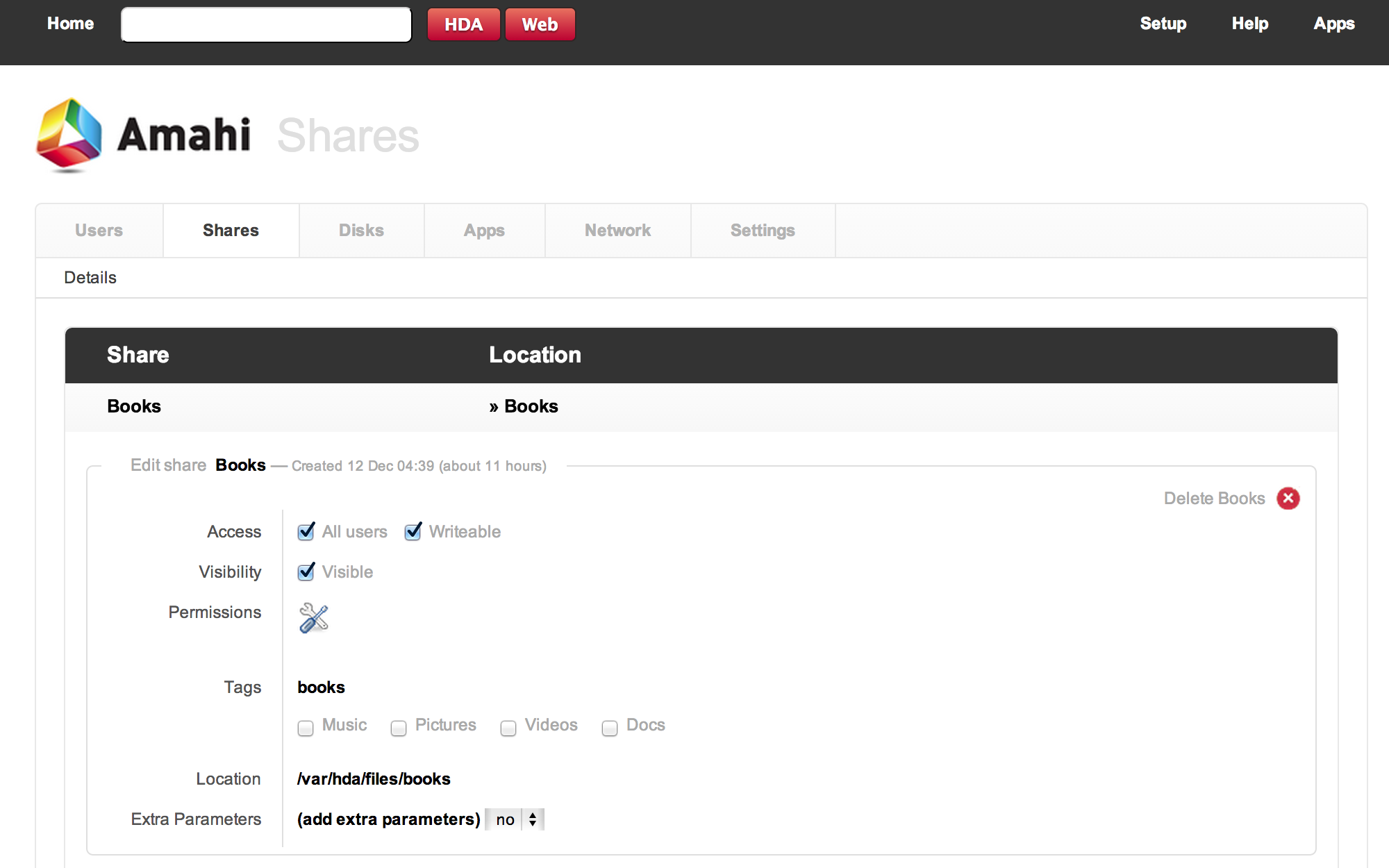 And the code our service is based on is all open source.”
Amahi has a web-based dashboard for managing SAMBA settings, hard disk space, sharing, passwords, etc., as well as their installed apps. The Amahi store offers hundreds of open source apps – most are free – including ownCloud, Joomla, Amahi DLNA server and OpenVPN.
Amahi got its start 8 years ago as a script for managing Puchol’s own home server. At the time, Puchol was a developer working on AMD64 – the 64-bit kernel for x86 code – and Amahi was the side project he occasionally shared with his friends. The “home digital assistant” software has since grown into a business that boasts a community of 85,000 users.
The latest distribution, based on Fedora 19, is free to download and installs on practically any piece of hardware – from an old PC to ARM-based devices – to create a home cloud server for storing photos, streaming music and movies, and sharing files.
In the early days, the company thought it could partner with a hardware vendor to sell a pre-installed setup but discussions with potential partners took too long, Puchol said. So they turned to packaging open source applications for easy install from Amahi’s substantial app store.
“We follow the app install instructions, configure DNS, databases, etc., package that whole thing into a one-click install and we charge people a fee for that convenience,” Puchol said. “What we do is very much in line with what the EFF (Electronic Frontier Foundation) preaches; if people are willing to pay for services around open source, as long as you don’t restrict their freedom, you’re welcome to provide value.”
Amahi wants to share that revenue with app owners who put their apps in the Amahi store. And while they currently offer a Dropbox-style cloud storage service for back-ups, there may be room to expand in the cloud, Puchol said. Revisiting the hardware vendor model, with the goal to reach users beyond the Linux community in the broader public, is also an option, “similar to what Android is doing but on a smaller scale,” he said.
Despite the rise of cloud storage services, NAS has stayed a popular option, especially among more tech-savvy users and those who just want to have more control over their own data. And Puchol anticipates demand to remain strong as the number of network-attached devices in the home continues to climb. It’s not practical for all that data, from dozens of devices, to be backed up in the cloud given bandwidth restraints and hosting costs, he reasons.
In the range of NAS options, Amahi offers more of a do-it-yourself approach compared with devices by Netgear, Qnap, and Synology, for example. But instead of targeting the small-to-medium business set as these dedicated hardware vendors do, Amahi is aimed at the techie with limited time, or the casual home user with limited system administration skills. Amahi installs like any Linux distro and can be accessed and managed over the web through a simple dashboard interface.
Amahi’s users fall somewhere in between cloud evangelists who believe all data will eventually live in the cloud (and therefore don’t need a home server) and skeptics who don’t want any of their data online, Puchol said. Users also tend to be more security-conscious, he said, and the community has grown significantly since the NSA surveillance leaks, even though the Amahi server alone is not a security-hardened device.
“We strongly suggest having it behind a hardware firewall or router,” Puchol said. “A lot of people are looking for that all-in-one machine, but we encourage having it separated.
“Amahi isn’t targeted specifically toward super security minded people,” he said. “We’re trying to strike a balance between being in a trusted environment, which is your network, or on the cloud, making it somewhat safe and secure from the outside.”
For more, see our previous coverage of Linux NAS devices.
Editor’s Note: This is a guest blog post by Adam Jollans, Program Director of Linux and Open Virtualization Strategy at IBM.
The key events of 2013 set up many of the changes in open computing that we can expect to see in 2014. This year, KVM (Kernel-based Virtual Machine) will go cross-platform, Linux will increasingly be deployed for mission-critical workloads, and the ubiquitous buzzword “software-defined” will amplify the need for open computing technologies. Here is a look at what’s in store for 2014.
Just like Linux, KVM is going cross-platform. This will usher in a new wave of adoption, with the open source hypervisor being deployed for new workloads. IBM has long supported KVM on the x86 platform, and there have already been experimental ports of KVM to a number of other platforms. And, as is already widely known, at the 2013 Red Hat Summit, IBM announced plans to extend support for KVM technology to IBM Linux-only Power servers. The result is that clients will have greater choice, when they adopt Linux-based systems, to drive new workloads such as big data, cloud, mobile and social computing.

Bolstering this innovation are IBM KVM Centers of Excellence. In November 2012, IBM opened its first KVM Center of Excellence in Beijing to promote KVM-based solutions from IBM and its partners, and help customers and partners explore open virtualization and open cloud strategies. The site for the first KVM Center worldwide was chosen because of the rapid adoption of virtualization and cloud computing in China, and was followed by a second KVM Center of Excellence for Wall Street clients in 2013.
There is increased interest in an open alternative to proprietary hypervisor technologies. Contrary to the conventional wisdom that customers have standardized on a single x86 hypervisor, a report by Gabriel Consulting Group shows marked diversity in the x86 hypervisors used in practice by IT departments which it coined “hyperversity.” The new support for KVM on Power, which will enable open virtualization on a really powerful processor, coupled with the support of the KVM Centers of Excellence, will help take this interest to the next level.
The adoption of Linux is accelerating as it is becoming a go-to operating system for more and more mission-critical applications. Linux is supported by IBM not only on the x86 platform, but also on the trusted mainframe and – high-performance Power servers. IBM plans to invest $1 billion in new Linux and open source technologies for IBM’s Power Systems servers, thus helping clients capitalize on big data and cloud computing with modern systems built to handle emerging challenges posed by new applications.
Many IBM clients have successfully implemented Linux with IBM hardware and software for their mission-critical workloads. Just to cite a few:
EVRY, one of the largest IT services companies in the Nordic region, has replaced its existing mainframes with three IBM zEnterprise EC12 servers running Linux, IBM z/OS, IBM DB2 for z/OS, IBM CICS and IBM IMS software, supporting 50 production LPARs for clients – and enabling the Oslo-based company to meet 10% year-on-year growth in transaction volumes; handle peaks in demand of up to 38,500 MIPS; and benefit from a non-disruptive capacity-on-demand feature that ensures the solution is future-ready.
Brodos AG, one of the leading distributors of telecommunications hardware, software and services in Germany, has consolidated to IBM BladeCenter HS23 servers with Intel Xeon processors, running SUSE Linux Enterprise Server with KVM, and an IBM Storwize V7000 Unified disk system. Brodos can scale up the IBM solution quickly and easily to provide for new customers – and the solution enables Brodos to maintain low operational costs, helping it compete successfully with international firms on new business.
Tokyo-Mitsubishi UFJ (BTMU) has developed an SOA platform to realize its “cloud-banking” concept. The SOA solution employs the IBM zEnterprise 196 mainframe as its platform, with SUSE Linux Enterprise Server as the operating system, divided by IBM logical partitioning. An MQ-based, high throughput messaging backbone was then built using IBM WebSphere Message Broker. With the SOA platform using WebSphere Message Broker, the bank has speeded up its ability to build services and has a service re-utilization rate increase of 18%.
 The new buzzword, “software-defined,” is really all about the virtualization of everything combined with intelligent software management of workloads and resources. With Software-Defined Environments, we are talking about virtualizing compute, storage and networking resources, and then dynamically allocating resources to those workloads based on their specific needs. For that, you need open, interoperable technologies like never before.
Recognizing the importance of open computing, there are a number of consortiums and frameworks working to advance open technologies in support of software defined environments. For example, the stated goal of the OpenStack Project, available under the Apache 2.0 license, is to produce the ubiquitous open source cloud computing platform that will meet the needs of public and private cloud providers regardless of size, by being simple to implement and massively scalable. It also provides management of virtualized compute, storage and network resources. The OpenDaylight Project is a collaborative project under The Linux Foundation that aims to advance software-defined networking and network functions virtualization. The Open Networking Foundation is dedicated to the promotion and adoption of software-defined networking through open standards development, and has introduced the OpenFlow standard, a software-defined networking standard. And KVM of course delivers open virtualization of compute resources. Undoubtedly, these initiatives will continue to advance open standards this year as organizations increasingly embrace the flexibility and scalability of Software-Defined Environments.
 Let’s not stop here – let’s continue this important discussion. Join me at IBM Pulse 2014 in Las Vegas (February 23-26), where I will host a panel discussion about the relevance of open technologies to Software-Defined Environments.
Adam Jollans is currently leading the worldwide cross-IBM Linux and open virtualization strategy for IBM. In this role he is responsible for developing and communicating the strategy for IBM’s Linux and KVM activities across IBM, including systems, software and services.
He is based in Hursley, England, following a two-year assignment to Somers, NY where he led the worldwide Linux marketing strategy for IBM Software Group. He has been involved with Linux since 1998, and prior to his U.S. assignment he led the European marketing activities for IBM Software on Linux.