
The first release candidate to KDE’s Plasma Media Center 1.2 is now available…
Read more at Phoronix

Nelson Mandela passed away today. He was 95.
I am not going to pretend to know all the details about his life or the intricacies of his struggle. What I do know is that he inspired a generation around change and equality. It was not just his philosophy that inspired so many…it was his action too.
He was and will always be the purest definition of ubuntu.
When Andy Rubin left his job heading up Google’s Android team earlier this year, it turned out he was heading for an even more droid-like project: robots. Rubin revealed to The New York Times that the Google “moonshot” he’s been working on is a robot project.
Rubin’s team has launched a “10-year vision” for building robot hardware and software by acquiring seven robotics companies, said Rubin, who began his career as a roboticist, but is best known for creating Android. The companies include Schaft, a spinoff from the University of Tokyo’s Jouhou System Kougaku(JSK) Lab that makes humanoid robots. The other acquired companies include robot arm markers Meka and Redwood Robotics, as well as firms that make other robot components and services, including Industrial Perception, Bot & Dolly, Autofuss, and Holomni.
 Rubin told the Times that manufacturing and logistics were some early targets for the project. The story suggested Google may apply the technology to its new Google Shopping package delivery service.
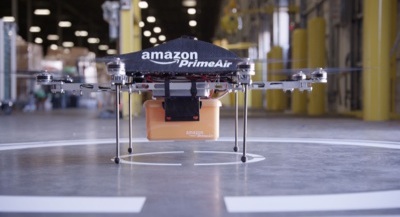
Amazon is also considering robots for delivery work. Earlier this week on 60 Minutes, Amazon CEO Jeff Bezos said his company is experimenting with robot drones for delivery of packages under five pounds. Whether the drones would be cost-effective or even permitted to fly by the FAA is under question.
Security is another issue. This week, hacker Samy Kamkar unveiled his Linux-based SkyJack drone, which he claims could take control of drones such as the Amazon prototype in mid-flight. Skyjack is a modification of the Linux-based Parrot AR.Drone quadrocopter, featuring custom software running on a Raspberry Pi. An even more insidious AR.Drone hack called the SkyNet instead hijacks ground-based WiFi routers.
It remains to be seen whether Amazon’s drone or Google’s robots will be based on Linux, though it already forms the basis of all the major products and operating systems launched by the two companies. These include Google’s other major moonshot effort: the essentially robotic Self Driving Car. Schaft, whose offices in Japan will be retained in partnership with Google’s robot moonshot offices in Palo Alto, Calif., has yet to offer details on its platform. The company posted a job listing, however, for engineers knowledgeable about Robot Operating System (ROS) and other similarly open source technologies like OpenRTM, Euslip, and hrpsys.
Google may well combine ROS and Android, just as ROS and Linux have been integrated in numerous robots, including Rethink Wireless’ Baxter. Google has already launched a working group looking to build ROS-compatible cloud services for robots. One of the enabling technologies promoted by the group is an Android compatible, ROS framework called RosJava. Developed by Google in partnership with now defunct ROS creator Willow Garage, the Java-based development platform is still in alpha stage.
While ROS/Linux robots typically integrate the two open source platforms on the device itself, Google may instead choose to keep Android as a separate, removable device. This is how Android is typically used in robotics, often in telepresence robots such as R.bot’s Synergy Mime and Synergy Swan. With R.bot’s Synergy robots, a motor controller in the base of the bot is in turn controlled by customer-supplied Android phones or tablets that act as the interactive “face” of the robot.
On the other hand, using an off-the-shelf Android device for a brain could prove limiting in a manufacturing environment. In this case, Google may instead augment the ROS motor controls with an embedded Android or Linux computer. Whatever solution it chooses, it seems likely Google will choose open source firmware. If it works for phones, laptops, and cars, why not robots?
To get a feel for how Linux is being used in robots today, see our slide show of top 10 new Linux robots.
