
Home Blog Page 1713

Automotive Linux Leaves Microsoft and Blackberry QNX in the Dust

Sales of automotive Linux are expected to rise to 53.7 million units in 2020, overtaking Microsoft and Blackberry QNX in the global automotive infotainment market, according to a new report from IHS Automotive.

“The auto industry prefers OS platforms in which it can control direction and features,” according to IHS. “Such control is not possible in proprietary OS platforms.”

This newfound control is allowing automakers to innovate at new levels and has helped fuel the Motor Trend Magazine’s car of the year for two years running. Both the Cadillac CTS sedan (2014 Motor Trend car of the year) and the all-electric Tesla Model S (won in 2013) run Linux.
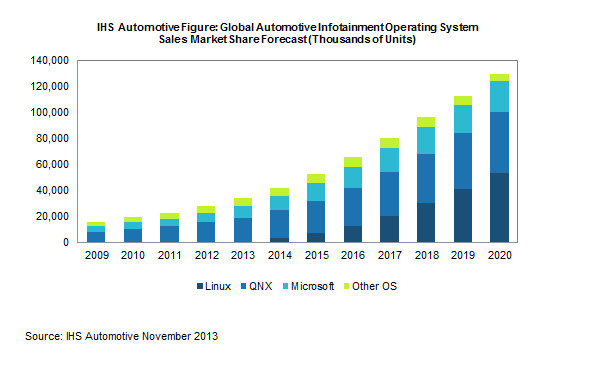
IHS-automotive-linux-graphicTogether they demonstrate that innovative minds from the automotive and open source communities are coming together to produce award-winning cars that impress critics and consumers alike. The IHS Automotive numbers prove it out.

Consumers expect automotive technology that easily integrates with their mobile devices and rivals that user experience. As a result, the automotive industry’s manufacturing cost has been shifting to the software and away from hardware. The Motor Trend cars of the year demonstrate the use of open source software that is developed collaboratively to address this shift and deliver unique and new experiences to the consumer.

GM’s Cadillac CTS boasts the same Debian Linux-based CUE (Cadillac User Experience) in-vehicle infotainment system that earlier this year hit the market in the Cadillac XTS sedan and that’s now present in most Cadillac models. Tesla’s 2013 Model S includes an impressive 17-inch flat-screen computer running a custom-built Linux OS.  

These advanced IVI systems provide all of the advanced features we want in luxury cars, from voice recognition and touch-powered controls, to navigation and telematics data from all of the car’s sensors. And they help directly position automakers to compete globally in a rapidly changing market. The CTS, for example, is part of Cadillac’s new wave of products that have pushed sales up 27 percent so far this year.

Cadillac CTS“(The CTS) has once again successfully evolved in order to remain contemporary and competitive well into the foreseeable future,” writes Motor Trend in its January 2014 issue announcing the car of the year.

GM and Tesla are not alone in embracing open source in order to meet this demand. Some of the world’s largest automakers including Nissan, Jaguar-Land Rover and Toyota are participating in Automotive Grade Linux to develop a common, Linux-based open source platform for IVI software development.  BMW, Peugeot, Volvo and others are working on standards and code for Linux based vehicles through an organization called GENIVI as well.

This disruption fueled by collaboration and open source software is what places Linux inside Motor Trend’s car of the year two years in a row. And it’s this work that will continue to shape the way we interact with our cars well into the future.


Amazon Web Services Worth $50 Billion By 2015, And That May Be Too Low

For a company that charges so little for its products and services, Amazon sure is worth a lot. Nowhere is this more true than in its Amazon Web Services (AWS) business unit. Despite dropping prices dozens of times over the past few years, one analyst is now projecting the value of the AWS business to top $50 billion by 2015, driven by success in its Marketplace.

At a mere 6X multiple on an estimated $8 billion in 2015 revenues, $50 billion may actually undervalue Amazon’s cloud business.


Read more at ReadWriteCloud

Ubuntu 14.04 Looks Toward Qt 5.2, Qt Mir In 14.10

Ubuntu 13.10 shipped with Qt 5.0 instead of Qt 5.1, since while it was available for months prior there were some “unfixed regressions” in the newer tool-kit release. With Qt 5.2 being right around the corner, Canonical is looking to switch to the newer open-source tool-kit release if there isn’t as much fallout…

Read more at Phoronix

Linux 3.13 Gets A Second Helping Of Power Management

A second pull request has been submitted for the Linux 3.13 kernel that provides further updates to the often less than desirable ACPI and power management code…

Read more at Phoronix

How to Protect Your Android Device from Malware

If you’re in the majority of Android users, your smartphone or tablet isn’t protected from malware attacks. In fact, Jupiter Research reckons that a full 80 percent of smartphones are unprotected. Why is that a problem? The answer is that even if your smartphone hasn’t been affected so far, it likely will be, and that’s because of the vast sums of money motivating criminals to seek out and capture financial data, passcodes, and other potentially profitable information. The more machines, the more money.

Read more at LinuxInsider

Manage and Limit Download/Upload Bandwidth with Trickle in Linux

Have you ever encountered situations where one application dominated you all network bandwidth? If you have ever been in a situation where one application ate all your traffic, then you will value the role of the trickle bandwidth shaper application. Either you are a system admin or just a Linux…

[[ This is a content summary only. Visit my website for full links, other content, and more! [[

 
Read more at TecMint

Qualcomm Adds New Chip for 4K Video to Snapdragon Line

The mobile processor giant also unveiled its fourth-generation 4G LTE processor with “significant” improvements in performance and power consumption. [Read more]

 
Read more at CNET News

How to Configure Raspberry Pi for the First Time

You flashed an SD card with Raspberry Pi image, and plug the SD card into Raspberry Pi. Then what next? The first thing to do after booting Raspberry Pi is to configure your Raspberry Pi. Each Raspberry Pi system comes with its own software configuration tool. For example, use raspi-config for Raspbian, firstboot for Pidora, […]
Continue reading…

The post How to configure Raspberry Pi for the first time appeared first on Xmodulo.

Read more at Xmodulo

GitHub Resets User Passwords Following Rash of Account-Hijack Attacks

GitHub is experiencing an increase in user account hijackings that’s being fueled by a rash of automated login attempts from as many as 40,000 unique Internet addresses.

The site for software development projects has already reset passwords for compromised accounts and banned frequently used weak passcodes, officials said in an advisory published Tuesday night. Out of an abundance of caution, site officials have also reset some accounts that were protected with stronger passwords. Accounts that were reset despite having stronger passwords showed login attempts from the same IP addresses involved in successful breaches of other GitHub accounts.

“While we aggressively rate-limit login attempts and passwords are stored properly, this incident has involved the use of nearly 40K unique IP addresses,” Tuesday night’s advisory stated. “These addresses were used to slowly brute force weak passwords or passwords used on multiple sites. We are working on additional rate-limiting measures to address this. In addition, you will no longer be able to login to GitHub.com with commonly-used weak passwords.”

Read 3 remaining paragraphs | Comments


Read more at Ars Technica

LLVM 3.4 Branched, Christmas Compiler Present Planned

LLVM 3.4 has been branched and is now under a feature freeze. Over the next several weeks there will be extensive testing done of this major update to the open-source compiler stack while an official release is planned to happen right before Christmas…

Read more at Phoronix