
Home Blog Page 1773

How Docker is Changing Linux Clouds

Docker is a Linux technology that is changing how many developers view running applications in a safe isolated way and which has now been adopted by Red Hat. Hardware-emulating virtualisation has ruled the cloud, but Docker-managed lightweight containers are now coming to the fore.

docker logoAlthough Docker’s container management has been limited to Ubuntu until now, this is changing. Docker has announced that it will be working with Red Hat to package Docker 0.7, the next version, for Fedora and together they are setting out to eventually support Docker with Red Hat Enterprise Linux. Docker’s creators, dotCloud, are also working with Red Hat to integrate Docker with Red Hat’s PaaS platform,OpenShift, getting libvirt support for Docker and more. But what does Docker bring to the Platform as a Service cloud?

At its heart, Docker simplifies managing Linux Containers. Although Linux has a number of ways to create containers – lightweight isolated Linux systems that run on the host without hardware virtualisation, contained and managed by the kernel – in their raw form they are usually not as simple as they could be to get working. Containers offer a more resource-efficient way of deploying and running multiple applications, because they share the Linux kernel between safely sandboxed virtual systems rather than using a virtual machine emulating hardware and running its own full Linux kernel and user space code. Taking LXC and Linux Containers as an example, to use them without application assistance, a user has to create the container, create a root filesystem, wire up virtual networking and then load up their application into the container. It can be a lot of work and it is not easy to reliably reproduce at scale.

AUFS Filesystem at Its Core

This is where Docker steps in to take on the challenge of loading containers so that they can be as convenient to use as their namesake in the cargo business. It’s that same convenience that has put Docker at the core of a number of new open source projects for orchestrating clouds of containerised systems and eschewing the weightiness of the more traditional virtualised cloud platforms.

So what makes Docker convenient? At the core is its use of AUFS, Another Union File System, which allows for an underlying read-only filesystem to be overlaid with a read-write filesystem that saves only the things changed for the underlying filesystem. This is all presented to the user and operating system as a single filesystem. In Docker, these filesystems are referred to as images and a selection of images can be stacked up to provide a container’s contents.

A user who wants to create a container based on Ubuntu would run docker pull ubuntu and this would download a set of images for Ubuntu. Once pulled, the images are held locally. These images are, by default, obtained from the other major element of Docker, the central repository at index.docker.io. This is provided as a public service by Docker’s creators, dotCloud. Docker users can search it for images which will fit their needs. For example, CentOS and BusyBox are among the popular images on the repository.

When Docker is asked to run a command the user specifies the image they want to run that command in. The command docker run ubuntu ls would create a container and attach the ubuntu images as read-only and create a read-write image over that. If the command made changes though, for example installing the Apache server with a command like docker run ubuntu sudo apt-get -y install apache, those changes happen to the read-write image. A user can also create a terminal session with the command docker run -t -i ubuntu /bin/bash and then run any commands within the container to create an environment ready to run an application.

If the command runs to completion and exits, the container will become stopped. If it launched servers or long running commands it will start running. The command “docker ps -a” will list IDs of all the containers, running and stopped, and any one of these images can be committed, with the docker commitcommand, to the local image store to preserve it and allow it to be recalled easily. They can also be pushed back up to the index.docker.io repository for others to use; index.docker.io only holds public images, but it is possible to build a private repository server for an organisation.

Scripts for Running an Image

These are all useful features but there is still a lot of manual intervention in creating and running an image in a new container. That’s where one other feature of Docker comes to the fore, Dockerfiles. These are “scripts” which allow the entire process of creating an image to be encapsulated in a single file, including selecting a base image, setting metadata and environment variables, executing commands, configuring networking and file access, exposing ports for servers and setting what command should be run to start the application in the container. A Dockerfile can be run with the docker build command which will result in a locally saved image and a docker run command can get it up and running.

This text-file-driven simplicity, combined with a REST API behind the scenes, has made Docker ideal to use for running applications in systems orchestrated over multiple machines. For example, Dokku is a “mini-Heroku” PaaS (Platform-as-a-Service) which uses Docker to run applications written in various languages within their own containers and, in turn, it has inspired projects such as Flynn, a more extensive PaaS. The Erlang cloud Voxoz also uses Docker as part of its deployment formula. Docker also finds uses in providing a quick way to deploy applications such as the open source CI platform Strider which distributes Strider as either a DockerFile or an image of its software.

For existing PaaS platforms such as Red Hat’s OpenShift, Docker will offer a new level of virtualisation within the cloud with application-level portability, rather than just emulated virtual machine portability. In the process, Docker will also be losing its dependency on AUFS and gaining support for Red Hat and Linux’s thin-provisioning technologies. That change will make Docker available to even more Linux distributions and able to integrate and change even more clouds.

Demand for Linux on IBM’s System z Accelerates, Clients Continue to See Cost Savings

This is a guest blog post by Greg Lotko, vice president of IBM System z. 

Greg Lotko, IBMRecently, at LinuxCon 2013, IBM announced another investment in support of the Linux open source community – a pledge to invest $1 Billion to promote Linux development on Power Systems. This assurance echoes IBM’s landmark 1999 decision to invest in the Linux platform across all its units including, Linux on System z and IBM Software Group Linux support. By reinforcing its commitment to Linux, IBM continues to build upon all of its previous and ongoing investments.
The announcement further strengthens IBM’s strategic commitment to Linux and other open source technologies, such as OpenStack, and comes on the heels of IBM’s acquisition of CSL International, the producer of virtualization management software for Linux on System z. The August 2013 purchase of CSL International continues to reinforce our commitment to the Linux platform. IBM’s initial Linux investment in 1999, and continued investment across all hardware platforms is helping transform enterprise data centers, fueling the tremendous interest, development, and support for Linux on System z.  

When Linux support on System z was introduced in 1999, it was met with both curiosity and skepticism as Linux was not yet a widely accepted technology. However, over time, as virtualization technologies were adopted, clients have realized the robustness of Linux on System z by experiencing the economic benefits and improved quality of service that are key advantages of Linux workload consolidation. These gains have resulted in System z being able to grow into an enterprise level Linux leadership position. 

Today, Linux on System z is a quickly growing and accepted Linux platform for server consolidation and Linux workload deployment with an installed MIPs CAGR of 48 percent. More than 75 percent of the Top 100 System z accounts run Linux, on the Integrated Facility for Linux (IFL). Linux is helping IBM attract new clients to the System z platform, such as White Cube in the UK, and is enabling existing System z clients to tackle new workloads, cut costs and meet new business requirements, by integrating new and existing workloads.

Clients like Algar Telecom (Brazil) migrated from the x86 platform, to Linux on System z to support their growing business. In the process, Algar cut their data center costs by 70 percent, reduced their maintenance effort by 65 percent and boosted operational efficiency by 30 percent. (Get the full details from the IBM Algar case study.) Other examples are Nationwide Insurance (US), which saved an estimated $15 million over the first three years, and Baldor Electric (US), which eliminated 200 servers and cut their energy costs by more than 60 percent. Even clients with smaller IT budgets like EFiS EDI Finance Service AG (Germany), National Registration Department of Malaysia and Shelter Mutual Insurance (US), have saved or expect to save thousands of dollars a year in IT costs with their move to Linux on System z.

Open source technologies like Linux provide businesses with exciting opportunities to increase flexibility, cut costs, and drive business innovation. IBM’s Linux for System z and virtualization development teams in Boeblingen, Endicott, Bangalore, Beijing, Moscow, Brazil and Israel continue to push the boundaries of enterprise level Linux development working in close cooperation with the IBM Linux Technology Center and our distribution partners Red Hat & SUSE to address business and client needs. 

**All Stats as of 2Q13.

Greg Lotko is the vice president and business line executive for IBM’s Systems & Technology Group, System z division. He is responsible for all facets of IBM’s mainframe business including strategy, architecture, operations, technology development and overall financial performance.  

An Interview with Knoppix Distro Founder Klaus Knopper

A couple of weeks ago I approached Klaus Knopper (Founder of Knoppix) via email asking whether he would be interesting in answering a few questions about the Knoppix project. Knoppix is one of the oldest Linux distributions, yet it is as relevant today as it was when it was first released.

Without further ado here are the questions I put to Klaus and the answers that he gave.

Please can you introduce yourself with a brief explanation as to how long you have been working with Linux and your relation to the FOSS world?

Because I was never much interested in computers, I started quite late and got interested in writing software only because of my studies in electrical engineering. It was the time when there was no WWW yet, but electronic communication and sharing of ideas and working on projects over the internet caught my interest.

For more read the Everyday Linux User blog.

French National Police Switch 37,000 Desktop PCs to Linux

France’s National Gendarmerie — a national law enforcement agency — is now running 37,000 desktop PCs with a custom version of the Linux operating system, and by summer of next year, the agency plans to move all 72,000 of its desktop machines to the open source OS.

Linux is now the primary means of running computer servers inside the data centers that drive the web’s biggest services, from Google to Amazon to Facebook, but it has struggled to replace Microsoft Windows on the desktop. The news from the Gendarmerie could be a sign that this is changing.

Read more at Wired.

Great Talks Mark First Xen Project User Summit

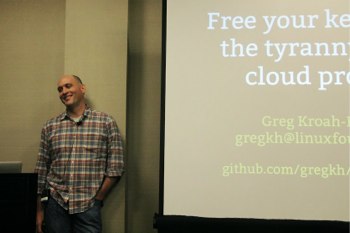
Greg-KH-Xen-SummitThe first Xen Project User Summit may be over, but it has left a fine legacy in its wake.  Co-located with LinuxCon and CloudOpen in New Orleans, the event featured some excellent talks covering a wide range of Xen-related subjects.  From clouds to orchestration, from hardware architectures to file systems, the Summit gave attendees much to think about.

The day began with the keynote address from Demetrios Coulis of CA Technology.  He described how CA’s AppLogic product relies on the leading-edge capabilities provided by the Xen hypervisor to facilitate the product’s virtualization fabric.

The Featured Talk of the afternoon session was Greg Kroah-Hartman, maintainer of the stable branch of the Linux kernel, who discussed some interesting concepts regarding the use of kexec to boot alternative kernels within a Xen VM.  He hopes to have a working model in time for the Xen Project Developer Summit in October.

Other highlights from the day’s talks included:

  • Bryan’s Smith’s amusing introductory session called “Xen for Puppies” which explained basic Xen concepts using a variety of puppy photographs.  Even the most experienced among the attendees had to snicker at the images Bryan presented.
  • Olivier Lambert’s outline of the Xen Orchestra project, which seeks to provide a useful web interface to XAPI and XenServer.  Xen Orchestra has been building fans in recent months with the work done so far.  And while there is plenty of work yet to do, it has definitely made considerable headway toward its goal.  Check out Olivier’s slides to learn more, and if you are interested in developing a GUI for Xen, consider pitching in.
  • Karanbir Singh of the CentOS project discussed the task of adding the Xen hypervisor back into the distribution.
  • Patrick McGarry of Inktank clued us in on the Ceph filesystem and how it integrates with Xen.
  • And Larry Wikelius of Calxeda gave us a look into the future of Xen on ARM, telling us why it will be so very important.

Cloud technologies were well represented as well.  Paul Voccio of Rackspace gave us a run down of using Xen on OpenStack at Rackspace.  Then Chiradeep Vittal of Citrix Systems discussed network multi-tenancy of Xen clouds using CloudStack.

James Bulpin, CTO of XenServer, and I tried to clear up the confusion between Xen Project, XenServer, and XAPI.  A lot of people aren’t sure where one ends and the next begins.  We helped to draw the lines and even gave the attendees a short quiz to see if they understood which was which.

Perhaps the biggest surprise of the day was Grant McWilliams’ talk describing a Xen-based security appliance.  It’s one of those case studies which challenges the mind, talking about a use of Xen which most people would not anticipate.  You can watch Grant’s stimulating talk here.

https://www.youtube.com/watch?v=7qlCVNxZ-ZY” height=”315″ width=”420″ allowfullscreen=”true

 Karanbir Singh summed up the day nicely when he said, “There were some great opportunities for conversations and just meeting up with everyone.  Although we had a small audience on the day, it’s generated no less than 20 emails to me and I suspect there might be a few more coming in the days down the road.”

Even if you missed the Summit, you can still join in

Slides for many of the talks can be found in the presentation section of the XenProject.org website.  Videos of the talks themselves should be published over the next several days.  Check the XenProject.org videos list to see them as they become available.

The Xen Project is looking to create additional user-specific events in the future.  We’d love to hear your suggestions on how we can improve these events in the future.  Contact me at This e-mail address is being protected from spambots. You need JavaScript enabled to view it with your comments.

The Linux Foundation Sets Program for Big Automotive Summit

Vehicles have been an emerging platform for Linux for several years, with many of the auto makers and a few technology standards bodies participating in collaborative development, plus steadfast support for the trend from The Linux Foundation. The foundation’s Automotive Linux Summit is coming up in Edinburgh, October 24 to 25, and features a number of top speakers. The summit actually covers Linux and open source technologies for infotainment (IVI), driver assistance, connected cars and more. The agenda for this latest conference is set, and here are the details.

The Automotive Linux Summit will feature speakers from around the globe “who are accelerating open source advancements in the auto industry.” A Hacker Lounge will also showcase a car with a Tizen-based IVI system for developers to test code and try out new apps. The Automotive Summit is also co-located with LinuxCon and CloudOpen Europe.


Read more at Ostatic

Intel Iris Pro 5200: Windows 8 vs. Ubuntu Linux Redux

Earlier this month I published benchmarks of Intel’s Iris Pro 5200 graphics when comparing the Intel driver performance between Windows 8 and Ubuntu Linux. The test results found that there were some performance wins for Intel OpenGL on Linux after the very latest open-source driver optimizations were made, but there are still some losses. In this article are a few more Windows 8 vs. Linux benchmark results for the Haswell Ultrabook with Iris Pro graphics.

Read more at Phoronix

Virtualization Won’t Save Your Data

Some people believe that virtualization makes their data safer. They’re wrong.

Android 4.3 on Tap for Galaxy S4, S3, Note II, Says Report

The report came from French carrier SFR, which plans to kick off the updates in October. [Read more]

 
Read more at CNET News

Qt 5.2 Alpha Gets Love From Bluetooth, NFC, QML

As was expected to happen, Qt 5.2 Alpha 1 is now available for downloading. Qt 5.2 is set to introduce several new default modules, tidies up the Android and iOS support, has a new JavaScript engine for Qt QML, and there’s a whole host of other changes for this leading open-source tool-kit…

Read more at Phoronix