
After showing improved performance with the new VMware Fusio 6, are there any upgrades in moving virtual machines from Ubuntu 13.04 to the soon-to-be-released Ubuntu 13.10?..
Read more at Phoronix
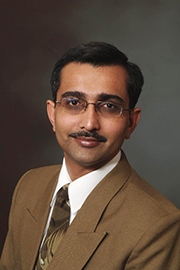
This is part one in a two part series on how to use open source ConVirt to manage virtual machines written by guest contributor Jaydeep Marfatia, executive vice president of engineering and founder of Convirture.
 When server virtualization first took the IT industry by storm, there was only one real solution on the market – VMWare. A lot has changed since then. Many companies are looking at open source virtualization like Xen and KVM to see if they can use it for production workloads. We believe, from a performance and scalability perspective, both are ready for prime time, but from an infrastructure management perspective, there seems to be a lot of holes, particularly when you compare the management tools against VMware’s vCenter. There are several products looking to fill this “management gap” in open source virtualization, including virt-manager, oVirt, openQRM, and ConVirt.
In order to use open source (or any source) virtualization, you need to have robust management of your infrastructure (e.g. your host servers, virtual machines, network and storage). This means that, across this infrastructure, you need to be able to address the following areas:
Part two of this post will give specific guidance on using Convirt Open Source, which offers an open source, agent-less lifecycle management solution that works for both KVM and Xen. In addition, I’ll touch on some of the advanced automation capabilities which are available in ConVirt’s commercial (e.g. paid for) version as well.
Today, I’ll give you an overview of ConVirt Open Source, who’s using it and why.
ConVirt Open Source enables businesses using KVM and/or Xen to standardize and proactively manage virtualized environments in a centralized fashion. Businesses can create and provision “gold” images, diagnose performance problems, and balance load across the data center, all from an interactive Web-based interface and with a consistent feature set across open source virtualization platforms. As an open source product, ConVirt Open Source is licensed under GPL and is free to download and use.
Who Uses ConVirt?
You should consider using ConVirt if you fall into one of the use cases below:
For more, see part 2 in this series, How To Build Your Virtualized Datacenter Using Open Source, Linux, KVM and Xen.
Jaydeep Marfatia is Executive Vice President of Engineering and Founder of Convirture. Jaydeep is responsible for all aspects of product development at Convirture. He brings a wealth of industry experience to his current role, including over 10 years in systems management. Prior to co-founding Convirture, Jaydeep held a senior engineering management position in the ASLM division at Oracle, and was one of the principal architects of the Oracle Enterprise Manager 10g product suite. He holds a degree in Computer Science from the University of Mumbai.
 After more than 20 years of development, Linux is the largest, most successful collaborative project in the world. More than 10,000 developers from more than 1,000 companies have contributed to the Linux kernel since tracking began in 2005, according to the foundation’s latest annual development report. It powers servers, mobile devices, stock exchanges, cars, appliances, air traffic control towers, the space station, genomics research… the list goes on and on. So, what’s next?
Ask Mark Hinkle, senior director of open source solutions at Citrix. He’ll speak at LinuxCon and CloudOpen Europe in Edinburgh, Oct. 21-23 on how the Linux and open source communities can build upon their success for the betterment of technology and the world. In this Q&A he gives a preview of his talk and discusses maintaining the values of the Linux community; how users can help sustain innovation; Citrix’s contributions to open source software and Linux; and the role of cloud computing in the future of Linux.
Can you give us a preview of your talk? Where does Linux go from here?
Linux has become an unquestionable success. The 21-year history of Linux is a manifestation of the Mahatma Ghandi statement, “First they ignore you, then they laugh at you, then they fight you, then you win.” As it has evolved from Linus’ hobby to a worldwide success as a server, desktop, mobile and embedded platform Linux has had a drag-along effect providing a rising tide to so many other open source boats.
This talk will focus on how Linux is no longer just an operating system. Open source isn’t just a software development methodology, as the term is no longer being applied only to specifically licensed software projects. It has become a platform for innovation that provides both technology and a blueprint for success. You’ll have to show up or watch the video stream to get any more out of me.
If there is no roadmap for Linux, how do we discuss the future of the OS?
Linux has prospered since its genesis because users wanting to scratch their own itch have driven it. I believe innovation will continue to come from the users of technology as much or more so than from software vendors (who still provide an essential supporting role). As we go forward I think we discuss the set of values that we adhere to as we develop Linux rather than a technology direction.
I believe those active in the development of Linux should strive to maintain the greatest degree of openness not only in its licensing, or its APIs or source code but in the ability for users to participate, improve and refactor the software. And of course while we do that WE DO NOT BREAK USER SPACE! as Linus so gently puts it.
Linux should continue to embrace a meritocracy where user or vendor alike can set direction by the quality of their participation. We want to make sure we continue to foster that innovation and instill confidence in prospective participants that the Linux community wants to collaborate and continually evolve in that direction.
In an interview with Linux.com, Wired’s Kevin Kelly said that in order for Linux to overcome the innovator’s dilemma it will need to try something where it’s likely to fail and that will require “some very well placed nudges.” Do you have an idea what those nudges should be?
In the context of the Innovator’s Dilemma Linux is a sustaining innovation. Simply put it brought better value to an existing one provided by other operating systems. The next act could be a disruptive innovation breaking new ground. I believe the medical field would be an ideal direction to nudge Linux.
I can foresee Linux trying to help power biomedical devices. Given its capacity to run on embedded devices it seems that computers in the body would ostensibly be a good fit for the field of biomedical devices.
I learned by way of the Open Prosthetic Project that one of the most common prosthetics for arm amputees is still the David Dorrance body-powered arm developed in 1912. Most medical devices are very simple today for various reasons of stability and safety. Growing up watching Steve Austin, the Six Million Dollar man, I would think that given our pervasive use of technology that we’d have astounding computer powered limbs for those who need them. The reality is that information technology lags behind miserably in the medical field and that industry is ripe for innovation.
Though it may fail as well Linux users are used to building redundant highly available systems to minimize interruption. There are also some hiccups. Some days we can’t see our LOLcats or post pictures of our lunch to our favorite social media sites when the Interwebs are borked. The stakes would be considerably higher if Linux powered things like heartbeats or brain functions. Though these types of endeavors are well worth pursuing even if we fall short initially.
How is Citrix planning for and contributing to the future of Linux?
Citrix is both a user and developer of Linux, though admittedly we are small part of a gigantic ecosystem. Our vision is that we see a world of “Any-Ness” which enables you to access your data and your apps on any device, anywhere, anytime. We want to enable the infrastructure to deliver that promise. Linux is a dominating force in the data center and mobile alike so we want to invest in making that successful by providing development and other resources to open source projects that support that goal.
How we are doing that is by sponsoring the Linux Foundation as a Gold member and being an active participant in both the Xen Project and OpenDaylight. In Xen Project we believe by providing a robust Type I hypervisor that is works well via the Linux kernel via ParaVirtual OPerationS(PVOPS). In OpenDaylight we want to drive a pervasive SDN solution that is extensible just like Linux. Our CloudStack developers also provide patches upstream when possible to make Linux even better suited to cloud computing.
Citrix also wants to help champion virtualization for Linux on the ARM platform. Recently we joined Linaro, an industry-wide engineering effort to drive the future of Linux on ARM. We want to continue to collaborate on initiatives that help provide the best Linux experience for ARM users whether that is in the GCC toolchain, power management or other ways that are deemed necessary.
What is the future of cloud computing and where does Linux fit in?
In the cloud we see Linux as the foundation for the world’s largest cloud computing environments for a reason. It’s stable, scalable and extensible and as I stated earlier, it is a platform for innovation. It’s not only a common host operating system that can be augmented and segmented by hypervisors it is also a guest operating system that runs the applications that we have come to depend on so it fulfills a dual purpose.
One place that is evolving quickly is the use of containers for Linux applications. While the hypervisor is ideal for providing secure, portable containers there’s also a user-driven need arising to provide lighter weight virtualization for the Linux application layer. LXC in combination with SELinux for security could be groundbreaking as it could provide an industry changing solution to the problem of Linux application portability across clouds.
It is difficult to write the future of the cloud today while we are steeped in the moment of groundbreaking innovation the application of this new technology is really a story that will be written by the users of the cloud.
See the full schedule for LinuxCon and CloudOpen Europe and register now.
One of the highlights of my time at LinuxCon and CloudOpen this year in New Orleans was the first-ever women in open source luncheon held the very first day of the conference. It was a real pleasure and an inspiration to see women from all backgrounds and levels of experience with Linux and open source come together to talk about their skills and interests in technology.
 There were no formal presentations. Instead each of the more than 50 women had the chance to stand up and introduce herself and share her experiences as a woman and a professional in the Linux community and the tech industry in general.
“It’s important to The Linux Foundation to have a place where women can learn from each other and be supported,” said Jennifer Cloer, Linux Foundation director of communications in her welcoming remarks. “We want to give women more opportunities to connect.”
All women attending the conference were invited to the lunch. And though it represented a small subset of total attendees at LinuxCon, which draws more than 1,100 Linux professionals each year, the lunch felt huge, especially to those who could remember being the only woman at other open source conferences in the past.
Karen Copenhaver, a software licensing attorney with some 30 years in the industry, was among the women attending the lunch and ended the roundtable with some inspiring remarks.
“When I walked into the room it felt good. I felt like I belonged here,” said Copenhaver.
“One of the things I love about working with open source is that the most valuable person in the room is the person everyone trusts,” she said. “Many of you can play that role in your communities.”
Again and again the women who stood up to talk recounted moments in their careers when they were the only woman in the room. But mostly they spoke enthusiastically about their past and current projects as sysadmins, software developers, Linux kernel developers, network engineers, project and community managers, marketing directors and open source strategists, among other professions. And they expressed their eagerness to see more women succeed in such highly technical fields.
The Linux Foundation, too, is eager to help grow the number of women in open source professions, as well as those attending and speaking at Linux events, said Linux Foundation event coordinator Angela Brown. She encouraged the group to provide feedback and advice on how to improve next year’s programs and events. For example, the woman-sized t-shirts available at registration were the direct result of a request from a kernel developer attending a previous event.
“I hope this room continues to grow every year,” Brown said.
Many of the women who attended the lunch felt energized by the experience as well and left a little more connected to each 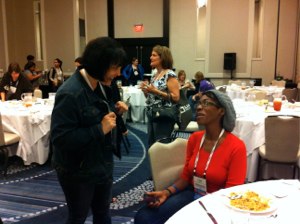 other and their profession.
“This was amazing,” said Sujatha Gurumurthy, a senior talent advisor at Intel after the lunch, who was attending LinuxCon for the first time. She was breathless and grinning after handing out her business cards to others around the room.
Another first-time LinuxCon attendee was the recipient of one of those cards.
“I love LinuxCon, I think it’s amazing,” said Lidza Louina, an intern this summer in the Outreach Program for Women and an aspiring kernel developer. She worked with mentor and Linux kernel developer Greg Kroah-Hartman on updating and maintaining Linux device drivers. “It’s another learning experience and a great way to network with people.”
Indeed, throughout the rest of the conference when I saw one of the women from the lunch in the hallway or in a session, we immediately recognized each other and had a good reason to say “hi” and a starting point for discussion.
I hope to see Lidza, Sujatha, and all of the other women at lunch again next year — in a room twice as big.