
Home Blog Page 1788

VLC Media Player Adds Support For H.264 / HEVC

The VLC project has merged support for x265 to provide support for HEVC/H.265 in the popular open-source cross-platform media player…

Read more at Phoronix

DevOps Really Does Speed Things Up, Study Shows

New study suggests a real impact on the business when developers and operations people put their heads together.

Valve Chief: All Gaming Roads Lead to Linux

The future of the gaming industry is Linux, Valve CEO and founder Gabe Newell told the crowd during his keynote address at LinuxCon on Monday. Newell also hinted at a Valve announcement next week that will bring Linux into the living room — perhaps a hardware extension for its Steam distribution platform. The company could be planning to release Steam Box, a Linux-based device designed to connect with TVs to play Steam-based games, which would compete with living room consoles.

Read more at LinuxInsider

LinuxCon and CloudOpen Live Blog Day 2: OpenStack and Candy Chang

We’re live blogging from LinuxCon and CloudOpen in New Orleans at 9 a.m. and 2 p.m. Central, Sept. 16-18. Catch Tuesday afternoon keynotes from Candy Chang, TED fellow and Jonathan Bryce, OpenStack.


Raspberry Pi’s Eben Upton Demos Wayland Support on the Pi

Raspberry Pi Foundation founder and executive director Eben Upton this week gave his promised demonstration of developer features coming soon to the Pi. Though they’re still in the very early stages of testing, Upton displayed Weston running native Wayland apps on the Linux-based Pi during his keynote at LinuxCon and CloudOpen on Monday.
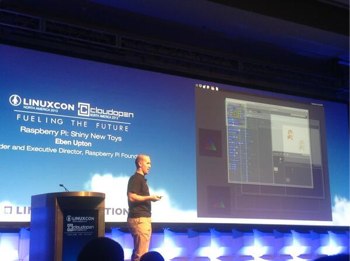
Eben Upton on stage at LinuxCon 2013Weston is a reference implementation of Wayland, the compositor that Upton has called “the future of Linux desktop graphics.” Both Gnome and KDE are expected to be ported to Wayland.

In accidentally opening the first app three times on the single-board computer he joked on stage, “We’re pushing our luck running three copies of that.”

Upton has been working hard with partners, including Collabora, to implement Wayland support on the Raspberry Pi, and said Monday that he anticipates releasing a preview of RPi with Wayland support, with bug tracking on it, in the next few weeks. He aims to have the boards shipping with Wayland support by the end of the year.

Developing Wayland support is just one open source project the RPi Foundation has invested in with the income it earns from Pi sales. In less than two years the Raspberry Pi has sold more than 1 million units — more than Upton could have ever imagined when they began the project in 2006 as a modest idea to provide a low-cost educational computer for students.

They’re also contributing engineering time and money to SmallTalk projects to develop Squeak and Scratch on ARM, as well as LibreOffice and XBMC, Upton said in his keynote at LinuxCon. And the open source community has given a lot back in return, submitting “really high quality” patches to the RPi software, Upton said.

The Pi’s popularity has skyrocketed among embedded developers and tinkerers, alike, and the board can be found in all sorts of gadgets from near-space cameras, to weather balloons, air quality monitors and motion sensors.

The community is growing and an ecosystem of businesses has sprung up around it. But this is just the beginning for low-cost Linux-based computers, which have seen an enormous interest from the developing world, Upton said.

“There’s no question that Linux and Linux on ARM is going to dominate Africa.”

See more coverage of Upton’s keynote and other Monday keynotes in our live blog transcript. Or read Upton’s pre-LinuxCon Q&A for more on their open source efforts. 

IBM Bets Big Again on Linux: $1B for Linux on Power Systems

Linux is a thoroughbred in the world of computing and as sure a thing as you can get. With a community of tens of thousands of developers from more than 200 companies supporting the Linux operating system, it is constantly being updated with changes that are shared across a wide variety of industries and with users in diverse environments.

IBM knows from experience that Linux can fuel innovation and accelerate technologies and today at LinuxCon is announcing it will invests $1B in Linux and new open source technologies for its Power Systems servers.

It’s putting $1B on the horse in the front. We think it’s a pretty good bet.

If this sounds familiar, it should. IBM invested $1B in Linux in 2000 in a very visible campaign that included dedicating 1,500 engineers to Linux and an ad campaign that has become widely recognized (He’s Just a Kid). This helped start a flurry of innovation for Linux that has never slowed and helped put IBM in a dominant position in computing throughout the 2000s. It has greatly benefited customers and the Linux community.

The difference today is that customers are already using Linux. Based on our Enterprise End User Report, 80 percent of enterprises are increasing their use of Linux over the next five years and 74 are maintaining or increasing their use of Linux to support the the cloud.

What customers want is to be able to fully capitalize on big data and cloud computing applications, especially in open cloud environments. History tells us that Linux and open source software will deliver.

IBM knows it. We know it. Customers love it.

LinuxCon and CloudOpen Live Blog Day 2: Wired’s Kevin Kelly and IBM

We’re live blogging from LinuxCon and CloudOpen in New Orleans at 9 a.m. and 2 p.m. Central, Sept. 16-18. See yesterday’s coverage and follow today’s keynotes here and on the live video stream.

9 a.m. (CST)

Brad McCredie, IBM, “Linux, Cloud and Next Generation Workloads.”

Kevin Kelly, Wired, “The Technium.”

2 p.m. 

Candy Chang, TED fellow, “Before I die.”

Jonathan Bryce, OpenStack, “The new Superpower.”


Linux Development By the Numbers: Big and Getting Bigger

The open-source operating system project is steadily growing through any number of measurements: programmers, updates, and changes per hour. [Read more]

 
Read more at CNET News

IBM and Linux: The Next Billion Dollars

IBM is renovating its Power computers by investing a billion dollars into making it a full-fledged Linux line for Big Data, cloud, data analytics, and the datacenter.

Rsync (Remote Sync): 10 Practical Examples of Rsync Command in Linux

Rsync (Remote Sync) is a most commonly used command for copying and synchronizing files and directories remotely as well as locally in Linux/Unix systems. With the help of rsync command you can copy and synchronize your data remotely and locally across directories, across disks and networks,…

[[ This is a content summary only. Visit my website for full links, other content, and more! [[

 
Read more at TecMint