
After making headlines with its unexpectedly voluminous contributions to the Linux kernel in 2012, Microsoft has all but disappeared from the Linux development scene, according the latest report from the Linux Foundation.…
Read more at The Register
Technology has entered a new era in which software is no longer a differentiator, but the foundation that the “big winners” are building their services on, Jim Zemlin said today in his annual State of Linux speech at LinuxCon and CloudOpen North America in New Olreans.
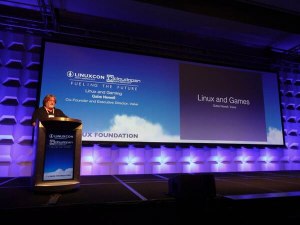 Companies like Google, Facebook, and Twitter are built on free and open source software and this pattern is defining success in computing. Big shifts in the tech landscape toward cloud computing and a web-centric application model are also favoring Linux and open source.
“Linux is the default model for new areas of innovation,” Zemlin said.
As cloud and web-scale computing take over, Linux is leading this change and replacing Unix as the de facto operating system for servers. He predicts that Linux and open source will continue to dominate as functionality is abstracted to service layers and hardware support becomes more important.
“Every IT trend is being developed on top of free and open source software,” he said. “I can throw a dart and it hits a company being created on free and open source.”
Twitter, which last week announced it plans for an IPO, has open source software at its core and hires 10-15 percent of its engineering staff from people who work on Twitter-related open source projects, Zemlin said.
Valve, the gaming company that in February released its Steam web platform for Linux, also builds and runs all of its source code, animation and assets on Linux — a typical setup for companies in the gaming industry, said Gabe Newell, co-founder and executive director of Valve in his keynote that followed and reinforced the message in Zemlin’s talk.
The same trends shaping the tech industry overall are shaping the gaming industry — driving innovation and changing the business model, Newell said.
The center of gravity has shifted from console hardware platforms with price and access controlled by PC makers, to web-based free-to-play and massive multiplayer online games. As a result, businesses are investing in developers and services and users are the focus of market development strategies, Newell said.
The realization that this was the new business model, led Valve to change its approach to game development.
“Valve became convinced that Linux is the future of gaming,” Newell said.
So they began working hard to make sure Linux is a good solution for gamers and game developers, he said. They started by porting one game to Linux and the lessons they learned in that process applied to many of the games that followed. They now have 198 games running on Linux and have developers working on contributions to other open source projects.
The next step is solving the fragmentation problem between the various platforms in the mobile, living room and desktop spaces. They’re aiming for a “grand unification” and have plans to announce their vision for a hardware solution next week.
See the full coverage of their remarks in Linux.com’s live blog from LinuxCon and CloudOpen. And watch this afternoon’s keynotes live on streaming video.
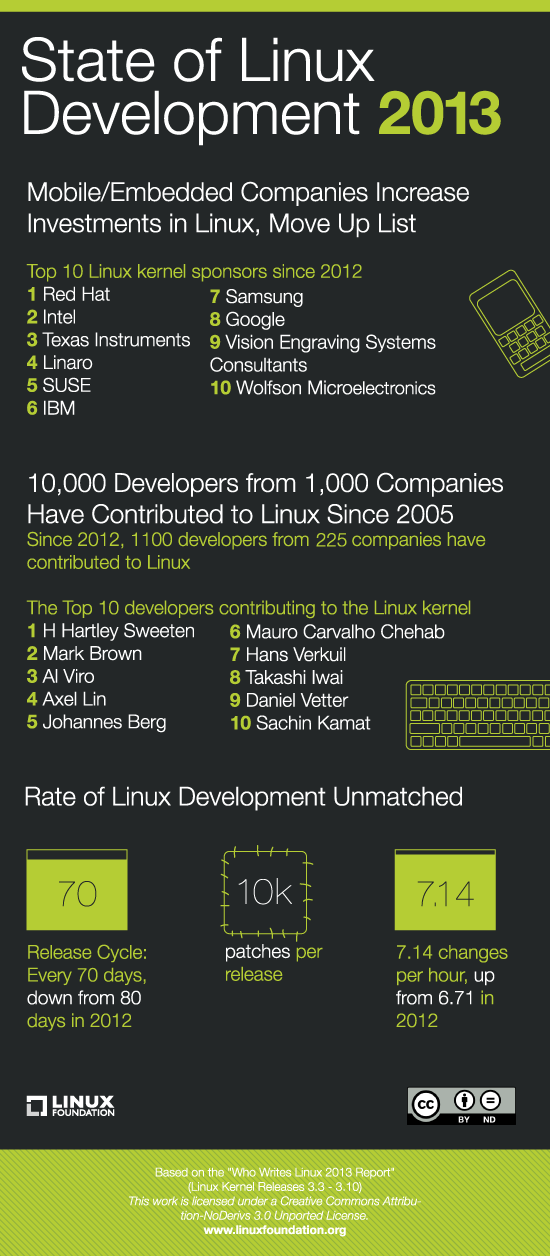 One of the greatest impacts Linux is having on the technology industry is in the way it’s built. We often tout Linux’s success stories – from running Facebook, Amazon and Google to powering eight out of 10 financial trades to running the world’s supercomputers and mobile devices, and more. But these successes are the results of a massive collaborative development effort that is 22 years in the making and today is being studied and leveraged by everyone from software developers to business executives in industries ranging from networking to financial services to life science and more.
One of the things we do each year is partner with Linux kernel developers Jon Corbet and Greg Kroah-Hartman to understand the rate at which Linux is being developed, who is writing the code and what companies are sponsoring that work. The result is our annual “Who Writes Linux” report, which we’re releasing today atLinuxCon/CloudOpen. The report helps give us a glimpse into how Linux is able to rise and adapt to new technology requirements across industries more quickly than any other operating system. It’s truly history in the making.
Here are some of the highlights from this year’s paper:
* Linux is being developed faster than ever and faster than any other software in the world, accelerating tech innovations throughout the industry. The average number of changes accepted into the kernel per hour is 7.14, which translates to 171 changes every day and more than 1,200 per week (more stats are in the paper).
Ernst & Young was recently quoted saying we’re no longer in a 10-year reinvention path for enterprise IT. It’s now a 4-5 year path. They say it’s happening at a pace they’ve never seen before. In this world, Linux and collaborative development are the only way.
* More developers than ever are contributing to Linux. Nearly 10,000 developers from more than 1,000 companies have contributed to the Linux kernel since tracking began in 2005. Just since the last report, more than 1,100 developers from 225 companies have contributed to the kernel. And, Linux kernel 3.10 saw the most developer contributions ever.
* Mobile and embedded companies are increasing their investments in Linux. Linaro, Samsung and Texas Instruments together increased their aggregate contributions from 4.4 percent during the previous version of the paper to 11 percent of all changes this year. Google’s contributions are also up significantly this year. There were other notable shifts like Microsoft dropping in the rankings after the bulk of its Hyper-v work was finished.
Linux has dramatically changed the way software is built and distributed. Business executives today are trying to understand in a world where software is free how do they innovate? They have to find the value line, the line above which value is derived. Millions of dollars and thousands of engineering hours are being invested in collaboratively building software that is below the value line in order for companies to accelerate technology innovation on the products and services on which they can differentiate. And, it’s not just on Linux. OpenDaylight, OpenBEL andopenMAMA are all Collaborative Projects at The Linux Foundation that represent this trend and that are taking a page from the Linux playbook so they might make some history of their own.
Tiny Core Linux 5.0 has been released. Tiny Core Linux is a minimalist, but highly modular and extensible Linux distribution with flwm as the default window manager. From the release announcement: “Team Tiny Core is proud to announce the release of Tiny Core 5.0. Changelog: Linux kernel update….
Eric Turgeon has announced that the third beta release of GhostBSD 3.5, a FreeBSD-based operating system featuring LXDE, MATE, Openbox and Xfce desktops, is now ready for download and testing: “The third beta build of the 3.5 development release is now available on SourceForge for LXDE and Xfce….