Most of the ARM cores available today in little single board computers are either A8 or A9 cortex. The ARM A15 CPU cores should be around 40 percent more powerful than an A9 core running at the same clock speed. The A15 CPU can be found in some consumer oriented machines such as the Nexus 10. Most devices with A15 cores are dual core configurations as of mid 2013.
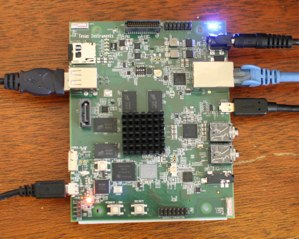 The TI OMAP5432 is a small single board computer that was released in Q2 of 2013. It has a dual core A15 at up to 1.5 GHz, 2GB of DDR3 memory, 4Gb of flash memory, USB 3.0, a SATA port, 10/100 ethernet, HDMI, and a microSD card slot. The HDMI is driven by the OMAP 5 CPU which also has a DSP and also includes various image and video accelerating hardware along with two Cortex M4 microprocessors. The OMAP5432 is released as an Evaluation Module (EVM), so it is not targeted towards end users. We have obtained one of these boards to benchmark the performance of the OMAP5 SoC.
Being an “evaluation” board, the OMAP5432 also comes with reset and power buttons on board, both 3.5mm and a headset jack for audio in and out, a bank of four really tiny switches to tell the board what to boot from, a USB connector for a serial console, and a collection of headers for cameras, additional video out, general IO, and power measurements.
Running Android or Linux
The TI OMAP5432 supports running Android 4.2 (from the internal flash) as well as Ubuntu Linux 12.04 from a microSD card. To write Android onto the device the serial console and USB3 ports are used together with a specific configuration of the four tiny switches. Getting Ubuntu on the TI OMAP5432 requires installing the SDK on a desktop machine, using the SDK to create a boot image and writing that boot image to a micorSD card. When you insert the resulting microSD card into the OMAP5432 board, upon boot you will have to run a first-time script to complete installation, downloading some 500Mb of additional packages and setting up DHCP based network connectivity using NetworkManager. Having the Linux evaluation software based on Ubuntu allows easy installation of KDE, web servers, relational databases, vlc, xbmc, totem and other software from package repositories. The kernel used was linux-image-3.8.4-100-omap5 which has a package description “Linux kernel image for version 3.8.4 on TI OMAP4-based systems”.
The TI OMAP5432EVM uses a 12 Volt, laptop-style power brick. When the board is plugged into power and left off it used 0.7 Watts. At idle without X Window running, it used 3.4 Watts. Running one instance of “openssl speed” needed 4.4 Watts and two simultaneous instances moved up to 5.2 Watts. Playing the h264 1080p Big Buck Bunny took 4.7 Watts when using the special hardware video decoding. Note that these numbers are using the 60 Watt laptop style power brick which itself will likely be running at a fairly low efficiency at the low end of its power spectrum. So, for example, the OMAP5432EVM might only be seeing less than half the 4.4 Watts consumed at the wall.
The recommended video playback method for hardware decode uses gstreamer0.10 and the dri2videosink. Other players like totem which are gstreamer based also worked very nicely with hardware decoding. Unfortunately the mplayer from apt-get install didn’t seem to do any hardware acceleration and using the two A15 cores could not play back Big Buck Bunny in real time. It is wonderful to see hardware video decode being so easy to use with mainstream players like totem on an evaluation board.
A Few More Considerations
Being evaluation hardware one expects a few edge cases to crop up from time to time. Sometimes the board would not start X Window in 1080p or offer that resolution through xrandr to change to. After a bit of tinkering which included benchmarking the SATA SSD, I found that I needed to temporarily disconnect the USB hub while booting the board otherwise the keyboard and mouse were not available after boot. I also had a little bit of trouble getting audio up and running on the board but that might have been because I installed whole desktops on the microSD card. No real show stoppers but things to be aware of if you are considering using an OMAP5432 EVM board for regular tasks.
We would like to thank SVTronics for the OMAP5432 EVM review hardware. SVTronics will be releasing some accessories for the OMAP5432EVM in the near future including a display interface board.
Next time around I’ll attach an SSD to the SATA port and belt it with bonnie++ to see how quickly bits can go to and from storage from the OMAP5. I’ll also do some benchmarking on the internal 4Gb of flash memory. There will also be some benchmarks for the CPU itself and details on CPU usage during video playback. For good measure we’ll see the cairo tests on the board to see how 2d is currently ticking over.
For part 2 in this series, see “Benchmarking Performance of TI’s OMAP 5432 Board.”
