
The open cloud company is attributing the Q1 revenue miss to “currency exchange rates.”
Read more at Enterprise Open Source Toolkit
With its new Silvermont architecture, it looks like Intel has finally leaped forward in mobile. But whether it can ward off ARM’S upcoming 64-bit ARMv8 processors is another story.
Intel’s announcement this week of its 22-nanometer (nm) Silvermont revision of the Intel Atom came with some remarkable claims. Silvermont is three times faster and five times more power efficient than existing Atoms, says the chipmaker. More importantly, Intel says its quad-core Silvermont-based “Bayfield” system on chip (SoC), due in tablets by year’s end, will offer twice the performance and 4.3 times lower power consumption than quad-core ARM SoCs. Dual-core Silvermont “Merrifield” SoCs for smartphones, due by year’s end or early 2014, are said to be 1.6 times faster and 2.4 times more power efficient than quad-core ARM SoCs.
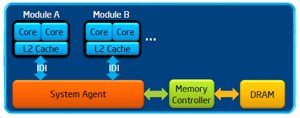 The power and performance gains were achieved by advancing from the 32nm Saltwell Atom architecture to the 22nm process and Tri-Gate “3D” non-planar transistor technology borrowed from the latest “Ivy Bridge” Core processors. Further gains stem from improved out-of-order execution and power management, a faster GPU, and enhanced coordination among up to eight cores. (See this LinuxGizmos report for more technical details.)
The improved power consumption, which is due primarily to Tri-Gate, is especially notable since the 32nm Saltwell-architecture “Medfield” Atom demonstrated greatly improved battery life. The Medfield, which has appeared in a few Android phones including Motorola’s Razr i, still trailed ARM in power consumption, but came fairly close.
Intel even appears to have an answer for ARM’s innovative big.LITTLE architecture, which debuted in Samsung’s eight-core Exynos Octa-Core. While big.LITTLE divies up tasks among faster Cortex-A15 cores and more power-efficient Cortex-A7 cores, Intel claims that Silvermont’s new multicore framework enables similar sharing without the complexity of mixing different core types.
Until Silvermont, Intel has taken a rather leisurely course toward mobile. When the first 45nm “Bonnell” Atoms shipped in 2008, the iPhone was still new, the first Android phones had yet to ship, and tablets were thick, pricey, and typically Windows-based. Intel tried to promote the Atom via its Linux-friendly Mobile Internet Device (MID) form-factor. However, these extra-thick tablets with 5- to 7-inch resistive touchscreens proved unpopular with consumers. Nevertheless, the Atom managed to thrive on netbooks, and once that trend had ebbed, it was already well established on a range of increasingly Linux-based embedded devices that required better power efficiency than Core processors could provide.
ARM processors were even more power efficient, however, and the booming market for ARM-based smartphones and tablets spurred ARM SoCs to much faster speeds and even more power efficiency. Meanwhile, the sheer volume of Android and iOS sales helped lower costs.
While ARM chips evolved quickly, the Atom developed more slowly, especially when it came to power consumption. Few expected the recent market shift from notebooks to smartphones and tablets to occur as quickly as it did, but the signs were clear. By the time Intel ported Android to x86 and developed its 2GHz Medfield, the Atom was still trailing ARM in battery life and price, although it bested most devices on performance.
By year’s end, when the first Silvermont tablets appear, the Atom will have vaulted ahead of its ARM competition. It’s unclear how long that advantage will last. After all, ARM is expected to move from 28nm to 20nm fabrication on the Cortex-A15 and 64-bit, ARMv8 Cortex-A57 designs by 2014. The micro-server and desktop-targeted A57 will support a big.LITTLE arrangement with the similarly ARMv8-based Cortex-A53 smartphone/tablet SoC. Both should advance to 16nm fabrication by 2015 or 2016.
Still, even if Silvermont falls short of its claims, ARM SoC vendors must be cringing at the news that Intel plans to introduce a new Atom architecture every year. In fact, Intel is already planning a 14nm Airmont design for 2014. Silvermont is particularly threatening to Qualcomm and Nvidia, which unlike Samsung, don’t have the luxury of populating a best-selling line of Android mobile devices with their own chips.
Assuming the Silvermont claims are close to being true — and that Intel can compete on price — the mobile market will undergo a significant shift. Windows 8 tablets could get a lease on life, and the Atom should significantly cut into ARM’s dominion of Android, likely resulting in lower prices for users. As long as Samsung sits atop the Android heap, ARM should continue to dominate Android, but in the unlikely event that Samsung or Apple switch to the Atom, things could be very tough for ARM indeed.
Meanwhile, it’s all good news for Linux, which unlike Android or Windows — the other two platforms officially supported by Silvermont — is already equally at home in both the x86 and ARM worlds. Silvermont-based networking, automotive, and server SoCs are in the works, and although there are no details, Intel says CPU versions are in the pipeline, presumably aimed at embedded applications. What’s not to like?
Spend five minutes browsing the tech press and there’s a very good chance you’ll come upon Kickstarter. Gone are the days when products had to be at least on the verge of release for them to get publicity; today, anyone with a cool idea can post it on Kickstarter—or one of its many clones–spread the word, and start raking in the cash they need to make it happen.
There are clearly downsides to this new model, as more than a few scandals have illustrated vividly along the way. Nevertheless, Kickstarter and sites like it have opened up a whole new world of possibilities to tinkerers and entrepreneurs of virtually every ilk.
Of course, combine the words “tinkerer,” “entrepreneur” and “possibilities,” and there’s a good chance you’ll find Linux involved somewhere along the way. Sure enough, 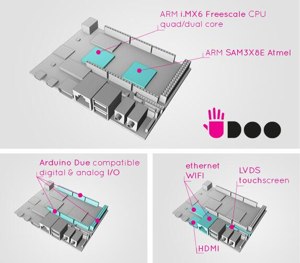 more than 60 Linux-related projects are currently listed on Kickstarter. Here’s a small sampling of some particularly compelling examples.
Now claiming more than $385,000 in funds raised out of just a $27,000 goal, UDOO is a mini PC that can run either Android or Linux and features an embedded Arduino-compatible board. “UDOO merges different computing worlds in one; each world has its strengths and weaknesses, and all of them are useful today in education as well as do-it-yourself (DIY) and rapid prototyping endeavors,” the project’s Kickstarter page explains. Equipped with an ARM i.MX6 Freescale processor for Android and Linux alongside Arduino DUE’s ARM SAM3X, UDOO is open hardware. It runs Linaro. The project is slated to be funded on June 8.
With more than two weeks still remaining in its Kickstarter funding campaign, the Raspberry IO (RIO) project aims to create a smart I/O card that can be stacked on top of the well-loved Raspberry Pi mini PC. The result “will turn the Pi into an amazingly powerful embedded computer for its size and price, and opens a world of applications” in areas including robotics navigation, unmanned vehicles and machine control, the project page explains. At the time of writing, this project had raised just over $4,000 of its $15,000 goal. May 25 is its deadline.
Then there’s the cross-platform OpenShot video editor, which surpassed its $20,000 funding goal last month. Now claiming more than $45,000 in raised funds, the current Kickstarter project aims to release a brand-new version of the award-winning OpenShot that’s powered by a cross-platform video editing engine for use on Windows, Mac and Linux. A November/December 2013 beta release date is planned for all three platforms.
Funded on March 22, meanwhile, was LinuxonAndroid, a project run by a U.K. university student with the goal of getting “full-blown Linux distros” such as Ubuntu and Debian running on Android devices. Among the potential results the project lists could be the ability to run a Web server from a phone, for example. A full 1,058 pounds, or roughly $1,637, were raised of the project’s 600-pound ($928) goal.
Last but not least, self-proclaimed “DoorToDoorGeek” Stephen McLaughlin blew past his $500 funding goal last year for a series of educational videos about Android and Linux. Pulling in more than $3,400 instead, the DoorToDoorGeek video series achieved its funding goal in August.
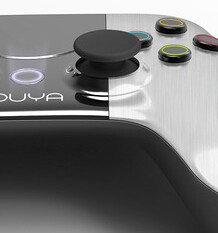 Although there are a lot of people saying that the Android-based Ouya gaming console will be hindered by not having cutting-edge games available for it as it launches, the console continues to generate major buzz, and developers are producing games for it. The Ouya team has also stayed on track for a June launch for its $99 consoles, focusing on a strategy of keeping the Ouya interface simple. Here are some of the most recent updates on this much awaited game console.
 Scientific Computing is featuring an interview with Bill Dally, Nvidia’s Chief Scientist and Senior Vice President of Research. Dally will keynote ISC’13 with a talk entitled “Future Challenges of Large-Scale Computing.”
The biggest impediment to innovation is legacy software. Many innovations are held back by the need for backward compatibility — or by the excessive focus on yesterday’s software at the expense of tomorrow’s software. To address this challenge, at the same time we develop new architectures and software techniques, we work to develop a path for legacy software to migrate to the new architecture.
Read the Full Story.
Related posts:
The post Nvidia’s Bill Dally on Future Challenges of Large-Scale Computing appeared first on insideHPC.