
It’s not looking good for the traditional computer.
Read more at Enterprise Open Source Toolkit
Listening to Tony Awtrey sing Pie Jesu from Andrew Lloyd Webber’s Requiem is awe inspiring. The classically trained tenor has a euphonious voice capable of taking your breath away. He’s also a Linux developer and Chief Scientist in the defense industry.
“It’s just a rehearsal, but I still like it,” Awtrey said of his performance (see the video, below), which he edited with open source OpenShot software on his Debian Linux desktop.
 Singing is just one of his hobbies, along with some tinkering on Raspberry Pi and other small ARM platforms, he said. Maintaining an extensive home network also keeps him busy.
“It is a 16 core, 8 terabyte system which I run a number of virtual systems on using kvm, libvirt, and spicy,” he said via email. “I also develop simple tools for the Android-based phones and tablets we use, and have recently gotten a Google Chromebook to play with.”
But the bulk of his time is spent at work where he runs Debian unstable and uses XFCE as his preferred desktop environment.
He’s been a Linux user since 1993 when he worked at a small Unix shop. They couldn’t afford a SPARCstation running SunOS. And DOS and Windows “seemed so primitive,” by comparison, he said.
“Old farts like me will remember having to edit their config.sys and protocol.ini files, struggling to configure the drivers to load into extended or expanded memory, so you could still play Wolfenstein 3D or Doom after you got the network stack running,” he said. “The kids these days with their built in networking and Steam game downloads… get off my lawn!”
He stumbled onto Slackware Linux trying to find an X Window implementation that would work on DOS.
“The next day when my boss came in, he walked past my office, then stepped back to verify I really was running OpenLook on my office PC,” he said. “It didn’t take long for that stack of 30 or so floppies to make their way into almost every PC in the shop. We even sold Linux on PC hardware as an inexpensive X Terminal for some clients.”
That experience turned him into a Linux advocate. He started a LUG in Melbourne, Florida in the 90’s, and traveled to other user groups and conferences to “pound the lectern” about using Linux.
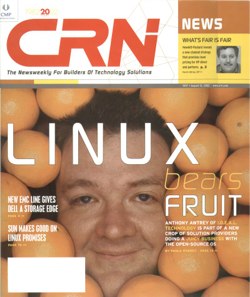
“I spoke a few times at LinuxWorld as well, and got quoted a bunch in the industry press, including a cover photo on Computer Reseller News back in 2002.”
These days his lecturing about Linux is behind him. He mostly just uses it.
“When I go to meetings and suggest using Linux, everyone just nods,” Awtrey said. “The success of Linux in the data center, on Android devices, it is like suggesting someone make buildings out of concrete. What else would you use?”
Awtrey recently joined the Linux Foundation as an individual member. It was a way of thanking the developers who contributed the source code and documentation behind the technology he’s built his career on, he said. Welcome, Tony!
There seems to be no end in sight to the uncertainty and debate over what, exactly, constitutes an open source cloud. What’s far more clear, however, is that the concept is rapidly gaining ground.
It’s hardly any wonder. Cost, customizability, transparency and collaborative development are all among the benefits frequently associated with the open cloud, as is innovation.
That, presumably, goes a long way toward explaining why Linux is by far the dominant platform in cloud computing, as the Linux Foundation’s latest Enterprise End User Report recently found. In fact, nearly 76 percent of cloud-enabled organizations use Linux servers for the cloud, the report concluded, while 74 percent plan to maintain or increase their use of Linux for future cloud initiatives.
Need more convincing? Here are just a few additional pieces of evidence from the past few weeks that suggest the open cloud is on the rise.
 1. IBM Jumps In
“IBM To Make Its Cloud Services and Software Open Source-based” was the title of the press release from the PC giant in early March, and it contained plenty of endorsement for the open cloud.
“History has shown that open source and standards are hugely beneficial to end customers and are a major catalyst for innovation,” said Robert LeBlanc, IBM senior vice president of software, in a statement. “Just as standards and open source revolutionized the Web and Linux, they will also have a tremendous impact on cloud computing.”
As a first step toward its new, open goals, the company unveiled a private cloud offering based on OpenStack that “significantly speeds and simplifies managing an enterprise-grade cloud,” it said.
Security is another benefit observers see included here.
Either way, the move is particularly big news given that competing “Big Three” server vendors HP and Dell have already pledged OpenStack support themselves, as a recent Data Center Knowledge article pointed out.
Speaking of industry giants, it was just a week or so later last month that Oracle announced it was buying Nimbula, a provider of private cloud infrastructure management software.
Last fall, Nimbula joined the OpenStack community and announced that it would collaborate on the OpenStack codebase as well as incorporate OpenStack services in future releases of its flagship Nimbula Director product.
“OpenStack has gathered strong industry momentum,” said Reza Malekzadeh, VP of marketing and sales at Nimbula. “Our customers appreciate the advanced functionality, scale and security model we provide, but have been asking us about a standardized core. We are excited to now be in a position to work with the OpenStack community to deliver a range of extended infrastructure and platform services around an industry-standard effort.”
Also in mid-March, the Open Data Center Alliance (ODCA) announced the release of a new white paper detailing auto maker BMW’s multiple phases of cloud implementation, from internal cloud delivery to full integration of public cloud services, using ODCA requirements. Entitled, “Open Data Center Alliance: Private Cloud Strategy at BMW,” the publication is designed to help other enterprise IT managers making their way to the cloud and help providers identify requirements for enterprise-ready cloud service delivery. A video featuring highlights is also available on the ODCA website.
 4. Rackspace Launches a School
Of all the possible signals that a technology is becoming ubiquitous, the launching of a school dedicated to training professionals in its use is pretty darn indicative.
That, in fact, is just what Rackspace did later in March with its launch of the Open Cloud Academy.
“Organizations are struggling to hire talent with the cloud computing skills necessary for the new world of IT,” the company explained in a blog post. “We hope to change that.
“This week Rackspace opened the doors to the Open Cloud Academy, an educational program designed to arm students with affordable IT certifications, specifically around open cloud technologies,” it added. “We want to offer an innovative, hands-on learning experience that helps jumpstart careers in open cloud technologies, including but not limited to sharpening Linux expertise, cyber and network security and software development.”
Then, too, there was Basho’s announcement last month that it was open-sourcing its Riak CS (Cloud Storage) software under the Apache 2 license, nearly a year after the product’s initial release.
“Over the past year we’ve had an opportunity to learn more from our customers,” Shanley Kane, a product manager at Basho, recently told Wired.
Developers also tend to be more attracted to open source technologies than proprietary ones, the company reportedly said, adding that going open source is expected to increase the product’s traction as well as ease integrations.
Finally, offering a nice complement to Rackspace’s IT-focused open cloud school, IBM on Monday announced that it is planning to open a lab in New York City designed to help financial services firms adopt open-source virtualization technologies.
Following the company’s launch late last year of a similar center in Beijing, the KVM Center of Excellence “will help clients, software engineers and business partners to quickly leverage open-source virtualization to build cloud-computing platforms,” it says.
“Wall Street is at the forefront of the adoption of Linux, and financial clients are now leading the way on adopting KVM in order to build a flexible computing infrastructure to meet business demands,” said Jean Staten, director of cross-Linux strategy at IBM, in a statement. “As the industry evolves to meet new demands from customers and regulators, these enterprises will need expertise on how to build open standards-based clouds.”
Earlier this week, Liquid Robotics unveiled the latest in its line of “Wave Glider” autonomous aquatic craft, due to ship in the third quarter, billing it as “the world’s first hybrid wave and solar propelled unmanned ocean robot.” In addition to its energy harvesting marvels, the 9.5-foot, Wave Glider SV3 is also notable for being the first Linux-powered Wave Glider. With its Linux- and Java-based Regulus operating system, the floating robot is far more adept at autonomous navigation than the Wave Glider SV2, and can now coordinate with its siblings in fleet operations.
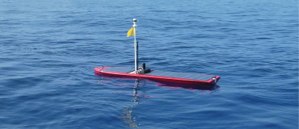 The SV2, which shipped in 2009, “ran on tiny embedded processors and didn’t really have an operating system,” said James Gosling, Liquid Robotics’ Chief Software Architect, in a phone interview. Gosling, the former Sun developer who is best known as the creator of the Java programming language, helped draw attention to Liquid Robotics when he joined the company in mid-2011 after a brief stint with Google.
The SV3 runs a Timesys distribution based on a Linux 3.x kernel, that is closely tailored to the craft’s single-core ARM processor, said Gosling. “OS selection is mostly driven by what works on that particular chipset,” he continued. “The ARM world is so fractured in terms of devices and board integration that kernels don’t slip in and out all that easily.” With that in mind, the flavor of Linux may change again soon. “We’ll be upgrading to a more robust multicore processor with some significant floating point on it in about six to eight months,” added Gosling.
No real-time patches were required for Regulus. “Everything moves so slowly — we’re traveling at about one and a half knots — that we don’t need real-time code,” said Gosling.
Regulus does, however, tap Linux capabilities in providing for more flexible wireless communications, and enabling multiple security features, including secure virtual containers. It also offers improved, adaptable power management for the SV3’s complex hybrid power system.
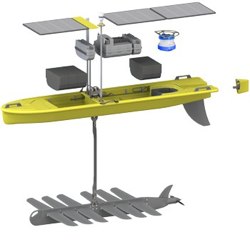
On the earlier SV2, a 112-Watt solar panel was used for powering sensors and communications, leaving navigation to the device’s underwater wave harvesting system. The SV3 adds a much more powerful, 170-Watt solar array connected to an auxiliary thruster for backing up the wave power. The latter is generated via a submarine extension with articulated wings suspended four meters below the surface.
The hybrid system increases speed and duration, while supporting more power-hungry sensors, cameras, and other equipment. When it’s sunny, the waves tend to be lighter, and vice versa, so the power sources complement each other. Just in case, the SV3’s more powerful 980 Wh battery enables travel even on cloudy, becalmed days.
Regulus integrates a cloud platform for coordinating multiple craft, downloading new apps, and acting as an intermediary between the Wave Gliders and their customers. Much of the processing, however, is done on board. “In the marine world, we’re used to having edge nodes that are pretty stupid, but we now have a lot of processing power,” said Gosling. The applications are written in Java. “The dividing line between an application and the OS gets kind of thin,” said Gosling. “The Java code controls the operation of all the devices, and Linux is primarily used for connecting the low-level drivers with the satellite, communicating via an RS232 serial connection.”
Although the Wave Glider can be controlled remotely, including via smartphone apps, it’s designed primarily for autonomous navigation. “The previous SV2 would just follow coordinate points, but on the SV3, operations are expressed more as goals to be achieved,” said Gosling. “The SV3 can also come up with its own goals. For example, if it detects a ship, it creates a goal not to crash into it. This lets it more easily weave its way around shipping traffic.” (Gosling has posted some videos about SV3 obstacle avoidance on his Nighthacks blog site.)
 Communications are handled via cellular and WiFi, or when out at sea, via satellite links. The Wave Glider SV3s can also communicate directly with each other within WiFi range. Whatever the network, Regulus’ swarm-savvy software helps coordinate the autonomous boats, which are tracked via GPS.
“We can give the Wave Gliders swarm-like goals,” said Gosling. “For example, if you’ve got a picket fence around a marine protected area, you can give them all essentially the same goal: Stand around this border. They can manage among themselves who goes where.”
While the SV2 broke records by crossing the Pacific Ocean in autonomous mode, the Wave Glider SV3 could theoretically travel for years without human intervention. This greater autonomy, endurance, and intelligence should be welcome to the Wave Glider’s largely scientific customer base. Some 200 SV2s now ply the seas in the service of oceanographers, meteorologists, climatologists, seismologists, and others, many of whom work for energy companies, fisheries, or the government. BP is using the floating robots to check water quality around oil rigs in the Gulf of Mexico, and the U.S. Navy is now evaluating the SV3 for surveillance tasks, according to Wired.
Customers not only pay $300,000 per craft — up from $175,000 for the SV2 — but must also purchase expensive Iridium satellite connections, which are required beyond cellular range. “At about dollar a kilobyte, you can’t send very much data,” said Gosling. “So we do an immense amount of data reduction.”
Instead of sending raw sensor data, Regulus can analyze and summarize the data onboard. For example, if the craft is carrying a hydrophone to listen underwater, and if customers can’t wait to retrieve the recordings later, Regulus can instantly report key findings.
“One big application has been in marine mammal monitoring around oil rigs,” said Gosling. “If a marine mammal is in the area, they have to shut down. So instead of sending an expensive acoustic signal, the SV3 can run the processing algorithms onboard and then simply report that it has detected a whale.”
Despite the increased onboard processing, which Liquid Robotics refers to as “datacenter@sea” technology, “there’s no way that the role of the cloud is diminishing,” said Gosling. “When you do more processing on the vehicle, the answers that come back may be smaller, but they are more precious. We don’t have a ‘big data’ problem like a DNA sequencer cloud application might have, but what we have is data that is really important, that needs to be quickly streamed to whatever customer cares about it.”
For now, Regulus remains proprietary. “We might open source parts of it, but mostly it doesn’t make any sense because no one has a device vaguely like this one,” says Gosling.
Meanwhile, Linux developers who want to get their feet wet in open source aquatics should soon have access to a new Raspberry Pi- and Arduino-based Ziphius aquatic drone. The comparatively modest Ziphius has been accepted into Engadget’s “Insert Coin” competition, and is expected to go live on Kickstarter in the next month or so for a few hundred dollars.