
IBM’s decision this week to base its cloud services on OpenStack may help establish this open source platform as the standard in enterprises.
Read more at ComputerWorld

Rock the Vote needed a way to manage the fast growth of the data handled by its Web-based voter registration application. The organization turned to GlusterFS replicated volumes to allow for filesystem size upgrades on its virtualized hosting infrastructure without incurring downtime.
Luke Kanies, founder and CEO of Puppet Labs, kicked off the last day of ApacheCon with a keynote on Growing Authentic Communities. Despite being early on the final day of a conference, Kanies managed to draw a respectable crowd at ApacheCon eager to hear about techniques for growing a community.
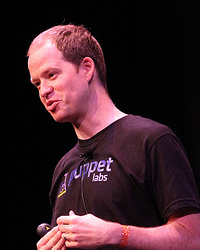 Why were so many people interested in what Kanies had to say? He reasoned that people were interested because he’s running a company and a project simultaneously. That was by design, he says, from the earliest days of Puppet. Doing it the other ways – either trying to graft a company onto an existing community or trying to create a community from a company project – don’t work so well.
“A lot of companies think you can force the creation of a community,” but you can’t says Kanies.
For those who aren’t familiar with Puppet, the project started in 2005 – with a single user on the dev list (Kanies, obviously) and no user list. At the same time, Kanies started the company with the goal of making enough money to pay “a bunch of software developers.”
How would he be able to tell if it was a good project? Whether people were willing to pay, says Kanies, “was a good test of whether it’s good software.”
Obviously, Puppet has grown considerably since its early days. It’s an enormously popular open source configuration management tool, with thousands upon thousands of users and investments from major companies. How’d it go from one guy to a well-functioning community and successful company with plenty of developers?
One thing Kanies says that Puppet has done well is to make pretty major changes (like the switch from the GPL to the Apache Software License) without having “a major outcry.” How’d they manage that? It’s a combination of community practices that other communities would do well to emulate. Engage, don’t announce, says Kanies. It’s much better to say “here’s this thing we’re thinking about” than to make an announcement by fiat – even if the company behind the project can do that, it shouldn’t.
Kanies says the process took about six months, and only two of 3,000 or so people complained.
Another major factor is transparency – which isn’t the same thing as “openness,” says Kanies. Communities should be transparent in how they operate and honest in answering questions, but that doesn’t mean that (for example) Kanies is going to answer questions about funding or other topics that aren’t something he can disclose to the entire community.
He also stressed being willing to admit that a project isn’t perfect, or suitable for every use case. “People are really hesitant to say, ‘yeah, it won’t work for that,’” says Kanies.
When a project is new, it might not work terribly well. When a project is mature, it might be hard to change direction, etc. Any stage of a project is going to have its own problems. Kanies says you have to acknowledge those, and also think about the “great aspects” of the stage the project is currently at rather than being uncomfortable.
Another biggie Kanies mentioned is to admit when you’re wrong. Just do it and move on, don’t focus on being right at the expense of community.
Another practice? Kanies says that his philosophy was to “answer every question” even if the answer is “I don’t know.” Make sure every user is responded to and try to help them. This is something that’s very hard to do, but it helps turn might-be users into users, and users into vocal proponents of the community. I remember getting a response directly from Patrick Volkerding shortly after trying Slackware in 1996, when I wasn’t too sure about this Linux thing. Getting courteous, speedy support directly from the man himself convinced me to keep plugging away at learning Linux.
Obviously, as the community scales, a single person will hit the limit of his ability to help. Kanies says it’s important to work with the community to “help them grow to be the people who are going to be the ones to help.”
And while you’re at it, be nice, says Kanies. Don’t focus on who’s right, and don’t be OK with technical rudeness. Insist on comity in the community, even if other FOSS projects might not be quite so friendly. Unfortunately, Kanies says he can’t really point to specific techniques that led to “people being nice and getting work done instead of scoring points. One of the things I’m most surprised by is the complete lack of religion in our company.”
On the corporate side, Kanies says that companies need to make sure that employees are convinced about community “or get them away from the community.” It may not be necessary for every employee to be well-versed or interested in working with the FOSS community – but if they work directly with the community, they’d better be.
Puppet may not be the perfect embodiment of community, but the project and company have grown admirably over the years. Anyone working with a FOSS project that has commercial ties would do well to take his advice to heart.
Joe Brockmeier is employed by Citrix as an advocate for open source cloud computing, and spends most of his time working on or promoting Apache CloudStack Brockmeier is a PPMC member for the project, and can be reached on Twitter or by sending an email to jzb at Apache.org.
Linux and free software are fantastic vehicles for creative works, including large-scale commercial creative projects, because we have a large selection of professional multimedia creation software, and most of it is free of cost. But it takes more than just playing with great software– what does it take to launch a large project, and keep it going? How do you find funding, or make any money? Terry Hancock and Rosalyn Hunter, the husband and wife team behind Anansi Spaceworks, are venturing forth into the new uncertain territory of independent creative artists, and going where few Linux nerds have gone before with their ambitious 3D animated series, Lunatics!.
Terry is a writer, Linux nerd, developer, free software advocate, artist, moviemaker, astronomer, space-advocate, and science-fiction buff. The real science fiction that employs good science, not the kind with teenage vampires in love, and he even had ambitions of launching a production house for producing science fiction films.
Lunatics! takes advantage of great free-of-cost and free/open source Linux software like Blender, GIMP, Inkscape, Krita, Ardour, Hydrogen, and lots more, at a savings of many thousands of dollars over comparable closed, proprietary software. It also takes advantage of Creative Commons licenses, which are copyleft licenses (just like the GPL and other Linux software licenses) for music, photographs, movies, books, and other creative works. The idea behind Creative Commons is to foster a creative community that builds on shared works, much like the GPL and other copyleft software licenses have enabled giant pools of shared code. Creative Commons simplifies the process of granting permissions, and keeps control in the hands of artists rather than third parties.
Terry is also the author of the excellent Lib-Ray project. Lib-Ray was invented to meet the needs of the Lunatics! project so that it could be released in an open high-quality format, rather than the closed, restricted Blu-Ray. Lib-Ray is a brand-new open high-definition video standard, an alternative to Blu-Ray minus the digital restrictions management, and all of the restrictive silliness that is part of the Blu-Ray standard. Or, as Terry says: “elaborate schemes of “copy-protection” or “region-coding” or “DRM” — which are all about preventing playback, not enabling it.” These restrictions are baked into Blu-Ray and you cannot escape them, not even for original works you create yourself. We’ll talk about Lib-Ray more in a future article.
Terry and Rosalyn have had their hands full planning, creating, funding, and figuring out a business plan to get Lunatics! launched, and to make it sustainable. They have a long way to go, and Terry generously shares what they have learned so far in using Linux and free software, and free software principles in every aspect of this project. Producing Lunatics! has so far involved fundraising, learning to use complicated high-end software, writing scripts and making storyboards, auditioning and hiring actors, planning a release schedule, figuring out how to distribute it, and how to generate revenues as episodes are released. This is all pioneer territory, and Terry and Rosalyn are going out a long limb.
Lunatics! is the story of the first lunar homesteaders. (Which I thought we would have by now– what went wrong?) The plan is for a first season of 18 episodes released online in the high-definition Lib-Ray format, and also on hard media.
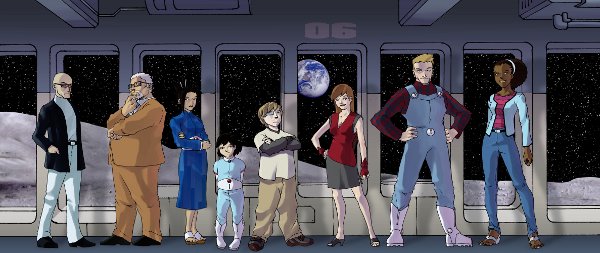 The cast of Lunatics!
Terry explained to me: “We’ve completed the pre-production work that was paid for by our first Kickstarter in December 2011…In some ways we actually got far ahead of where we planned to be — instead of just recording a temporary soundtrack with Rosalyn and I doing all of the voices, we have a nearly-final soundtrack with the characters voiced by professional actors who worked for free on this project on the speculation that we can make money on this project later on. We have also recorded most of the voice parts for the second episode, “Earth” which we are going to present as an audio production when we go into our next round of fund-raising.
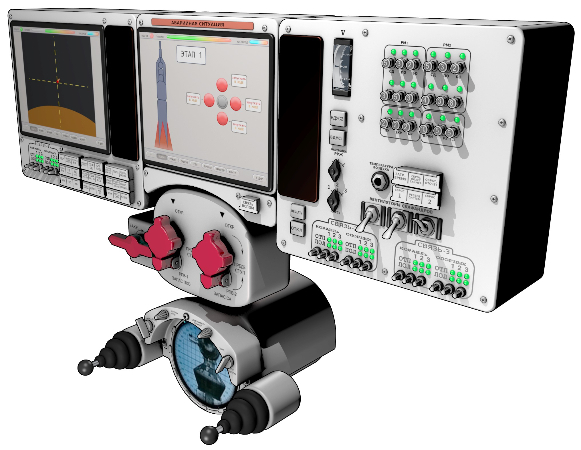 SoyuzSF ControlPanel
“We’ve been extremely fortunate in the actors. Paul Birchard, an American-born character actor living in Glasgow, Scotland (he’s one of those people who plays Americans on British TV, although he’s also done some small parts in Hollywood movies) took an early interest in the project, because (it turns out), he’s a free software fan and he reads my column in Free Software Magazine. So when I started talking about making a free-culture movie, he got in touch with me — LONG before I was ready to think about casting! But his interest encouraged me enough to take the casting seriously and look for “real” actors.
“Some of the roles were particularly demanding — two of the roles require bilingual actresses (unless we had different people do the voices, which would be a mess). Luckily we got them: Veronika Kurshinskaya is originally from Yaroslavl, Russia, having moved to Los Angeles to pursue acting in 2008, I believe. She’s been very enthusiastic about the project, and she does a really good job with the part of “Anya” who is a challenging character.
“”Hiromi” is supposed to be a Japanese-American who’s spent a lot of time in Japan with her maternal grandmother, so we needed someone who not only could speak Japanese well, but who would speak flawless California-accented English. Karrie Shirou is actually from Torrance, where the story bible says Hiromi is from. She’s not quite as fluent in Japanese as we hoped, but with scripted lines, she’s able to deliver the Japanese lines very nicely (you can hear an example in the pilot). There won’t be many of these, but we need them occasionally for story reasons.
“Tim is played by Lex Quarterman who is actually in his twenties — and luck would have it, is also fluent in Russian (which is great because his character is Anya and Josh’s son — he really should be bilingual too, though we had not dared hope for that!). He doesn’t quite sound like what we envisioned for Tim, but he has a really great sense of comic timing and he always cracks us up.
“William Roberts is an experienced voice actor in radio and animation, and he gives a great voice to the colony leader, Rob Lerner. Basically his work is just perfect — almost no directing required there. He’s also an American working in Britain (in fact, he and Paul know each other, though I didn’t know that when we cast him).
“Paul Birchard, who is also a great character actor, wound up playing both Josh Farmer (who is in fact a farmer) and R. Allen Emerson the colony’s resident “meta-conceptual” artist (who appears in the second episode Earth — for which we have recorded most of the voice lines, but which I have not yet had a chance to mix). In that episode, there’s actually a couple of scenes where Paul is arguing with himself, as a result. Allen is probably the hardest role of all, because there’s such a knife edge between whether he seriously believes what he’s saying or if he’s just putting you on — he’s kind of like Adam West’s Batman that way. I was a little antsy about having one actor play two major roles, but Paul has been so enthusiastic about the project and I figured he knew how much work it would be.
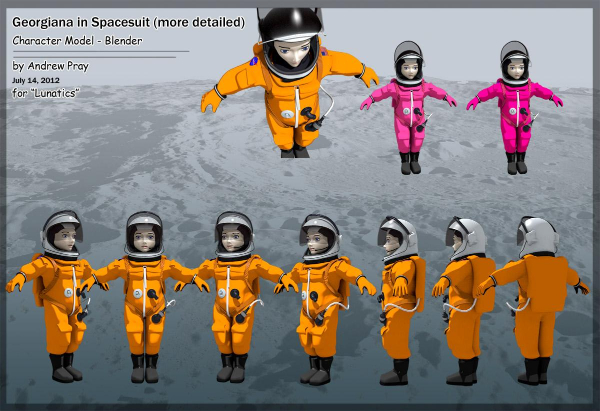 Georgiana in Spacesuit
“We had so many people contact us from our casting calls that I was also able to cast professional actors in several smaller parts. The level of enthusiasm from actors really surprised me. We had to turn down over 150 people for these parts! I did not expect that.
“We had hoped to cast the eighth colonist, Dr. Sarah Allison, but we didn’t really get the right voice, and after a lot of consideration, I decided that I really did want to cast an African American woman to voice an African American woman, considering the trouble I had gone to for “Hiromi” and “Anya”. I also realized this could get political very quickly (already I have had a lot of people putting more attention on this character than we intended — clearly she’s going to be very important to some people). Of course, I live with a Black female scientist, so they don’t seem so extraordinary to me, but it is true that you don’t see a lot of them in movies or on television — and certainly not presented realistically. So I was a little taken aback when people reacted so strongly.
“Sarah is also a considerable departure from the stereotypical “angry Black girl” character that you see in a lot of media. She did not grow up in a tough urban neighborhood; she grew up climbing on rocks in rural New Mexico. She’s a sappy romantic who sings ballads along with the radio when no one is listening. She’s also just scarily gung-ho about her subject matter, which is lunar geology. She’s awkwardly tall (“five foot thirteen”), and would actually have exceeded the height requirement for Apollo astronauts. She likes hiking and exploring, and is the single most experienced lunar-EVA expert in the universe. Moving into the colony affords her the opportunity to make the Moon her permanent residence, instead of just an assignment.
“Fortunately Sarah doesn’t actually have any voice lines until episode three (we did insert a couple of silent cameos in the first two episodes). One thing the actress will benefit from is that she will start out being paid — one of our ground rules is that we won’t make episodes three to five unless we have the money to pay the actors and animators for them.
“We cast our own daughter Ariel to play Georgiana — she’s playing about two-years younger than she is. I listened to two adult auditions for this part, but there’s just an authenticity to giving her a real child’s voice.
“We decided to spread out the character introductions to avoid overwhelming the audience with a whole lot of faces and names all at once. The pilot is structured kind of like a “road movie”, starting with just Georgiana and Hiromi; then we meet Sergei; then we meet Tim and Josh; and then Anya; and finally they meet Rob at the colony (although in fact, Rob also appears in the media segment near the beginning). Episode two introduces Allen as a focus character. Sarah is introduced at the end of episode three, which is focused on Tim. Episode four is all about Sarah, and then episode five is a complex ensemble piece which serves as the “little-finale” for “Block 1”.
“If we can’t raise money after that, then we’re done. If we can, then we’ll make “Block 2”, which has focus episodes for Hiromi and Rob and Anya, as well as the beginnings of the “Season 1 Story Arc” which I can’t reveal yet! But it’s going to be awesome. A third block will close out the season with a killer cliff-hanger, and then we’ll fund-raise for season two.”
Even with professional software like Blender this stuff is not magic, and it takes a lot of work and skill.
“There are some open, high-risk production questions that have to be answered before we can put solid plans into place. I still need to demonstrate the digital puppetry concept. Honestly, I should’ve done that ages ago, but it’s one of those packages with no appreciable documentation and no user-base. So I’ve seen what the author can do with it, but it’s quite a different thing to do it myself. Also, it has to interact with the game-controller hardware and so on, so it’s kind of a big deal to set up.
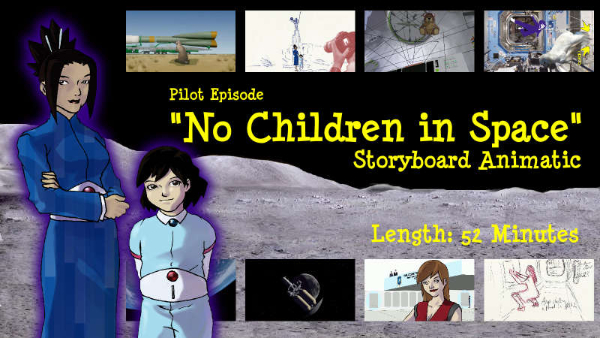 Cover Image for pilot episode
“It isn’t the only solution, though. If it falls through, we have some other options, like doing the character animation in 2D. I have some offers to do that kind of work on contract with Synfig which are pretty attractive and the budgets would be similar for the pilot.
“There are basically three reasons I don’t want to go with that 2D solution:
“1) The options for re-use are limited: we’d have to re-use cels a lot, which can tend to look kind of cheesy (this was done a lot in the old Filmation Star Trek animated series, for example). That’s a kind of problem I’m willing to accept if there’s no other way, but it’s a definite disadvantage.
“2) 2D animation is much more linear in cost: we’d have to keep paying more or less the same cost-per-minute for character animation, whereas 3D animation is highly front-loaded, with most of the cost going into the models and rigs. So with 3D, our costs would effectively drop as the series progressed, while with 2D we’d be stuck in low gear the whole time.
“3) 2D animation is more sensitive to the artistic skill of the animator. It’s quite different to be good at manipulating an existing model and having to redraw the same character accurately many times over. With the 3D digital puppetry approach, I expect to be able to contribute or fill in, with the 2D digital-cel animation approach, I’d be completely dependent.
“It would be very nice, but I have serious doubts about the sustainability of it (I’m also not convinced that the people making the offer could actually handle the workload it would represent. We might have to split it over more than one studio).
“I still need to finish the teaser trailer (which will demo the character animation and rendering styles as well as providing a nice lead-in animation for our fund-raiser).
“And I still need to build the blocking model of the colony set. That’s not really hard, but it is awfully tedious — it will take many hours of modeling for me to do that. I just need to have some good blocks of time available for that.
“I’m also planning to edit the audio for episode two, which should probably work okay as an audio-drama, since it’s very dialog-driven.
“Rosalyn is beginning a novelization (or serialization) of the storyline.”
That is one heck of a workload, and contributors are welcome. Here are some of the things they’re looking for: Blender artists, general IT help to keep the servers running and software updated, Plone talent, free-software teleconferencing and a good digital white-board facility.
Circling back to funding, because that is always a big question:
“My idea behind Lunatics was to create something big enough that it had to be commercial in order to continue. One of my goals is to prove that a free-culture based business model like this is viable commercially.
“One of the limits of the current group of free-culture film projects is that they are very much “single-auteur” works. Sure, Nina Paley hired a number of people to help her with audio on “Sita Sings the Blues”, but the animation is all her work. Or the works are sponsored by some kind of umbrella organization which foots the bills: the Blender Open Movies are funded by the Blender Foundation. “Tube” is associated with a college 3D education program, and so on.
“To do a proper, independent-film start up on a commercial basis, where the business plan is to make money using free-culture means that don’t rely on controlling copies? That’s new. That’s what we’re doing. I’m hoping that if we succeed, others will follow, and I’m looking forward to seeing the fruits of that alternative film culture.
“So, this is a marathon, not a sprint, and it’s all about sustainability.
“Considered as a cycle, each “season” will really be three “blocks” of six episodes (the first one just has five, including the pilot). The idea is that we will alternate between “release/fundraising” mode and “production” mode. We also have a winter break planned in.
“And it’s really dependent on the fans and the funding. If we just do one block and few people support it, then it’ll be a little short-term project. If we get funded for one season or for two, then that’s what we’ll do. We have story arcs planned up to a fourth season, after which we’d have to make up all new stuff, but we could probably go for a full seven-seasons if we get the fans to back us for it. To do that, though, would take a paying fan-base of thousands. That could happen — it’d still be small as television audiences go, but it could also be that we never get past the few dozen people backing us now.
“As we move into cyclic production, our fundraising for each new block will coincide with releasing the finished block of six episodes, one per week. The idea is that each episode will advertise the fund-raiser which will then (hopefully) pay for the next block. This will be added to some of the money we make from our creator-endorsed sales.
“Essentially, this is a combination of the business models of the Blender Open Movies (pre-sales which is a kind of crowd-funding) and Nina Paley’s Sita Sings the Blues (which is based on creator endorsed sales). You might note that while Blender Foundation had a hard time raising money for Elephants Dream, each succesive project has been easier — you can think of them collectively as being like a series. An on-going series is perfect for crowd-funding, because the previous body of work promotes the new work to be funded.
“The idea of “Creator Endorsed” probably needs some explanation. Essentially the insight behind it is this:
“For all the whining about “pirates” and “lost sales” and all the 12-year-olds sued into permanent poverty, the copyright industry is essentially powerless to enforce copyright rules on anything published on the Internet. Yet, most people pay for their media. Why?
“Is it because they fear enforcement? Ha! Everybody knows you can get away with pirating media, whether they approve of it or not. And a LOT of people do it. What’s more, pirates spend as much on media as (perhaps even more than) everyone else, as a number of studies have shown. So clearly, fear is not the motivator.
“Shocking as it may seem, the motivator is that fans want to pay artists for their work. What they resent paying for is the middlemen. Essentially they rebel against the inefficiencies of the publishing industry. So, if you give them a straight channel to the artist, they pay willingly. Generously even.
“So we don’t need copyright enforcement. We need a signal to tell fans, “Put your money here if you want the artists to get it”.
“And that’s what “Creator Endorsed” is. It’s a trademark to tell fans which copies are official copies that benefit the artists — only official merchandise is allowed to carry this mark.
“There’s another neat trick there: the way we distribute profits to the artists is a selling point of the product. So the only trust fault that exists (i.e. the only thing that has to be guaranteed by contract to avoid abuse) is that the way we tell fans we will distribute profits is in fact the way we do it. Fans, not contracts, are the ultimate arbiter of whether we have been “fair enough” in how we have distributed payments to artists.
“If we have sufficient profits for this to be an issue (i.e. our profits are more than pocket change), I hope to be able to afford an outside accountant to actually follow the spreadsheet we publish to fans, so everything is transparent.
“You’ll note that I put a fair emphasis on trust and process. Of course, I would try to be very fair regardless, but I feel that the precedents we set will probably be followed by others (if we succeed), and so it’s important to set up good practices from the beginning.
“Also, everything is different and often kind of backwards from the proprietary film industry, so we have to make a lot of this stuff up as we go along.”
For more information visit Lunatics!