
Linux 3.8: Hello 2013, Goodbye 386 Chips
After a few days’ delay, Linux creator Linus Torvalds on Monday released version 3.8 of the Linux kernel, the first new update to arrive in 2013.
“The release got delayed a couple of days because I was waiting for confirmation of a small patch, but hey, we could also say that it was all intentional, and that this is the special ‘Presidents’ Day Release’,” Torvalds wrote in the announcement email. “It sounds more planned that way, no?”
 Though it bears the nickname “Unicycling Gorilla,” Linux 3.8 brings a number of improvements that are far from frivolous. The removal of support for Intel 386 chips is surely among the most striking of those, but numerous others are notable as well and promise significant benefits for Linux users.
Ready for a rundown? Here’s a brief look at some of the highlights of Linux 3.8.
1. So Long, 386
While it seems unlikely that many will shed a tear over this change, Linux 3.8 does indeed remove support for the Intel 386 processor, as was widely reported late last year when the decision was made. What that means? Just that it can’t be run on very, very old PCs.
“This tree removes ancient-386-CPUs support and thus zaps quite a bit of complexity… which has plagued us with extra work whenever we wanted to change SMP primitives, for years,” wrote developer Ingo Molnar in the change submission in December. “Unfortunately there’s a nostalgic cost: your old original 386 DX33 system from early 1991 won’t be able to boot modern Linux kernels anymore. Sniff.”
Fans of older hardware can rest assured, however, that the 486 chip is still supported.
2. A New File System for SSDs
An interesting addition in Linux 3.8, meanwhile, is “F2FS,” an experimental new file system contributed by Samsung that’s optimized for flash memory storage devices. While Linux already has several file systems designed for flash devices — including LogFS, JFFS2 and UBIFS — they aren’t generally designed for non-native flash devices such as many commonly used solid-state drives (SSDs). F2FS, by contrast, targets SSDs specifically, and is optimized for the way they work. Samsung developer Jaegeuk Kim explained the differences in more detail in a list posting last fall.
3. Btrfs and Ext4 Refinements
Also from the file-system department are improvements in both the Btrfs and Ext4 file systems. In Btrfs, for instance, a new, explicit device replacement operation considerably speeds up the process of removing an old disk and adding a new one. Ext4, meanwhile, has gained the ability to store very small files in the unused inode space, making reading such files much faster while also saving disk space, according to the changelog on Kernel Newbies.
These are just a few of the many changes on the way to Linux users through this new kernel update. For a more complete look, check out Kernel Newbies or the multipart report on The H.
If You Don’t Know Linux, You Better Learn Fast
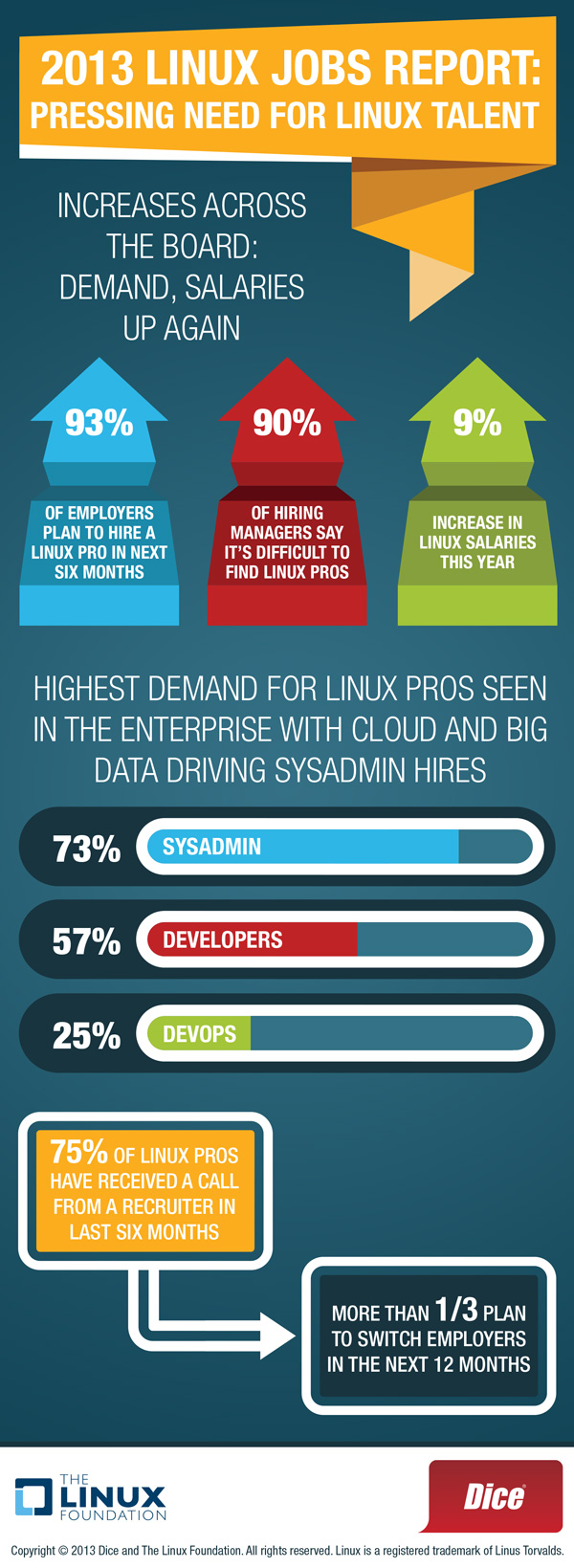 Jobs again this year were a major theme in the State of the Union address with the President saying that we must train our students for the jobs of tomorrow. Guess what? Those jobs of tomorrow are Linux jobs. Maybe the President didn’t realize he was talking about Linux, but we know that Linux is supporting the computing infrastructure that makes our 21st century lives possible. From the phones we use to the websites we frequent to the cars we drive, Linux is running it all. And nothing underscores this fact more than year-over-year demand for Linux talent to support its pervasiveness in every day life.
The 2013 Linux Jobs Report released today in partnership with Dice.com shows that demand for Linux talent is up for the second year in a row. Ninety-three percent of hiring managers say they will be hiring Linux pros this year. The report shows a significant spike in the areas of systems administration and DevOps. These jobs are filled by people who manage the massive data centers, cloud platforms and data analytics that run and inform each and every transaction companies and individuals conduct every day.
This year’s report for the first time surveyed both hiring managers and Linux professionals in an effort to provide a comprehensive picture of the state of the Linux jobs market. The results show that Linux pros are being aggressively pursued by recruiters; seventy-five percent of those surveyed said they have received a call in the last six months. And, more than 1/3 plan to make a move this year, representing an opportunity for employers. But according to the report, even more hiring managers than in 2012 are struggling to find experienced Linux talent (a full 90%).
As a community and an industry, we have a big job of our own: we must train students and professionals for the jobs of tomorrow: Linux jobs. Linux has experienced rapid growth in every area of computing over the last decade but we must be able to support that growth with talented professionals who know how to build and maintain Linux-based devices and systems.
The good news is anyone can get involved in Linux and they can do it right now. There are no barriers to entry here. As the expertshave pointed out, you can start contributing today. A bug fix here, a patch submission there. If you’re looking for some guidelines on how to get started, check out kernel developer Jon Corbet’s guide on participating in the Linux kernel community. Also, take advantage of the variety of The Linux Foundation’s Linux training courses, which are taught by leaders from the Linux and Linux kernel communities.
We encourage people to move on this opportunity fast. Linux needs your support, the army is is building.
Who would have expected that a free operating system would spur jobs growth? It is possible to share, collaborate and grow the economy, and Linux is a prime example.
The Key for Ubuntu for Tablets Will Be Apps

Slowly but surely, Ubuntu is heading in many new directions. Last year, Ubuntu TV ramped up, this year Ubuntu phones are upon us, and Canonical is also introducing features in Ubuntu designed for enterprises that may be tired of paying heavy licensing fees for proprietary software. This week, Canonical announced Ubuntu for Tablets (see the video here), which the company says will offer “unique multitasking productivity, effortless navigation and defence-ready security.”
The real key for Ubuntu tablets to succeed, though, will be rapid app development.
Canonical has announced that Ubuntu for Tablets will ship with some native apps and some web apps. And, of course, there are applications in the Ubuntu Software Center that will be readily available, but this week Canonical is making a developer preview available, and that’s certainly aimed at getting early development going. As Ars Technica notes, in a conference call with the press, Mark Shuttleworth provided further details: